Content last revised on September 10, 2026
VUO62-12NO7 | 1200V 62A Three-Phase Diode Rectifier Bridge Module
An In-Depth Engineering Review
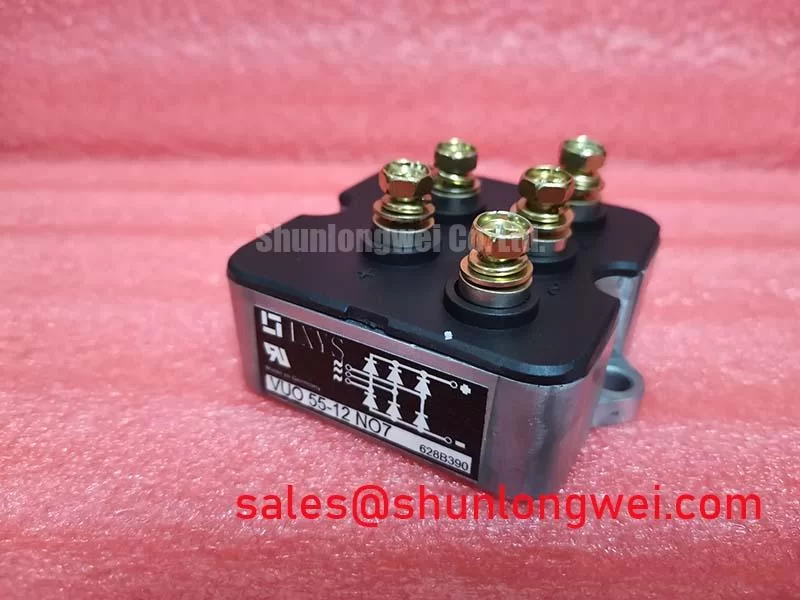
The VUO62-12NO7 is a three-phase rectifier bridge engineered for exceptional reliability and thermal efficiency in demanding industrial power systems. Featuring key specifications of 1200V V_RRM | 62A I_dAV | 1.29V V_F (max), this module delivers two critical engineering benefits: enhanced power cycling lifespan and a significantly reduced thermal load on system cooling components. This module is built for high reliability in industrial settings due to its planar passivated chips and a mechanical design optimized for temperature cycling, directly addressing common solder fatigue failure modes. For mains-connected AC-DC converters up to 480VAC requiring high uptime, the VUO62-12NO7 provides a robust and efficient front-end solution.
Application Scenarios & Value
Enhancing Drivetrain and Power Supply Uptime Through Superior Thermal Design
The VUO62-12NO7 is engineered for the input rectifier stage of high-reliability power conversion systems. Its primary applications include motor controllers, specifically Variable Frequency Drives (VFDs), Switched-Mode Power Supplies (SMPS), and power systems for industrial machinery where operational uptime is paramount.
A critical challenge in these applications is managing the thermal stress generated during continuous operation and the repetitive electromechanical strain from power-on/off cycles. The VUO62-12NO7 directly addresses this through its exceptionally low forward voltage drop. This characteristic reduces power dissipation as heat, easing the burden on the system's heatsink and improving overall energy efficiency. What is the primary benefit of its low forward voltage? Lower operational temperatures, which directly correlate to longer component life. The module's explicit design for "improved temperature and power cycling" ensures mechanical integrity over a long service life, setting it apart from standard rectifiers. For systems that demand higher current capacity, the related VUB72-16NO1 offers a similar voltage rating with an increased average forward current capability.
Key Parameter Overview
Decoding the Specifications for System-Level Reliability and Efficiency
The electrical and thermal parameters of the VUO62-12NO7 are tailored for robust performance in industrial environments. The following table highlights key specifications and their direct impact on application design.
| Parameter | Symbol | Value | Significance in Application |
|---|---|---|---|
| Repetitive Peak Reverse Voltage | V_RRM | 1200 V | Provides substantial safety margin for direct connection to 400V/480V three-phase AC lines, protecting against line transients. |
| Average Forward Current | I_dAV | 62 A (T_C = 85°C) | Defines the continuous DC output current capability, suitable for powering motor drives and power supplies in the 15-25 kW range. |
| Max Forward Voltage Drop | V_F | 1.29 V | A critical efficiency metric. This low value directly minimizes conduction losses, reducing heat generation and simplifying thermal management. |
| Surge Current (10 ms) | I_FSM | 570 A | Indicates high robustness against inrush currents typical during capacitor charging at system start-up, preventing component failure. |
| Isolation Test Voltage | V_ISOL | 3000 V~ | Ensures high dielectric strength between the terminals and the baseplate, meeting stringent safety requirements for industrial equipment. |
| Operating Junction Temperature | T_VJ | -40 to +150 °C | A wide operating range ensures reliable performance across diverse and uncontrolled industrial thermal environments. |
Download the VUO62-12NO7 datasheet for detailed specifications and performance curves.
Technical Deep Dive
Inside the V-Module Package: A Focus on Long-Term Operational Stability
The datasheet's reference to "improved temperature and power cycling" is a significant indicator of the module's internal design philosophy. In many power modules, a primary failure mechanism is solder fatigue, where the repeated expansion and contraction of different materials during heating and cooling eventually causes microscopic cracks in solder joints. This increases thermal resistance and can lead to catastrophic failure.
The construction of the VUO62-12NO7, from a reputable manufacturer like Infineon, is designed to mitigate these effects. This implies a focus on material compatibility (matching coefficients of thermal expansion) and robust internal interconnections that can withstand mechanical stress. To understand power cycling capability, consider an analogy: a standard module is like a road paved with cheap asphalt that cracks after a few seasons of hot summers and cold winters. A module with improved power cycling is akin to a road built with advanced polymer-modified asphalt that flexes with temperature changes, preventing cracks and ensuring integrity for a much longer service life. This inherent robustness is critical for applications like VFDs that may experience thousands of start/stop cycles over their lifetime.
Frequently Asked Questions (FAQ)
What is the direct benefit of the VUO62-12NO7's maximum forward voltage drop of 1.29V?
A lower forward voltage drop (V_F) directly translates to lower power loss (P = V_F * I_F) during operation. This means less energy is wasted as heat, leading to higher system efficiency and reduced requirements for cooling hardware, which can save space and cost in the final design.
How does the 3000V isolation voltage contribute to system safety in an industrial setting?
The 3000V RMS isolation rating provides a robust barrier between the high-voltage AC input and the module's baseplate, which is typically mounted to a grounded chassis or heatsink. This high level of isolation is crucial for preventing electrical shock hazards and ensuring the equipment can pass stringent industrial safety certifications like IEC 61800-5-1.
Is the VUO62-12NO7 suitable for rectifying a 480V AC three-phase line?
Yes. A 480V AC line has a peak voltage of approximately 679V (480 * sqrt(2)). The 1200V repetitive peak reverse voltage (V_RRM) rating of the VUO62-12NO7 provides a substantial safety margin well above this peak voltage, making it a highly suitable and reliable choice for such applications.
The datasheet mentions "improved temperature and power cycling." What engineering advantage does this provide?
This feature points to a design that is mechanically resilient to the stresses of thermal expansion and contraction. It translates to a longer operational lifetime, especially in applications with frequent on/off cycles or fluctuating loads, by minimizing the risk of internal connection fatigue and failure over time.
What mounting considerations are important for the V-Module package to ensure optimal thermal performance?
For optimal heat transfer, the module's baseplate must be mounted to a flat, clean heatsink surface. It is critical to apply a thin, uniform layer of thermal interface material (TIM) and to tighten the mounting screws to the torque specified in the datasheet. This ensures the lowest possible thermal resistance from the module to the heatsink, allowing it to operate at its specified current ratings.
An Engineer's Perspective
From a design standpoint, the VUO62-12NO7 is more than a simple rectifier; it's a foundational component for building reliable power systems. Its strength lies not just in its primary voltage and current ratings, but in the underlying features that enhance longevity. The combination of low thermal losses and robust mechanical design allows engineers to specify this module with confidence, knowing it is built to withstand the long-term operational stresses inherent in demanding industrial environments.