Content last revised on September 10, 2026
AT070TN07 V.D: Engineering a 7.0-inch TFT Display for Legacy System Integration and Reliability
Introduction: Core Specifications and Strategic Value
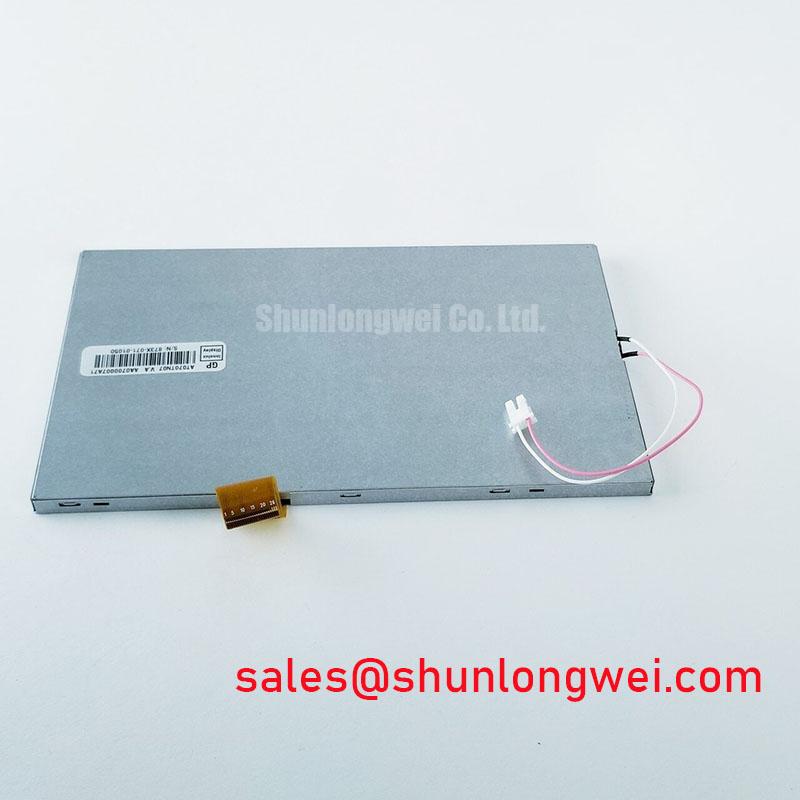
The AT070TN07 V.D is a 7.0-inch a-Si TFT-LCD module engineered for longevity and seamless integration into existing systems that rely on established display technologies. It provides a robust solution for applications requiring a direct-drive parallel interface and the specific performance characteristics of CCFL backlighting. Key specifications include: 480x234 Resolution | Parallel RGB (TTL) Interface | 250:1 Contrast Ratio. This design delivers two primary engineering benefits: simplified driver logic for compatible controllers and long-term MRO (Maintenance, Repair, and Operations) support. Answering a key question for engineers: What is the primary benefit of its TTL interface? It allows for direct, glueless connection to many legacy graphics controllers, eliminating the need for LVDS transceivers. For maintaining the operational life of existing industrial equipment without costly system redesigns, this display module provides an optimal and cost-effective pathway.
Application Scenarios & Value
System-Level Benefits in MRO and Long-Lifecycle Equipment
The AT070TN07 V.D is a strategic choice for engineers tasked with the maintenance and repair of long-serving industrial and commercial equipment. Consider a scenario where a proprietary control panel on a manufacturing line, designed over a decade ago, experiences a display failure. The original display utilized a parallel RGB interface and a CCFL backlight. Sourcing a modern MIPI or LVDS interface display would necessitate a complete overhaul of the driver board, firmware, and potentially the enclosure—leading to significant downtime and re-qualification costs. The AT070TN07 V.D serves as a near drop-in replacement in such cases. Its native parallel TTL interface connects directly to the existing controller, and its CCFL backlight is compatible with the original system's high-voltage inverter. This alignment makes it an indispensable component for extending the lifecycle of assets in fields like factory automation, medical monitoring devices, and specialized test equipment. While newer designs may utilize higher resolution panels like the AT080TN64, the AT070TN07 V.D's value lies in its perfect fit for the vast installed base of 480x234 resolution systems.
Key Parameter Overview
Decoding the Specs for Integration and Performance
The technical specifications of the AT070TN07 V.D are tailored for targeted applications where reliability and compatibility are paramount. The following table highlights the key metrics that directly influence system design and visual performance.
| Parameter | Specification | Engineering Implication |
|---|---|---|
| Resolution | 480(RGB) × 234 pixels | Optimized for systems with limited frame buffer memory and processing power; ideal for displaying clear status information, menus, and basic graphics. |
| Interface Type | Parallel RGB (1 ch, 6-bit), TTL | Enables direct connection to a wide range of microcontrollers and legacy graphics processors, simplifying hardware design by avoiding external interface ICs. |
| Display Mode | TN, Normally White, Transmissive | Provides fast response times suitable for video and dynamic content. |
| Active Area | 154.08 × 87.05 mm (W×H) | Standard 7.0-inch diagonal viewing area for compact HMI and portable devices. |
| Brightness | 250 cd/m² (Typ.) | Sufficient for typical indoor industrial and commercial environments. |
| Contrast Ratio | 250:1 (Typ.) (Transmissive) | Delivers clear differentiations between light and dark content for readability of text and graphical elements. |
| Backlight Technology | 1 pc CCFL (Cold Cathode Fluorescent Lamp) | Requires an external inverter for operation, a critical design consideration. Proven technology with a predictable performance lifecycle. |
| Operating Temperature | -10°C to +60°C | Ensures reliable operation in controlled industrial environments, such as factory floors and control rooms. |
| Viewing Angle | 60/60/40/60 (Typ.)(CR≥10) (L/R/U/D) | Best viewed from a direct-on position, typical for single-operator interfaces. |
Download the AT070TN07 V.1 datasheet for detailed specifications and performance curves.
Technical Deep Dive
Navigating the TTL Interface and CCFL Backlight Integration
A deeper analysis of the AT070TN07 V.D's core technologies reveals its specific design intent. The Parallel RGB (TTL) interface is a foundational aspect. Think of it as a multi-lane, one-way highway: separate, dedicated pins for red, green, and blue data, along with timing signals like Hsync, Vsync, and DE (Data Enable), travel directly from the graphics controller to the display's gate and source drivers. This "glueless" logic simplifies the electrical design for systems that have enough available I/O pins, as it sidesteps the serialization/deserialization (SerDes) silicon required for interfaces like LVDS. The engineering trade-off is a higher pin count and increased potential for EMI if PCB layout is not carefully managed, a key topic covered in resources like The Ultimate Guide to TFT-LCD.
The second critical integration point is the CCFL backlight. Unlike modern LED backlights that run on low-voltage DC, a CCFL requires a high-voltage, high-frequency AC supply, which must be generated by a dedicated inverter module. Engineers must account for the inverter's physical footprint, its power consumption, and the high-voltage wiring path in their mechanical and electrical designs. While this adds a component to the BOM, it also standardizes the replacement process for existing CCFL-based systems, ensuring consistent brightness and color temperature without re-engineering the entire lighting and power subsystem.
Frequently Asked Questions (FAQ)
What are the main considerations for my system's power supply when using the AT070TN07 V.D?
Your power supply unit (PSU) must provide two distinct outputs. First, a stable, low-voltage DC rail (typically 3.3V or 5.0V) is required for the display's logic board. Second, you must budget for a separate CCFL inverter module, which will take a DC input (often 12V) and convert it to the high AC voltage needed to strike and sustain the lamp. The inverter's power draw, especially during startup, must be factored into the total system power budget.
Why does the parallel TTL interface on this display have such a high pin count compared to modern displays?
The high pin count is a direct result of its parallel architecture. With a 6-bit RGB interface, there are 18 dedicated pins just for color data (6 for red, 6 for green, 6 for blue), plus additional pins for timing and control signals (Hsync, Vsync, clock, etc.). This contrasts with serial interfaces like LVDS or MIPI, which use differential pairs to transmit encoded data at very high speeds, drastically reducing the number of required pins but adding complexity with SerDes ICs.
Strategic Component Selection
Ensuring Lifecycle Continuity for Established Systems
The AT070TN07 V.D is more than just a display; it is a strategic component for lifecycle management. In an industry often focused on the newest technologies, this module provides essential support for the vast installed base of equipment that defines our industrial and commercial infrastructure. Its adherence to established interface and backlight standards provides a low-risk, cost-effective solution for extending the operational life of proven systems, safeguarding the initial investment and minimizing the total cost of ownership. For engineering teams focused on MRO and long-term product support, the AT070TN07 V.D offers a dependable path to continuity and reliability. For more on the importance of selecting the right display type, see our analysis of industrial versus consumer displays and the role of TFT-LCD technology in these applications.