Content last revised on September 10, 2026
MCC162-16io1 Thyristor Module: 1600V Power Control with Enhanced Thermal Reliability
Product Overview
Engineering High-Voltage Control with Built-in Reliability
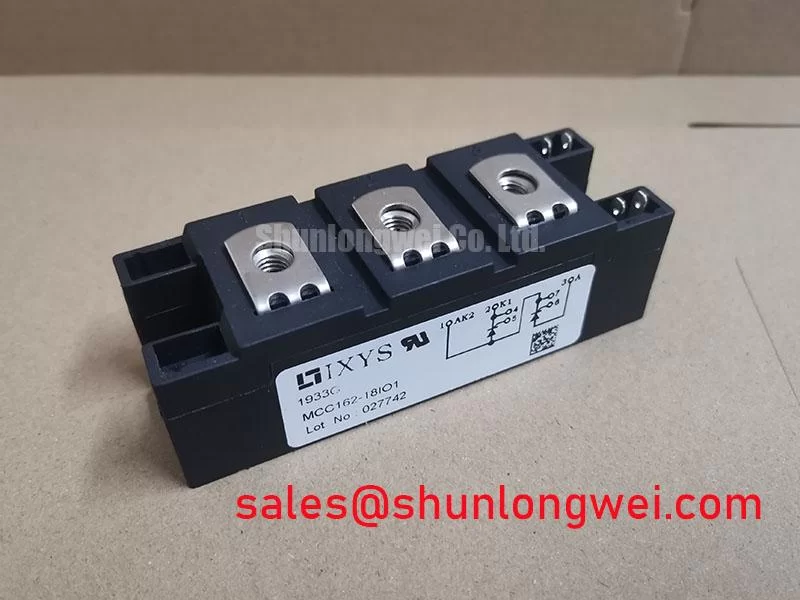
The MCC162-16io1 is a high-reliability thyristor module, engineered with two series-connected SCRs in a common cathode configuration for robust power control. Offering superior thermal performance and simplified system assembly, this module is a cornerstone for demanding industrial applications. Key specifications include: 1600V | 162A | 3000V~ Isolation. This design delivers two primary engineering benefits: simplified heatsink design and enhanced operational reliability. Its integrated isolated copper baseplate eliminates the need for external insulating materials, streamlining thermal assembly and improving heat dissipation. For controlled rectifier and soft starter designs operating on 480-690V AC lines, this 1600V module provides a robust and thermally efficient solution.
Application Scenarios & Value
Driving Reliability in Industrial Motor Control and Power Conversion
The MCC162-16io1 is engineered for high-stress industrial environments where precise power control and long-term dependability are critical. Its robust voltage and current ratings make it an ideal component for applications such as AC and DC motor controls, controlled phase rectification, and industrial power supplies. What is the key design feature of the MCC162-16io1? Its integrated isolated copper baseplate for simplified thermal management.
Consider the challenge of designing a soft starter for a high-inertia industrial motor. The start-up phase generates significant inrush current and thermal stress. The MCC162-16io1's 162A average current rating and high surge capability (I²t) effectively manage the electrical load. Concurrently, its excellent thermal transfer, facilitated by the isolated baseplate, ensures heat is efficiently drawn away from the semiconductor junctions. This prevents thermal runaway and significantly enhances the reliability of the entire drive system, a crucial factor in maintaining production uptime. For applications requiring higher current handling, the related MCC200-16IO1 provides a similar voltage rating with an increased current capacity.
Key Parameter Overview
Core Specifications for System Design and Integration
The technical specifications of the MCC162-16io1 are tailored for robust performance in high-voltage power conversion systems. The following table highlights the key parameters that are essential for circuit design, thermal modeling, and mechanical integration.
| Parameter Category | Parameter | Value |
|---|---|---|
| Electrical Specifications | Repetitive Peak Off-State and Reverse Voltage (VDRM, VRRM) | 1600 V |
| Average On-State Current (IT(AV)) @ TC=85°C | 162 A | |
| RMS On-State Current (IT(RMS)) | 255 A | |
| Gate Trigger Current (IGT) @ TVJ=25°C | ≤ 150 mA | |
| Thermal & Mechanical Specifications | Isolation Voltage (VISOL) (50/60 Hz, RMS, t=1 min) | 3000 V~ |
| Thermal Resistance, Junction to Case (RthJC) | 0.16 °C/W (per thyristor) | |
| Operating Junction Temperature Range (TVJ) | -40 to +125 °C |
The 1600V VRRM rating is a critical parameter for system robustness. Think of it as the height of a dam wall. For a river that averages 480 meters deep (analogous to a 480V AC line), a 1600-meter wall provides an immense safety margin against unexpected floods (voltage transients and line surges), ensuring the system is not compromised. Similarly, the 3000V~ Isolation Voltage acts as a built-in, high-integrity electrical shield between the live terminals and the module's base. This feature allows engineers to mount the module directly to a grounded chassis, simplifying the design and enhancing both safety and thermal performance. What voltage systems is the MCC162-16io1 designed for? It is ideal for high-voltage systems up to 690V AC.
Download the MCC162-16io1 datasheet for detailed specifications and performance curves.
Technical Deep Dive
A Closer Look at the Isolated Baseplate Design for Long-Term System Integrity
A key differentiator of the MCC162-16io1 module is its construction featuring an isolated copper baseplate. In traditional power module designs, engineers must specify, source, and install separate ceramic insulating pads and apply thermal grease across multiple layers to achieve electrical isolation from a common heatsink. This multi-step process introduces variables that can compromise both reliability and performance, such as inconsistent thermal compound thickness, potential for insulator cracking, and increased assembly time.
The MCC162-16io1 integrates the isolation layer directly into the module's structure, typically using a Direct Bonded Copper (DBC) substrate. This approach, validated at the point of manufacture, provides a guaranteed 3000V~ of isolation. The engineering benefit is twofold: it drastically simplifies the mechanical assembly process and it enhances thermal performance. By eliminating the external insulator, a layer of thermal resistance is removed from the heat path. To use an analogy, the thermal path is like a water pipe. Adding an external insulator is like inserting a narrow, constricted section into the pipe, impeding the flow. The integrated baseplate of the MCC162-16io1 is like a single, wide-diameter pipe, allowing heat to flow from the silicon chip to the heatsink with minimal obstruction. This results in lower junction temperatures, a wider safety margin, and ultimately, a more reliable system compliant with industrial standards like IEC 61800-5-1.
Frequently Asked Questions
Engineering Questions on the MCC162-16io1
What is the primary benefit of the 3000V~ isolation voltage provided by the module's baseplate?
The primary benefit is the simplification of the thermal and mechanical design. It allows the module to be mounted directly onto a grounded heatsink or chassis without requiring any additional insulating pads. This reduces assembly complexity, lowers the bill of materials, and improves overall thermal transfer by removing an interface layer from the thermal path.
Is the MCC162-16io1 suitable for phase-controlled rectification on a 480V three-phase AC line?
Absolutely. Its 1600V repetitive peak reverse voltage (VRRM) provides a substantial safety margin for the line-to-line peak voltages found in a 480V system (approximately 678V). This high blocking voltage capability makes it a highly reliable and conservative choice for building robust phase-controlled rectifier bridges and other power controllers on industrial AC lines.
System Design and Procurement
For technical inquiries, volume pricing, or to discuss how the MCC162-16io1 can be integrated into your next power system design, please contact our technical sales team for engineering support and component sourcing information.