

Content last revised on September 10, 2026
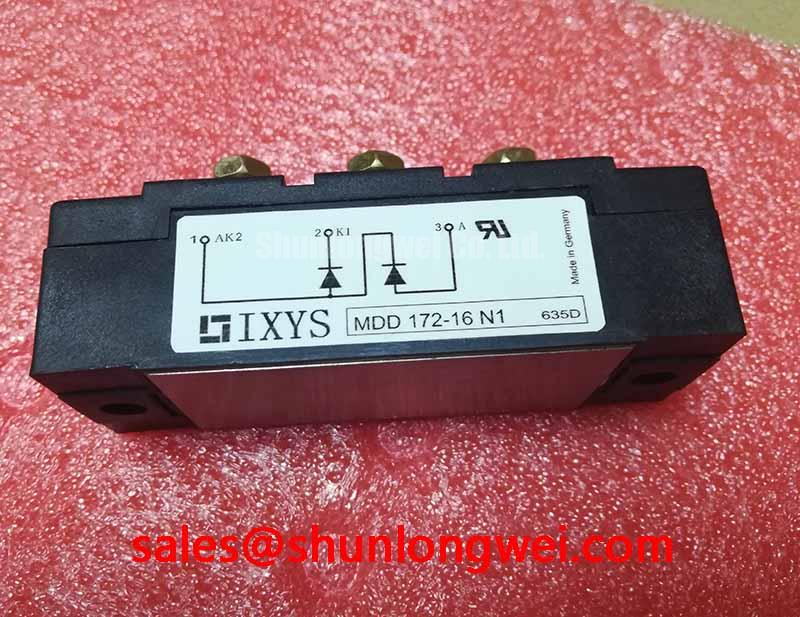
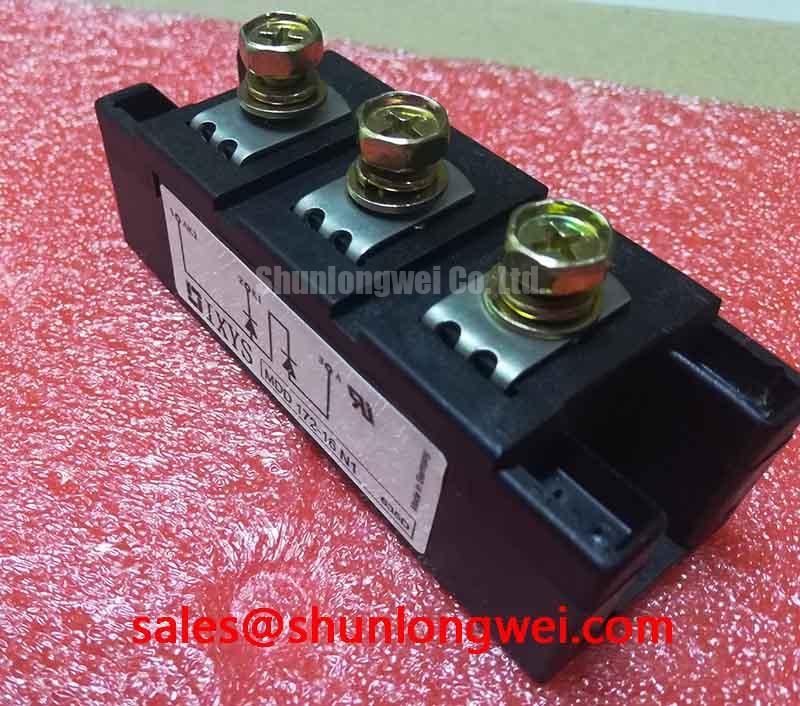
MDD172-16N1 IXYS Rectifier Diode Module 1600V 175A High Surge Ruggedness
The MDD172-16N1, manufactured by IXYS (now part of Littelfuse), is a high-performance dual diode module designed for industrial rectification and power conversion. Featuring a robust 1600V repetitive peak reverse voltage and a 175A average forward current rating, this module provides the necessary voltage headroom for 400V and 480V AC line applications. Its TO-240AA package utilizes Direct Copper Bonded (DCB) ceramic technology to minimize thermal resistance while ensuring 3600V~ isolation. For engineers managing industrial motor drives or high-power supplies, the MDD172-16N1 offers a reliable solution for handling high-surge currents without compromising on long-term thermal stability.
Does the MDD172-16N1 provide enough margin for 480V industrial grids? Yes, its 1600V rating offers a substantial safety factor against line transients and inductive voltage spikes common in heavy industrial environments. What is the primary benefit of its DCB substrate? It delivers excellent power cycling capability and optimized heat dissipation. For high-surge industrial rectification, the MDD172-16N1’s 6000A peak surge rating ensures unmatched circuit survival during fault conditions.
Key Parameter Overview
Decoding the Specs for Enhanced Thermal Reliability
The technical specifications of the MDD172-16N1 are architected for high-density power systems where thermal management is a critical design constraint. The 0.17 K/W thermal resistance is a benchmark for modules in this class, allowing for more compact heatsink designs without exceeding junction temperature limits.
| Category | Technical Specification | Value / Rating |
|---|---|---|
| Voltage & Current | Max Repetitive Peak Reverse Voltage (Vrrm) | 1600 V |
| Average Forward Current (Ifav) @ Tc=100°C | 175 A | |
| RMS Forward Current (Ifrms) | 300 A | |
| Surge & Dynamic | Non-Repetitive Surge Current (Ifsm) 10ms | 6000 A |
| Forward Voltage Drop (Vf) @ 150A, 125°C | 1.07 V | |
| Thermal & Isolation | Thermal Resistance Junction to Case (Rthjc) | 0.17 K/W |
| Isolation Voltage (Visol) | 3600 V~ | |
| Max Operating Junction Temperature (Tvj) | 150 °C |
Download the MDD172-16N1 datasheet for detailed specifications and performance curves.
Application Scenarios & Value
Achieving System-Level Benefits in High-Power Conversion
The MDD172-16N1 is optimized for industrial environments where ruggedness is as important as efficiency. In applications like Variable Frequency Drives (VFD) or input rectifiers for industrial power supplies, the 6000A non-repetitive surge current rating is a critical asset. Consider a heavy-duty industrial conveyor belt system: during motor startup or unexpected mechanical jams, the power stage may experience significant current surges. The MDD172-16N1 manages these spikes with a robustness akin to a structural levee designed for a 100-year flood—providing safety headroom that prevents catastrophic failures during line transients.
Beyond motor drives, this module is an excellent fit for Welding Power Supply units and Battery Charging stations. The low Vf of 1.07V reduces conduction losses, which is vital for thermal management in fan-cooled or liquid-cooled enclosures. For systems requiring slightly lower current handling, the MDD95-12N1B offers a 1200V alternative, whereas the MDD172-16N1 remains the preferred choice for 480V-600V grid stability. To further understand the nuances of power module selection, engineers can refer to this analysis of power modules.
Technical Deep Dive
The Engineering Logic of DCB Substrate and Ceramic Isolation
The internal architecture of the MDD172-16N1 relies on Direct Copper Bonded (DCB) technology. This involves bonding a layer of copper to a ceramic substrate (typically Alumina) at high temperatures. The DCB substrate acts as a high-speed thermal highway, moving heat away from the silicon junctions as efficiently as a radiator in a high-performance engine. This structure not only provides 3600V~ isolation between the electrical terminals and the baseplate but also ensures that the thermal expansion coefficients of the materials are closely matched. This matching is crucial for reducing mechanical stress during Power Cycling, significantly extending the module's operating lifespan in cyclic load applications.
Industry Insights & Strategic Advantage
Addressing the Shift Towards Modular Power Density
In the evolving landscape of Industry 4.0, there is a clear trend toward higher power density and modularity. Rectifier modules like the MDD172-16N1 support this transition by providing high current capacity within a standardized TO-240AA footprint. This allows OEMs to maintain common mechanical designs while scaling power capacity by simply upgrading module specifications. Furthermore, as global energy regulations tighten, the low conduction losses of the MDD172-16N1 assist in achieving higher system-level efficiency ratings. Understanding failure modes, such as those discussed in preventing overcurrent and overtemperature, remains essential for leveraging these modular advantages in reliable system designs.
FAQ
How does the Rth(j-c) of 0.17 K/W directly impact heatsink selection and overall system power density?
A lower Rth(j-c) means the MDD172-16N1 can dissipate heat into the heatsink more efficiently. This allows engineers to either use a smaller, lighter heatsink for the same power level (increasing density) or drive the module at higher currents within the same thermal envelope. It effectively increases the thermal "speed limit" of the system.
Is the 1600V rating necessary for 400V AC line applications?
While a 1200V module like the SKKD162/16 is often used, the 1600V rating of the MDD172-16N1 provides an additional 400V of safety margin. This is highly recommended for environments prone to unstable power grids or where inductive loads generate high-frequency voltage transients that could exceed the breakdown voltage of lower-rated diodes.
For more information on the current stock availability or to request technical documentation for your specific design, please reach out to our technical sales team. We provide high-quality components from leading manufacturers like IXYS to support your engineering and procurement requirements with data-driven transparency.