

Content last revised on September 18, 2026
Assembly Integrity & Layout Architecture: Implementing Critical Rate of Rise of Off-State Voltage for SKT552/16E
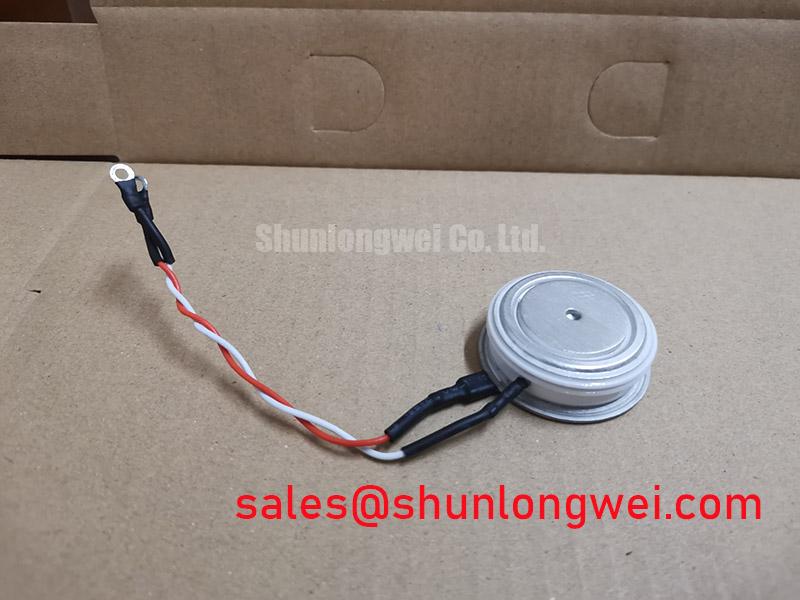
Before fitting the SKT552/16E into a replacement position, inspect the contact faces, terminal hardware, busbar flatness, insulation parts, and the condition of the existing RC suppression network. A thyristor can respond to a rapid off-state voltage transition if the surrounding circuit does not control the applicable rate of rise. The permissible device limit, snubber values, fuse coordination information, mounting method, and tightening requirements must be taken from the applicable original Semikron documentation for the installed assembly; they are not established by the 1600.0 V and 552.0 A ratings alone.
Design Consideration: keep the commutation loop compact and preserve the original snubber placement so stray inductance does not add avoidable transient voltage during turn-off. Where a series saturable reactor is present, verify its orientation, terminations, and condition before changing any firing or suppression components. The system engineer should validate peak voltage at the device terminals during switching tests against the DC-link condition and the published device limits.
Field Alert: Do not apply a generic mounting torque to this capsule device because the approved clamping arrangement and torque requirement must be verified from the original hardware documentation.
For a lower-current reference during a documented repair review, SKT340/18E can be examined as a separate Semikron thyristor reference, but its ratings, mechanical arrangement, and firing-circuit suitability require independent verification.
Field Diagnostics & Commissioning: Harmonic Current Injection and Line Filter in SKT552/16E Topologies
In a high-voltage three-phase motor solid-state soft starter, firing angle changes the conduction interval and therefore changes the line current waveform, displacement power factor, and reactive-power demand. During commissioning, capture phase voltage, line current, and gate timing together rather than interpreting current waveform distortion as proof of a defective thyristor. Uneven phase current can arise from firing synchronization, line imbalance, load condition, transformer connections, cabling, suppression parts, or the semiconductor path.
Check that each installed SKT552/16E occupies the intended phase position and that gate leads follow the original routing. A line filter should be evaluated as part of the complete starter topology, with measurements taken on the known-good signal and power paths. Engineering Recommendation: assess waveform quality at several commanded firing positions across the equipment operating range, then compare phase behavior under equivalent load conditions. The final filter configuration is system-determined and should be validated against the installed equipment requirements.
The Semikron-Danfoss Power Electronics & Modules official hub is an appropriate manufacturer resource when matching part-family information with the original service documentation. References to MiniSKiiP power modules should not be used to infer package, thermal, or terminal specifications for this discrete capsule thyristor.
SKT552/16E Operational Boundaries: Evaluating Fuse Total Clearing I2t versus Device Melt Limits
A semiconductor fuse review should begin with the exact fuse part number, its time-current data, total clearing I2t data, prospective fault current, and the thyristor withstand information specified for the original circuit. The fuse must interrupt a dead-short fault within the available device and assembly capability, but no device melt-limit value or coordinated fuse I2t value should be assumed for the SKT552/16E without the relevant official datasheet and protection documentation.
Engineering Recommendation: retain the original series-fuse location and inspect its contacts, holders, busbar joints, and any signs of thermal discoloration. A replacement fuse with a similar current label can have materially different clearing behavior. During fault investigation, record the gate command state, line condition, fuse state, and measured device terminal condition before assigning a cause. This produces a traceable basis for deciding whether the semiconductor, firing board, snubber path, or upstream protection requires further examination.
For broader repair and test planning, the practical system-level context in Future of Power Electronics can support a structured review of margins and measurement methods. It does not replace the device-specific protection data required for fuse coordination.
Preventing Spurious Faults: High-Frequency Switching Loss Dissipation Guidelines for SKT552/16E
The SKT552/16E is a thyristor, so IGBT parameters such as VCE(sat), soft turn-off behavior, and short-circuit operating area do not define this part. Likewise, diode reverse-recovery peak current and recovery time must not be assigned to this model unless they are specified for the actual commutating diode or associated assembly. In a line-commutated soft-starter topology, evaluate commutation behavior through measured voltage and current waveforms at the device and associated suppression components.
Design Consideration: reduce unintended high-frequency loop area to limit induced disturbance during commutation, then verify terminal-voltage and current behavior under controlled switching tests. Inspect gate wiring for secure routing and separation from high-current conductors, and confirm that the firing board produces consistent commands at each intended phase position. A noisy or inconsistent trace may indicate a system interaction that needs comparison with a known-good signal path; it does not establish a single component-level failure by itself.