Content last revised on September 10, 2026
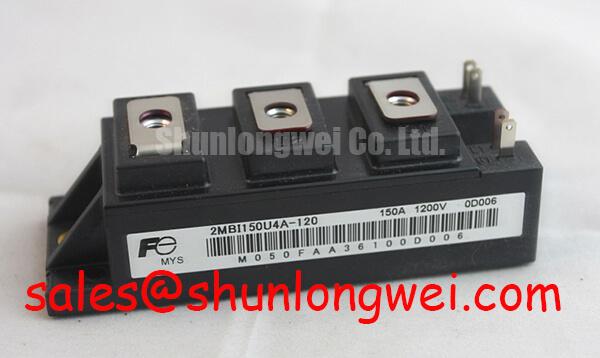
Technical Features and Application Insights of the 2MBI150UC-120 IGBT Module
High-Performance Power Switching Under Thermal Constraints
Minimizing Dynamic Losses in High-Frequency Industrial Converters
How do power electronics engineers maximize switching efficiency without incurring massive thermal penalties in high-current industrial drives? The Fuji Electric 2MBI150UC-120 provides the answer by striking a robust equilibrium between conduction and switching losses. The module provides a low-inductance switching platform that reduces power dissipation and simplifies industrial power converter design. Yes, the optimized planar-trench gate geometry minimizes transient switching losses, allowing higher carrier frequencies with smaller snubber components. What is the primary benefit of its low stray inductance? Suppressed voltage overshoot during fast turn-off transitions.
For industrial motor drives prioritizing efficiency and thermal margins, this 1200V module provides the optimal switching performance. Key specifications of the 2MBI150UC-120 include a 1200V collector-emitter voltage, a 150A continuous collector current, and a 785W maximum power dissipation rating. These ratings deliver a solid foundation for robust power conversion, offering key engineering benefits such as conduction loss reduction and fast switching transitions.
Frequently Asked Questions
Resolving Core Integration Challenges for Power System Designers
How does the low stray inductance of the 2MBI150UC-120 improve switching performance?
It reduces peak voltage overshoots during fast turn-off transitions. This minimizes stress on the package and allows engineers to scale back snubber circuitry.
What is the significance of the 1200V VCES rating in 400V AC grid applications?
A rating of 1200V provides a robust safety margin against transient overvoltages and DC-link fluctuations common in three-phase industrial grids.
How does the collector-emitter saturation voltage (VCE(sat)) impact thermal management?
With a low typical VCE(sat), the module minimizes static conduction losses. This allows for smaller heatsinks and reduces overall system thermal requirements.
Is the 2MBI150UC-120 suitable for paralleling in high-power applications?
Yes, the positive temperature coefficient of the saturation voltage at high temperatures ensures stable current sharing when modules are operated in parallel.
Key Parameter Overview
Key Specs Highlighted for Precision Application Design
System designers rely on precise electrical and thermal specifications to model inverter behavior. The saturation voltage behaves like a fixed constriction in a hydraulic pipe; a narrower restriction requires more pressure to push fluid through, converting wasted effort directly into heat. The parameter table below highlights the critical limits and typical operating characteristics of the 2MBI150UC-120.
| Parameter | Symbol | Value / Rating |
|---|---|---|
| Collector-Emitter Voltage | VCES | 1200V |
| Continuous Collector Current (Tc=100°C) | IC | 150A |
| Collector Power Dissipation (Per Element) | PC | 785W |
| Gate-Emitter Voltage | VGES | ±20V |
| Collector-Emitter Saturation Voltage (Typical) | VCE(sat) | 2.10V (at Tj=150°C) |
| Thermal Resistance (IGBT Junction-to-Case) | Rth(j-c) | 0.19°C/W |
| Isolation Voltage | Viso | 2500V AC (1 min) |
Technical & Design Deep Dive
Addressing Emitter Parasitics and Transient Overshoots
The 2MBI150UC-120 utilizes Fuji Electric U-Series technology, which employs a planar-trench gate layout. This layout enhances the carrier concentration in the drift region, lowering conduction losses. By integrating a Kelvin Emitter terminal, the module bypasses the parasitic inductance of the main power path. This layout configuration ensures the gate driver receives a clean control signal during fast di/dt transitions, preventing false turn-on events. How does Kelvin Emitter wiring improve gate control? By bypassing parasitic inductance in the main power path.
Think of stray inductance like a water hammer effect in plumbing. When a valve shuts off high-speed flow, a shockwave creates a pressure spike. Similarly, rapid current changes in a high-inductance path trigger voltage spikes that risk damaging the semiconductor. The module mitigates this with a low-inductance terminal structure. For a comprehensive look at optimization strategies, consult this detailed engineering guide on IGBT modules.
Additionally, when integrating these power stages, designers must balance transient switching speeds against electromagnetic interference (EMI). Gate resistors must be sized to control dV/dt without inducing excessive switching losses. Engineers can find practical guidelines on balancing voltage integration and power density in our strategic selection guide.
Application Scenarios & Value
Maximizing Reliability in Heavy-Duty Power Conversion
The module excels in systems exposed to demanding duty cycles. Consider a Variable Frequency Drive (VFD) controlling an industrial conveyor system. During start-up, the motor draws high starting surge currents, exposing the IGBT to severe thermal stress. The high transient current handling of the module allows it to withstand these surge currents without degrading the silicon junction. The low thermal resistance ensures rapid heat transfer to the heatsink, keeping junction temperatures within safe limits.
Beyond standard motor control, the module is regularly integrated into industrial welding power supplies, uninterruptible power supplies (UPS), and solar inverters. Its high isolation voltage of 2500V AC guarantees safety and electrical isolation from the control circuitry. This isolation simplifies safety certifications for systems deployed in harsh industrial environments.
For systems requiring different current capacities, the related 2MBI200UC-120 offers a Vces of 1200V at 200A. If working with legacy platforms, the older generation 2MBI150NC-120 is sometimes referenced. Alternatively, the 2MBI150US-120-50 provides a different package configuration with similar power ratings. As the industry transitions toward higher efficiency standards, selecting robust modular architectures remains a key strategic approach for long-term system reliability.