Content last revised on September 10, 2026
Fuji Electric 7MBR25NF120: Engineering High-Efficiency, Compact Motor Drives
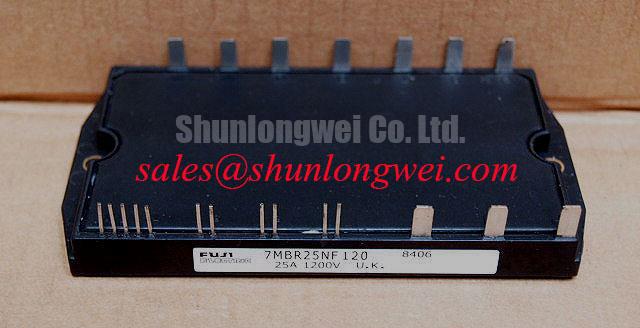
The 7MBR25NF120 by Fuji Electric is a highly integrated 7-in-1 Power Integrated Module (PIM) designed to streamline the development of low-power motor control systems. With specifications of 1200V | 25A | VCE(sat) 3.3V, this module consolidates a three-phase inverter, rectifier diodes, and a brake chopper into a single compact footprint. This level of integration delivers key benefits such as a significant reduction in system size and enhanced thermal performance. For engineers designing compact AC servo drives or small inverters, this module directly addresses the challenge of balancing performance with space constraints. The integrated nature of the 7MBR25NF120 simplifies both the bill of materials and the final assembly process.
Key Parameter Overview
Decoding the Specs for Integrated Power Stage Design
The electrical and thermal characteristics of the 7MBR25NF120 are foundational to its performance in demanding power conversion applications. The specifications detailed below are critical for accurate system modeling, thermal management design, and ensuring operational reliability. A key parameter is the collector-emitter saturation voltage VCE(sat) of 3.3V (typical), which directly influences the module's conduction losses and, consequently, its thermal efficiency. A lower VCE(sat) is akin to having less friction in a mechanical system—it means less energy is wasted as heat, allowing for more compact heatsink designs or higher power output in a thermally constrained environment.
| Parameter | Value | Conditions |
|---|---|---|
| Collector-Emitter Voltage (Vces) | 1200V | - |
| Continuous Collector Current (Ic) | 25A | Tc = 80°C |
| Pulsed Collector Current (Icpulse) | 50A | - |
| Collector-Emitter Saturation Voltage (VCE(sat)) | 3.3V (Typ) / 4.0V (Max) | Ic = 25A, Vge = 15V |
| Total Power Dissipation (Pc) | 200W | Per IGBT |
| Isolation Voltage (Visol) | 2500V | AC, 1 minute |
| Maximum Junction Temperature (Tj) | 150°C | - |
Download the 7MBR25NF120 datasheet for detailed specifications and performance curves.
Application Scenarios & Value
System-Level Benefits in AC Servo and Small Inverter Designs
The 7MBR25NF120 is optimally suited for applications where power density and design simplification are primary engineering goals. For designers of compact AC and DC Servo Drive systems, this module offers a compelling advantage. The 7-in-1 PIM architecture, which integrates the input rectifier, 3-phase inverter, and a brake chopper IGBT, dramatically reduces the required PCB real estate and simplifies the manufacturing process compared to a fully discrete solution. This high level of integration is a direct enabler for creating smaller, more cost-effective motor controllers without compromising on functionality, a key trend in modern industrial automation.
What is the primary benefit of its integrated brake circuit? It allows for the controlled dissipation of regenerative energy during motor deceleration. This is critical in applications like robotics or vertical-axis machinery where rapid stops can otherwise cause a dangerous rise in the DC bus voltage. The module's 1200V blocking voltage provides substantial design margin for systems operating on 400V to 480V AC lines, ensuring reliability against voltage transients. While the 25A current rating is ideal for low-power motors, for systems requiring higher power handling, the related 7MBR50SB120 offers a 50A capability within a similar integrated topology.
Frequently Asked Questions (FAQ)
Engineering Inquiries for the 7MBR25NF120
What are the main design advantages of the 7-in-1 PIM topology in the 7MBR25NF120?
The primary advantage is system simplification. By integrating the input rectifier, three-phase inverter, and brake chopper into one module, it reduces component count, minimizes PCB layout complexity, and lowers assembly costs. This consolidation also helps to reduce stray inductance within the power stage, which can improve switching performance.
How does the VCE(sat) of 3.3V impact the thermal design of a servo drive?
The 3.3V typical collector-emitter saturation voltage is a direct factor in calculating conduction losses (P_cond = VCE(sat) * Ic). A lower VCE(sat) results in less heat generated during operation, allowing for the use of a smaller, more cost-effective heatsink or enabling higher ambient operating temperatures while keeping the IGBT junction temperature within safe limits. For more information, see this guide on thermal management in IGBTs.
Is the 7MBR25NF120 suitable for high-frequency switching applications?
This module is specified for "high speed switching" and is well-suited for typical motor drive PWM frequencies, generally in the range of 2 kHz to 15 kHz. However, designers must analyze the trade-off between switching frequency and losses, which are detailed in the datasheet's Eon/Eoff curves, to ensure the thermal dissipation capacity is not exceeded.
What is the function of the integrated dynamic brake circuit?
The brake circuit, consisting of a dedicated IGBT and freewheeling diode, is used to manage regenerative energy from the motor during deceleration. It switches a large external resistor across the DC bus to dissipate this energy as heat, preventing the DC bus voltage from rising to damaging levels and allowing for controlled, rapid braking.
Strategic Outlook
As industrial automation continues to demand more compact and energy-efficient solutions, highly integrated power modules like the 7MBR25NF120 become increasingly pivotal. Its 7-in-1 topology represents a strategic design choice, shifting complexity from the PCB to the component level. This approach not only accelerates time-to-market for new inverter and servo drive designs but also enhances system reliability by reducing the number of interconnections and potential points of failure. For engineers focused on developing next-generation, space-constrained power electronics, the value proposition of such integrated modules is a critical component of a forward-looking design strategy.