Content last revised on September 10, 2026
KCS3224ASTT-X9: Engineering a Bridge for Legacy Industrial HMI Systems
A Strategic Component for System Longevity and MRO
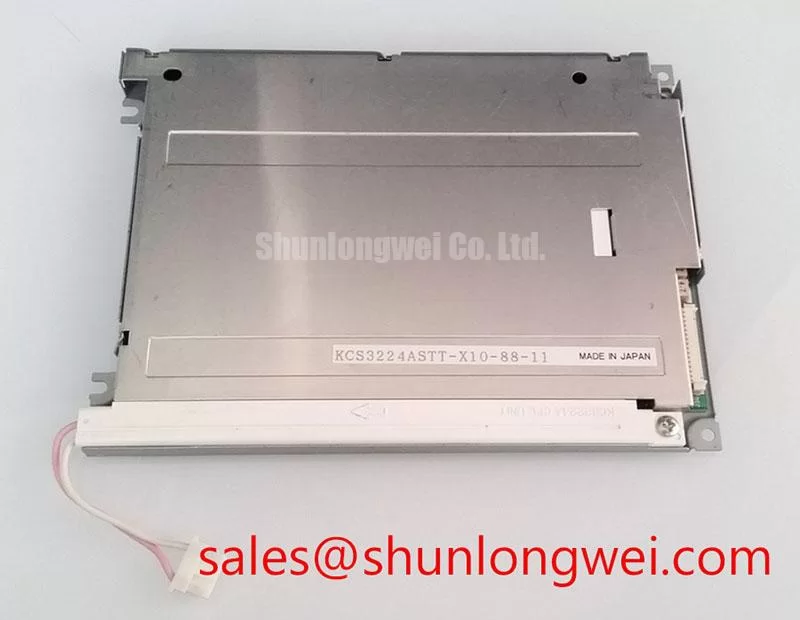
The Kyocera KCS3224ASTT-X9 is a 5.7-inch CSTN display engineered for reliability in legacy industrial applications. It delivers a direct, form-fit-function solution for maintaining and extending the life of existing equipment. With key specifications of 5.7-inch | 320x240 QVGA | CCFL Backlight | 8-bit Parallel Interface, its primary engineering benefits are unmatched legacy system compatibility and radically simplified integration. This display directly addresses the critical challenge of sourcing viable replacements for aging control panels and instrumentation. What is the key advantage of its parallel interface? Simplified integration with legacy microcontrollers. For maintaining industrial equipment with 5.7-inch QVGA displays, the KCS3224ASTT-X9 is a vital component for extending operational life.
Key Parameter Overview
Decoding the Specs for Legacy System Integration
The technical specifications of the KCS3224ASTT-X9 are tailored for compatibility with a generation of industrial hardware. Understanding these parameters is key to validating it as a replacement component in Maintenance, Repair, and Overhaul (MRO) programs.
| Parameter | Specification | Engineering Value & Interpretation |
|---|---|---|
| Display Technology | CSTN (Color Super-Twisted Nematic) | Provides a cost-effective color display solution sufficient for status indicators and basic GUIs, matching the performance of many original HMI panels. |
| Screen Size | 5.7 inch diagonal | A standard size for a vast range of industrial controllers, ensuring physical fit without mechanical modification to existing enclosures. |
| Resolution | 320 x 240 (QVGA) | Requires minimal processing power and frame buffer memory, ensuring compatibility with older, resource-constrained microcontrollers. |
| Interface Type | 8-bit Parallel Data | Allows for direct connection to MCU I/O ports, eliminating the need for complex interface ICs and simplifying driver development. |
| Backlight System | CCFL (Cold Cathode Fluorescent Lamp) | Ensures electrical compatibility with systems designed with a CCFL inverter, simplifying power system integration during replacement. |
| Brightness | 110 cd/m² (Typ.) | Offers sufficient visibility for typical indoor industrial environments, consistent with the original specifications of legacy equipment. |
| Contrast Ratio | 25:1 (Typ.) | Delivers clear readability for numerical data, text-based menus, and simple graphical elements common in industrial HMIs. |
| Operating Temperature | 0°C to 50°C | Suitable for use in control rooms and factory floor environments where extreme temperatures are not a primary operational factor. |
Application Scenarios & Value
System-Level Benefits in Equipment Repair and Life Extension
The KCS3224ASTT-X9 is not intended for new product designs but serves a critical role in extending the operational lifespan of deployed capital equipment. Its value is most evident in scenarios where a full system upgrade is cost-prohibitive or technically infeasible.
Consider the high-fidelity engineering challenge of a failed display on a CNC milling machine's control pendant from the late 1990s or early 2000s. The original display is obsolete, and the controller's firmware is locked. A complete retrofit with a modern TFT-LCD panel would require a new driver board, custom firmware, and significant validation. The KCS3224ASTT-X9, with its matching QVGA resolution and 8-bit parallel interface, can often be integrated directly with the existing controller signals. This transforms a complex re-engineering project into a straightforward component-level repair, minimizing downtime and preserving the proven reliability of the original machine controls. Its utility spans across various legacy systems, including industrial process controllers, medical monitoring devices, and specialized test and measurement equipment.
For systems that may require similar physical dimensions but different optical performance, the KCG057QV1DB-G000 offers another 5.7-inch QVGA option to evaluate for specific interface and performance needs.
Frequently Asked Questions
Engineering Inquiries for Legacy Integration
What is the primary difference between this CSTN panel and a modern TFT display?
CSTN is a passive-matrix technology, while TFT-LCD is active-matrix. This means the KCS3224ASTT-X9 has a lower contrast ratio and slower response time, which is perfectly acceptable for the simple GUIs of legacy systems. TFTs offer superior video performance but require more complex drive electronics that are often incompatible with older controllers.
Does the KCS3224ASTT-X9 require an external inverter for its backlight?
Yes. As it uses a Cold Cathode Fluorescent Lamp (CCFL) for backlighting, a separate high-voltage inverter is required to power it. This is a critical consideration to ensure the replacement plan accounts for, or re-uses, the existing CCFL inverter from the host system.
What are the power supply requirements for this display?
The panel typically requires a 5.0V logic supply. However, the complete system must also account for the separate, higher voltage required by the CCFL inverter, which varies depending on the specific inverter used.
Is the 8-bit parallel interface difficult to implement?
On the contrary, for the systems it's designed to repair, this interface is often simpler. It allows direct connection to a microcontroller's general-purpose I/O (GPIO) pins, avoiding the need for dedicated LVDS or other serial interface controllers. This simplifies both hardware and low-level software drivers.
Can I use the KCS3224ASTT-X9 for a new product design?
While technically possible, it is not recommended. Modern a-Si TFT displays with LED backlights offer vastly superior performance, longer lifespan, and better long-term availability for new designs. The KCS3224ASTT-X9's strategic value lies purely in supporting the existing install base of industrial equipment.
Technical Deep Dive
A Closer Look at the 8-bit Parallel Interface Advantage
The choice of an 8-bit parallel data interface on the KCS3224ASTT-X9 is a deliberate feature that underpins its value in legacy applications. Unlike modern high-speed serial interfaces like LVDS which require dedicated transmitters, receivers, and careful impedance-controlled PCB layout, a parallel interface is fundamentally more direct. It can be thought of as a local, multi-lane road instead of a high-speed highway. Each data bit has its own wire, alongside control signals like clock, horizontal sync, and vertical sync.
This architecture provides a key system-level benefit: it can be driven directly by the GPIO pins of many older microcontrollers. This eliminates an entire IC from the bill of materials—the display controller or bridge chip—reducing cost and simplifying the board layout. For an engineer tasked with repairing a system where the original display driver is part of a large, obsolete ASIC, the ability to bit-bang the parallel interface from a small, modern co-processor or FPGA is a powerful and practical recovery strategy. It reduces the re-engineering effort from a major system overhaul to a more manageable interface adaptation task.
An Engineer's Perspective on Component Selection
From a practical engineering standpoint, the KCS3224ASTT-X9 is a problem-solver for the installed base. Its selection is not driven by cutting-edge performance metrics but by its ability to seamlessly replace a failed component with minimal system disruption. The combination of its physical dimensions, QVGA resolution, and, most importantly, its direct parallel interface, provides a low-risk, high-value solution for extending the life of valuable industrial assets, directly supporting sustainable MRO strategies and protecting capital investment.