Power Semiconductor Selection Guide: Comparisons & Decision Frameworks
The power electronics landscape in 2025 is no longer dominated by a single silicon standard. It has fragmented into a complex ecosystem of competing substrates: Silicon (Si), Silicon Carbide (SiC), and Gallium Nitride (GaN). For the design engineer, the challenge is not just selecting a part number, but choosing the correct Figure of Merit (FOM) for the application.
A datasheet comparison of RDS(on) alone is misleading. The true cost of a power stage involves the total system volume, the thermal management budget, and the gate drive complexity. While WBG materials offer superior electron mobility, traditional silicon IGBTs and Superjunction MOSFETs often win on cost-per-watt and robustness against avalanche energy (EAS) events.
The WBG Divide: SiC vs. GaN
While both are Wide Bandgap materials, they serve distinct power domains.
Silicon Carbide (SiC) is the high-voltage champion (650V – 3.3kV), essential for 800V EV architectures and solar string inverters where thermal conductivity is paramount.
Gallium Nitride (GaN) excels in the sub-650V space, enabling ultra-high frequency switching (>1MHz) for compact adapters and server power supplies, but it demands more rigorous gate loop layout to prevent ringing.
Architecture Decisions: Discrete vs. IPM
Beyond the chip level, the packaging strategy defines the assembly process.
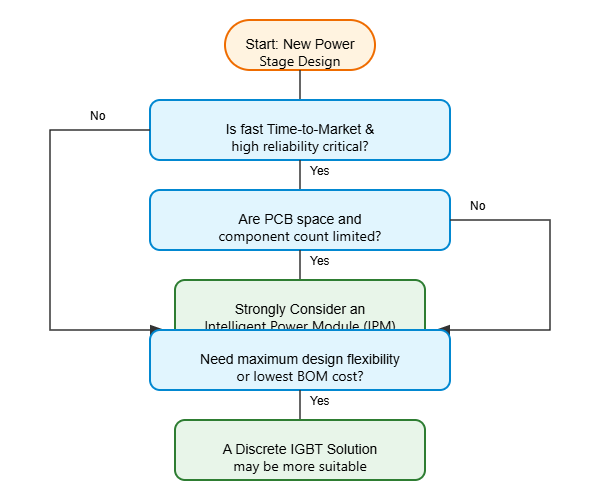
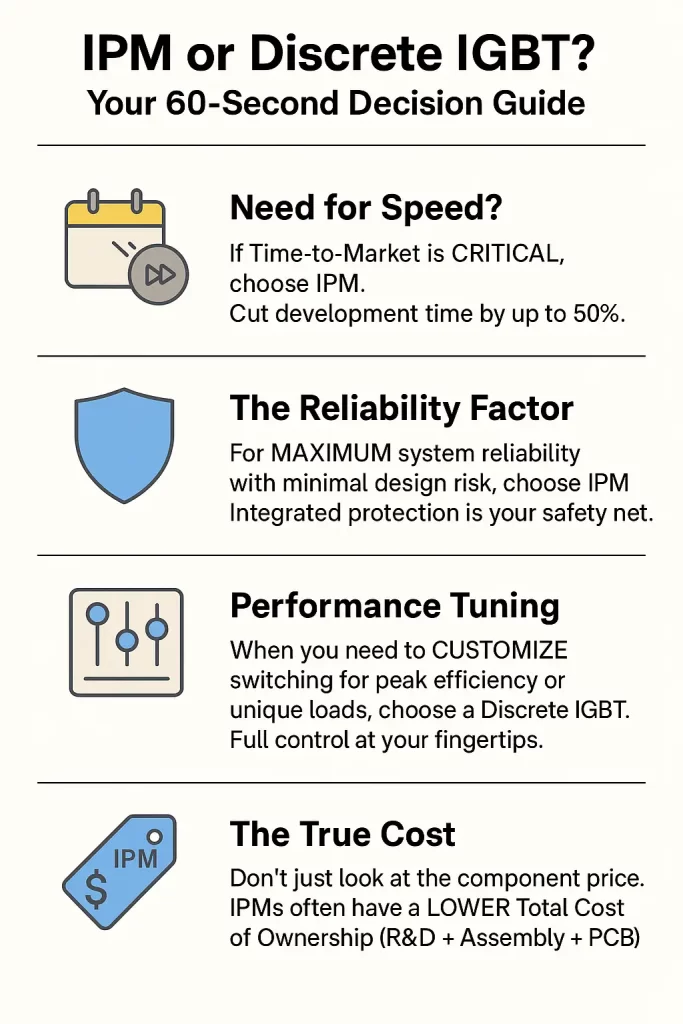
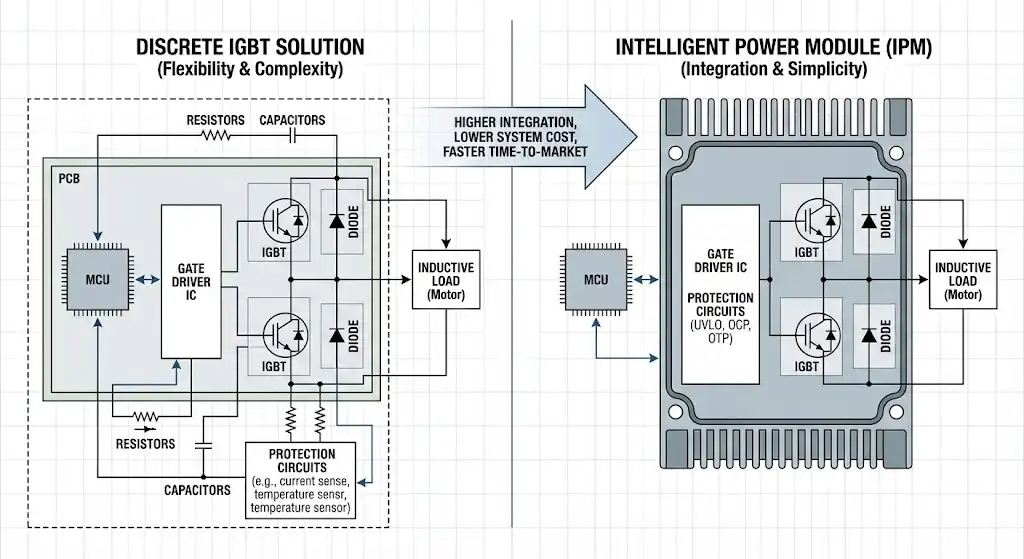
Discrete IGBTs/MOSFETs offer maximum flexibility for custom thermal stacks and gate drive tuning, ideal for high-volume, cost-sensitive designs.
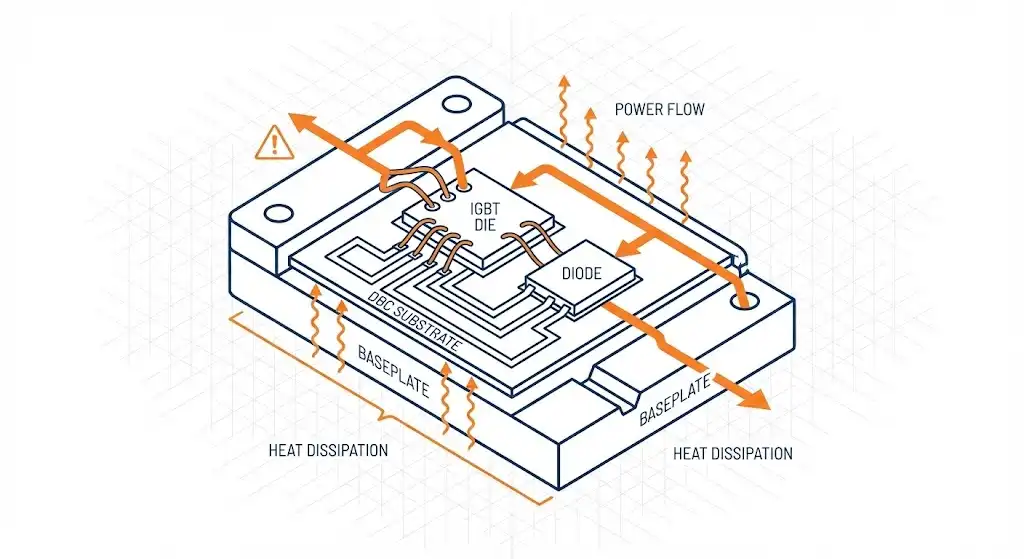
Intelligent Power Modules (IPMs), conversely, integrate the gate driver, bootstrap diodes, and short-circuit protection into a single molded package. As analyzed in our comparison guides, IPMs significantly reduce PCB real estate and stray inductance, making them the preferred choice for white goods and industrial fans up to 5kW.
The articles below provide a neutral, data-driven framework for navigating these choices, comparing key parameters like switching losses (Esw), thermal resistance, and system-level economics.
Content in This Series

SiC vs. IGBT: The Technology Showdown Powering the Future of Electric Vehicles
The Silicon Barrier: A Technical Showdown of Si MOSFET vs. SiC and GaN Wide Bandgap Technologies
IPM vs. Discrete IGBTs: A Guide to Simplified and Reliable Power Design
IPM vs. Discrete IGBT: A Decision Guide for Power Drive Design
IPM vs. Discrete IGBT: A Strategic Guide to Power Stage Design