Content last revised on April 16, 2026
Fuji Electric 2MBI100S-120: Engineering Reliability in High-Power Conversion
What makes the 2MBI100S-120 ideal for paralleling? Its NPT architecture provides a positive temperature coefficient for natural current balancing. Engineered with Fuji Electric's proven Non-Punch-Through (NPT) technology, this dual IGBT module guarantees temperature-stable switching and exceptional short-circuit ruggedness for heavy-duty motor controls. Featuring a robust 1200V and 100A rating within a classic 2-Pack topology, it drastically simplifies thermal design while ensuring fault survival in harsh environments. Thanks to its positive temperature coefficient, this module allows for straightforward paralleling in scalable inverter designs. For 400V-class industrial VFDs demanding high short-circuit tolerance, this 1200V module is the optimal choice.
Key Parameter Overview
Critical Specifications for Thermal and Electrical Assessment
| Parameter | Symbol | Value | Engineering Impact |
|---|---|---|---|
| Collector-Emitter Voltage | 1200V | 1200V | Provides ample voltage headroom for 400V to 480V AC line applications, ensuring safety against voltage spikes. |
| Continuous Collector Current | IC | 100A (@ Tc=80°C) | Supports high continuous power delivery for industrial automation and drive systems. |
| Collector-Emitter Saturation Voltage | VCE(sat) | 2.3V (Typ) | Maintains acceptable conduction losses while offering a positive temperature coefficient for paralleling. |
| Max Power Dissipation | PC | 780W | Defines the upper boundary for heatsink sizing and thermal interface material selection. |
Download the 2MBI100S-120 datasheet for detailed specifications and performance curves.
Application Scenarios & Value
Mastering Surge Currents in Industrial AC Motor Drives
In the realm of heavy-duty industrial automation, the Variable Frequency Drive (VFD) is the cornerstone of motion control. Engineers frequently face the challenge of managing unpredictable mechanical loads, such as a conveyor belt jamming or a pump experiencing a sudden rotor lock. These events generate massive surge currents through the PWM inverter stage. The 2MBI100S-120 directly addresses this hazard through its phenomenal Short-Circuit Safe Operating Area (SCSOA). Capable of withstanding a square SC SOA at 10 x IC, this module grants the system's gate drive circuit critical milliseconds to detect the anomaly and safely execute a shutdown sequence before semiconductor destruction occurs.
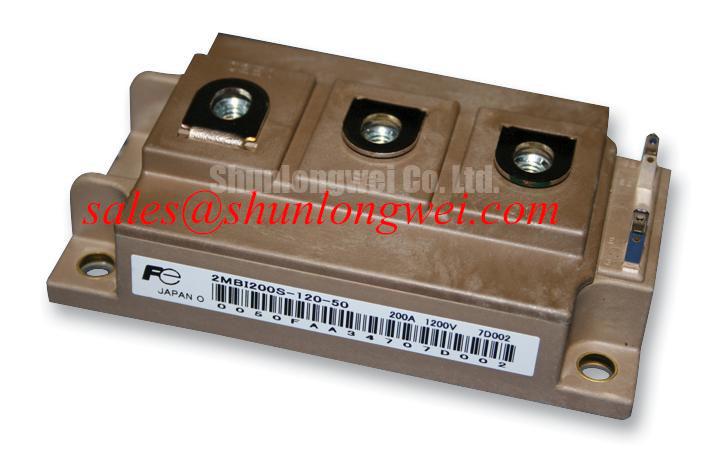
Furthermore, the 1200V blocking capability ensures that the active switching components remain secure from the inductive kickback common in highly inductive motor loads. While this 100A module is ideal for mid-range drives, applications requiring higher torque output can scale up seamlessly using the related 2MBI200N-120, which offers a 200A rating while maintaining similar architectural benefits.
Technical Deep Dive
Decoding NPT Technology for Superior Short-Circuit Resiliency
The core advantage of the 2MBI100S-120 lies in its Non-Punch-Through (NPT) silicon structure. Unlike Punch-Through (PT) variants, NPT IGBTs feature a wider, more lightly doped base region. This architectural choice yields a fundamental benefit: a remarkably small temperature dependence regarding turn-off switching losses (Eoff). As the junction temperature rises during heavy load cycles, the switching losses do not aggressively compound. To understand this, consider an automotive analogy: NPT's temperature stability is like a high-performance carbon-ceramic braking system that performs identically whether the rotors are freezing cold or red hot. System designers do not need to over-engineer the cooling apparatus to compensate for thermal runaway, fundamentally simplifying unlocking IGBT thermal performance in compact enclosures.
Equally critical is the module's robust Short-Circuit Withstand Time. The $10 times I_C$ rating acts much like an industrial-grade physical shock absorber. Just as a shock absorber dissipates sudden, violent kinetic energy without breaking the vehicle's chassis, the NPT silicon structure absorbs massive electrical stress transients, giving external protection circuitry ample time to react. This dual-faceted resiliency makes it a textbook example in any in-depth analysis of IGBT modules focused on harsh-environment reliability.
Frequently Asked Questions
Field Insights on the 2MBI100S-120
- How does the NPT structure of the 2MBI100S-120 affect its paralleling capability?
The NPT silicon architecture exhibits a strong positive temperature coefficient for VCE(sat). If one module in a parallel array draws more current and heats up, its on-state resistance increases, naturally forcing current to redistribute to cooler modules, thus ensuring stable current sharing. - What makes the square SC SOA at 10x IC critical for robust UPS design?
Uninterruptible Power Supplies (UPS) often face abrupt output short-circuits during downstream load failures. The ability to endure ten times the nominal 100A current provides the UPS controller with a wide temporal safety margin to clear the fault without sacrificing the inverter bridge. - Why is the small temperature dependence of turn-off switching loss practically beneficial?
It allows for highly predictable thermal modeling. Because Eoff does not drastically spike at elevated junction temperatures (up to 150°C), engineers can size heatsinks based on standard operating conditions rather than worst-case thermal runaway scenarios.
Future-proofing industrial power architectures requires components that do more than just switch efficiently; they must withstand inevitable grid and load anomalies. By integrating silicon that maintains consistent loss profiles across extreme thermal gradients, designers can secure long-term operational continuity and optimize the total cost of ownership in mission-critical infrastructure.