Content last revised on September 10, 2026
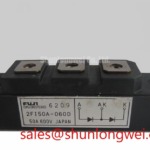
2FI50A-060D Fuji Electric 600V 50A Dual Fast Recovery Diode Module
The 2FI50A-060D, engineered by Fuji Electric, is a high-performance Dual Fast Recovery Diode (FRD) module designed to meet the rigorous switching requirements of modern power electronics. Featuring a 600V repetitive peak reverse voltage and a 50A average forward current per element, this module acts as a critical building block for high-frequency rectification and freewheeling paths. Its primary value lies in its optimized reverse recovery characteristics, which significantly reduce switching losses and electromagnetic interference (EMI) in high-speed power conversion stages. For high-frequency welding power supplies requiring minimal reverse recovery stress, this 600V 50A module provides the necessary efficiency margin.
What is the primary benefit of the 2FI50A-060D's fast recovery time? It minimizes energy dissipation during diode turn-off, directly enhancing overall system efficiency. How does the dual-diode configuration assist in design? It simplifies the mechanical layout of bridge rectifiers and half-bridge freewheeling circuits, reducing parasitic inductance in the power loop.
Key Parameter Overview
Functional Grouping of Electrical and Thermal Specifications
The following technical data is derived from official Fuji Electric engineering specifications to support precise system integration and thermal modeling.
| Parameter Category | Specification Feature | Technical Value |
|---|---|---|
| Voltage Ratings | Repetitive Peak Reverse Voltage (Vrrm) | 600V |
| Current Capacity | Average Forward Current (If) | 50A (Per Element) |
| Switching Speed | Reverse Recovery Time (trr) | 0.35µs / 0.45µs (Typical/Max) |
| Conduction | Forward Voltage Drop (Vf) | 1.5V (Max at 50A) |
| Surge Handling | Non-Repetitive Surge Current (Ifsm) | 500A (60Hz, 1 cycle) |
| Isolation | Isolation Voltage (Viso) | 2000V AC (1 minute) |
Download the 2FI50A-060D datasheet for detailed specifications and performance curves.
Application Scenarios & Value
System-Level Benefits in High-Frequency Power Conversion
In the realm of industrial automation and energy conversion, the 2FI50A-060D is frequently utilized as a freewheeling diode in conjunction with IGBT modules or as a high-speed output rectifier. Engineers often deploy this module in Variable Frequency Drives (VFD) and Uninterruptible Power Supplies (UPS) where efficiency and thermal stability are paramount. The low forward voltage drop of 1.5V ensures that conduction losses are kept to a minimum during high duty-cycle operations, extending the lifespan of the power stage.
For systems handling higher current densities or requiring complementary switching components, the 2MBI200VA-060 offers a integrated 600V IGBT solution, while for 400V-line systems requiring specialized protection, the 7D50D-050EHR provides a related specification profile. In Switching Power Supply (SMPS) designs, the 2FI50A-060D addresses the critical challenge of diode recovery spikes. By utilizing a "soft recovery" characteristic, the module dampens oscillations that can lead to voltage overshoots and EMI compliance failures, ensuring IEC 61800-3 standards are more easily met.
Technical Deep Dive
Analyzing Reverse Recovery and Conduction Loss Dynamics
The core technology of the 2FI50A-060D focuses on the trade-off between Forward Voltage (Vf) and Reverse Recovery Time (trr). To explain the trr parameter, consider a check-valve in a high-pressure fluid system. If the valve takes too long to shut when the flow reverses, a "water hammer" effect occurs, wasting energy and potentially damaging the pipes. Similarly, the 2FI50A-060D's fast recovery of 0.35µs ensures the "electronic valve" shuts almost instantaneously, preventing reverse current flow from the DC bus back through the diode.
From a Thermal Management perspective, the module's internal structure is designed to minimize the junction-to-case thermal resistance. This is vital because Forward Voltage and Switching Loss both generate heat. By maintaining a low thermal impedance, the 2FI50A-060D allows for more compact heatsink designs without risking thermal runaway. Proper mounting torque and the application of high-quality thermal interface material (TIM) are essential to maintain the integrity of this thermal path, as even microscopic air gaps can significantly increase junction temperatures and compromise long-term Power Cycling Capability.
Frequently Asked Questions
Engineering Insights for Design and Reliability
How does the reverse recovery time (trr) of the 2FI50A-060D impact high-frequency inverter design?
The trr of 0.45µs (maximum) directly determines the upper switching frequency limit of the inverter. Slower recovery times lead to higher turn-on losses in the complementary IGBT due to recovery current spikes. The 2FI50A-060D is optimized to keep these spikes minimal, thereby reducing the thermal load on the entire power bridge.
What are the implications of the 2000V AC isolation rating for industrial safety?
The 2000V AC isolation rating ensures that the internal semiconductor elements are electrically isolated from the copper baseplate. This allows multiple 2FI50A-060D modules to be mounted on a single common heatsink, which is often at ground potential, without risking high-voltage breakdown or leakage currents that could interfere with control electronics.
How should conduction losses be calculated for the 50A rating in a PWM application?
Conduction losses are calculated by multiplying the average forward current by the Forward Voltage (Vf). Since Vf is 1.5V at 50A, the peak conduction power per diode is approximately 75W. Engineers must account for the duty cycle of the PWM signal to determine the actual average power dissipation and select a heatsink capable of maintaining the junction temperature below the 150°C limit.
For more technical insights into power semiconductor integration, explore our guide on Power Semiconductor Selection or review our practical field guide on Testing Modules with a Multimeter to ensure system reliability. Our technical library also offers a deep dive into Ensuring Reliability and Diagnosing Failure Modes in high-power environments.
Our sales team provides expert procurement support for Fuji Electric components, assisting with volume technical specifications for global distribution.