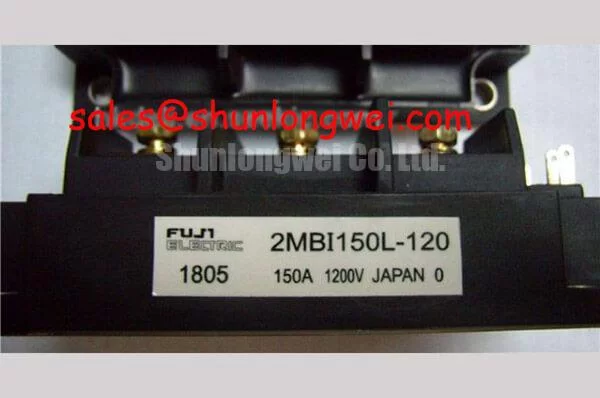
2MBI150L-120 Fuji Electric 1200V 150A IGBT Module

2MBI150L-120 IGBT Module In-stock / Fuji Electric: 1200V 150A. Low VCE(sat) design. 90-day warranty, motor drives. Global fast shipping. Get quote.

· Categories: IGBT
· Manufacturer: Fuji Electric
· Price: US$ 37 In-Stock Offer
· Date Code: Please Verify on Quote
. Available Qty: 378
90-Day Warranty
Global Shipping
100% Tested
Whatsapp: 0086 189 2465 1869

Content last revised on April 14, 2026

Fuji Electric 2MBI150L-120: Mastering Efficiency in Compact Power Topologies

The Fuji Electric 2MBI150L-120 represents a highly integrated approach to industrial power conversion. By balancing high-voltage switching efficiency with a space-saving physical footprint, this L-series dual IGBT module directly addresses the space and thermal constraints of modern equipment. It boasts core ratings of 1200V and 150A, alongside a notably low saturation voltage. What makes the 2MBI150L-120 highly suitable for compact drives? Its P.C. board mountable design significantly reduces parasitic inductance. This configuration yields immediate engineering benefits: reduced conduction losses and highly simplified printed circuit board layouts. For 1200V industrial motor drives prioritizing layout compactness, the 2MBI150L-120 module is the optimal choice.

Key Parameter Overview

Highlighted Indicators for High-Power Switching

Understanding the exact specifications governs how successfully this module integrates into your thermal and electrical design. The following table highlights the critical ratings tailored for efficiency-driven applications.

Manufacturer Fuji Electric
Collector-Emitter Voltage (Vces) 1200V
Continuous Collector Current (Ic) 150A
Package Configuration Dual / Half-Bridge, P.C. Board Mount
Drive Mechanism Voltage Drive
Key Optimization Low Saturation Voltage (VCE(sat))

Download the 2MBI150L-120 datasheet for detailed specifications and performance curves.

Application Scenarios & Value

Achieving System-Level Efficiency in Industrial Motor Drives

Engineers designing heavy-duty AC and DC servo drives frequently struggle to control thermal profiles during rapid acceleration phases. The 2MBI150L-120 directly mitigates this challenge through its low saturation voltage characteristics. During motor startup, the high inrush current typically generates intense localized heating. By keeping the voltage drop across the semiconductor low, this module restricts unnecessary heat dissipation, maintaining safe junction temperatures even under heavy load.

In the context of an UPS (Uninterruptible Power Supply) or welding machine, the compact P.C. board mounting ensures a streamlined mechanical assembly. Complying with rigorous standards like IEC 61800-3 requires stringent control over electromagnetic emissions. The direct board-mount nature minimizes stray inductance in the commutation loop, naturally suppressing voltage spikes and high-frequency ringing.

When evaluating dual modules for robust motor control, engineers might also consider the SKM150GB123D or the CM150DY-24A, which offer similar 150A 1200V ratings but cater to different packaging footprints and connection methodologies.

Technical Deep Dive

Engineering the Balance Between Switching Efficiency and Integration

The internal architecture of the 2MBI150L-120 prioritizes a low VCE(sat) parameter. To understand this, think of the saturation voltage as a toll booth on a busy highway. A lower toll allows more traffic to pass smoothly without causing congestion. Similarly, a lower VCE(sat) allows high current to pass through the IGBT with minimal energy wasted as heat. This fundamental physical trait dictates the thermal headroom of the entire inverter stage, offering a more resilient thermal management profile.

Furthermore, the physical packaging plays a decisive role in its dynamic behavior. Utilizing a P.C. board mount strategy is analogous to plugging components directly into a motherboard rather than using bulky extension cables. This direct connection drastically reduces the distance current must travel, thereby slashing parasitic inductance. Lower inductance directly translates to smaller voltage overshoots during turn-off events. Consequently, designers can deploy a much simpler gate drive circuit and scale down the size of snubber capacitors, achieving higher system density.

What is the primary benefit of its P.C. board mount design? It simplifies system layout while reducing parasitic inductance. How does low saturation voltage improve system reliability? It lowers thermal stress by minimizing energy wasted as heat.

Frequently Asked Questions

Addressing Core Engineering Challenges

  • Why is the P.C. board mount design of the 2MBI150L-120 crucial for high-frequency switching?
    By mounting directly to the printed circuit board, the module drastically cuts down parasitic inductance. This minimizes voltage transients and allows for cleaner, more reliable switching transitions across the entire operational spectrum.
  • How does the voltage drive mechanism simplify the overall circuit layout?
    Unlike current-driven devices, the IGBT operates via a voltage-controlled gate. This requires significantly less continuous driving power, allowing for a more compact and less complex driving stage, which further conserves PCB real estate.
  • What role does the 1200V rating play in industrial power grids?
    A 1200V blocking capability provides sufficient safety margins for systems operating on 400V to 480V AC industrial lines, protecting the inverter from typical grid fluctuations and transient voltage spikes.
  • How does the low saturation voltage impact heatsink selection?
    Because lower VCE(sat) restricts conduction losses, the device generates substantially less heat. This allows engineers to specify smaller, lighter, and more cost-effective heatsink solutions without compromising long-term component reliability.

Integrating the 2MBI150L-120 into power platforms ensures that performance demands do not compromise physical space constraints. By bridging the gap between high voltage tolerance and structural compactness, this module establishes a reliable foundation for next-generation power electronics.

More from Fuji Electric

Fuji Electric
Fuji Electric
Fuji Electric
Fuji Electric
Fuji Electric
Fuji Electric