
Content last revised on September 10, 2026
APT2X61D100J: A 1000V Dual FRED Diode Engineered for High-Frequency Switching Efficiency
Optimizing Power Density and Reducing Losses in Demanding Applications
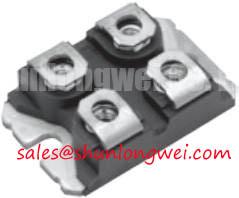
The APT2X61D100J from Microchip Technology is a dual Fast Recovery Epitaxial Diode (FRED) module designed to deliver exceptional performance in high-frequency power conversion systems. With its core specifications of 1000V blocking voltage and a 55A average rectified current per diode (totaling two individual diodes), all housed within the industry-standard SOT-227 package, this device directly addresses the critical engineering challenges of efficiency and thermal management. Key benefits include significantly reduced switching losses and the ability to operate at higher frequencies, which enables more compact system designs. For system designers working on high-power Switch-Mode Power Supplies (SMPS), the critical question is how to minimize switching losses without compromising reliability; the APT2X61D100J answers this by leveraging its ultrafast and soft recovery characteristics. Best fit for high-frequency Power Factor Correction (PFC) and boost converter stages where minimizing switching losses is paramount.
Key Parameter Overview
Decoding the Specs for Enhanced Switching Performance and Thermal Reliability
The technical specifications of the APT2X61D100J are tailored for high-efficiency power switching. Each parameter directly contributes to the module's performance in real-world engineering scenarios. The combination of high voltage, robust current handling, and superior dynamic characteristics makes it a strategic choice for modern power electronics.
| Parameter | Value | Engineering Implication |
|---|---|---|
| Maximum Repetitive Reverse Voltage (V_RRM) | 1000V | Provides substantial safety margin for high-voltage DC bus applications, ensuring robust operation under transient conditions. |
| Average Rectified Forward Current (I_F(AV)) | 55A per diode @ Tc = 105°C | Enables high power throughput in a compact SOT-227 footprint, suitable for demanding industrial loads. |
| Maximum Reverse Recovery Time (t_rr) | 280 ns | This rapid switching capability is essential for minimizing losses in high-frequency circuits, allowing for smaller and more efficient system designs. |
| Maximum Forward Voltage (V_F) | 2.5V @ 60A | A low forward voltage drop translates directly into lower conduction losses, which improves overall system efficiency and reduces heat generation. |
| Diode Configuration | Dual Independent Diodes | Offers design flexibility for use as anti-parallel diodes, in series for higher voltage, or as two separate freewheeling diodes. |
Application Scenarios & Value
Achieving System-Level Benefits in High-Frequency Power Conversion
The APT2X61D100J is engineered for applications where switching speed and efficiency are not just goals, but necessities. Best demonstrated in high-power Power Factor Correction (PFC) boost converters, this dual FRED module is pivotal. In a PFC circuit, the diode acts as a critical boost rectifier. The module's ultrafast 280 ns reverse recovery time (t_rr) and soft recovery characteristics directly reduce the turn-on losses of the main switching transistor (typically an IGBT or MOSFET). This is because a faster, softer recovery minimizes the period of simultaneous high voltage and current, a primary source of switching loss and electromagnetic interference (EMI). By lowering these losses, designers can push operating frequencies higher, leading to the use of smaller inductors and capacitors, which ultimately increases the power density of the entire Switch-Mode Power Supply (SMPS). This performance is crucial for meeting stringent efficiency standards like 80 PLUS Titanium and harmonic content regulations such as IEC 61000-3-2.
Its robust design also makes it an excellent choice for:
- Anti-Parallel or Freewheeling Diodes in motor controllers and inverters.
- High-speed rectifiers in uninterruptible power supplies (UPS).
- Snubber diodes to protect switching elements from voltage spikes.
- Output rectification stages in high-frequency welding power supplies.
For systems that operate on higher voltage lines and require a greater safety margin, the related DSEI2X61-12B offers a similar current rating but with a higher blocking voltage of 1200V.
Technical Deep Dive
Understanding the Engineering Advantage of FRED Technology's Soft Recovery
The term "Fast Recovery Epitaxial Diode" (FRED) signifies more than just speed; it points to the quality of the switching event. The key is the "soft recovery characteristic." When a conventional diode switches off, the current can drop abruptly, a phenomenon known as a 'snappy' recovery. This rapid change in current (di/dt) interacting with stray circuit inductance creates significant voltage spikes and high-frequency ringing, a major source of EMI. To understand this, think of the abruptness of a 'snappy' recovery like slamming on a car's brakes—it causes a violent jolt (the voltage spike) and noise. In contrast, the soft recovery of the APT2X61D100J is like a firm but smooth, controlled stop. This controlled recombination of charge carriers minimizes voltage overshoot and dampens oscillations, directly reducing stress on other components and simplifying the requirements for snubber circuits. This inherent softness is a critical factor in building reliable, high-frequency systems that can pass stringent EMC/EMI testing without extensive filtering, a crucial aspect in modern power designs for sensitive applications.
Frequently Asked Questions (FAQ)
How does the low reverse recovery charge (Qrr) of the APT2X61D100J benefit my PFC circuit design?
Low Qrr directly reduces the turn-on switching loss in the main PFC transistor (MOSFET/IGBT). Think of Qrr as the "braking energy" the diode needs to dissipate when it switches off. A lower Qrr is like having high-performance brakes that stop instantly with minimal heat, enabling the entire circuit to run faster and cooler, which is a key principle in high-efficiency power system design.
What are the thermal management advantages of the SOT-227 package?
The SOT-227 package features an isolated baseplate, which allows it to be directly mounted to a common heatsink with other components without needing additional insulating materials. This simplifies assembly and ensures a low thermal resistance path, facilitating efficient heat dissipation for enhanced reliability.
Can the two diodes in the APT2X61D100J be used in parallel?
While the module contains two independent diodes, paralleling them to double the current capacity requires careful design considerations. To ensure balanced current sharing, factors like symmetrical PCB layout and managing the negative temperature coefficient of the forward voltage (Vf) are critical to prevent thermal runaway in one of the diodes.
What is the significance of the "Dual Independent Diodes" configuration?
This configuration offers high flexibility. The two diodes can be used independently in two separate circuits, as anti-parallel freewheeling diodes for two switches in a half-bridge topology, or connected in series to achieve a 2000V blocking capability (with appropriate voltage balancing).
What defines a FRED (Fast Recovery Epitaxial Diode) and differentiates it from a standard diode?
A FRED is specifically engineered using epitaxial growth and controlled doping profiles to achieve very short reverse recovery times (trr) and a "soft" recovery characteristic. Unlike standard rectifiers, which are slow and optimized for line-frequency applications, FREDs are designed for high-frequency circuits (typically >20kHz) where minimizing switching losses and EMI is the primary goal.
From a design engineer's perspective, the APT2X61D100J's value lies in its balance of speed and control. The soft recovery characteristic is not a luxury but a fundamental feature that simplifies the entire power stage design, reducing the need for complex snubbers and filters, thereby accelerating time-to-market for high-performance power systems.