Content last revised on September 10, 2026
Optimizing Switching Efficiency and Thermal Margin in 1200V Industrial Drives
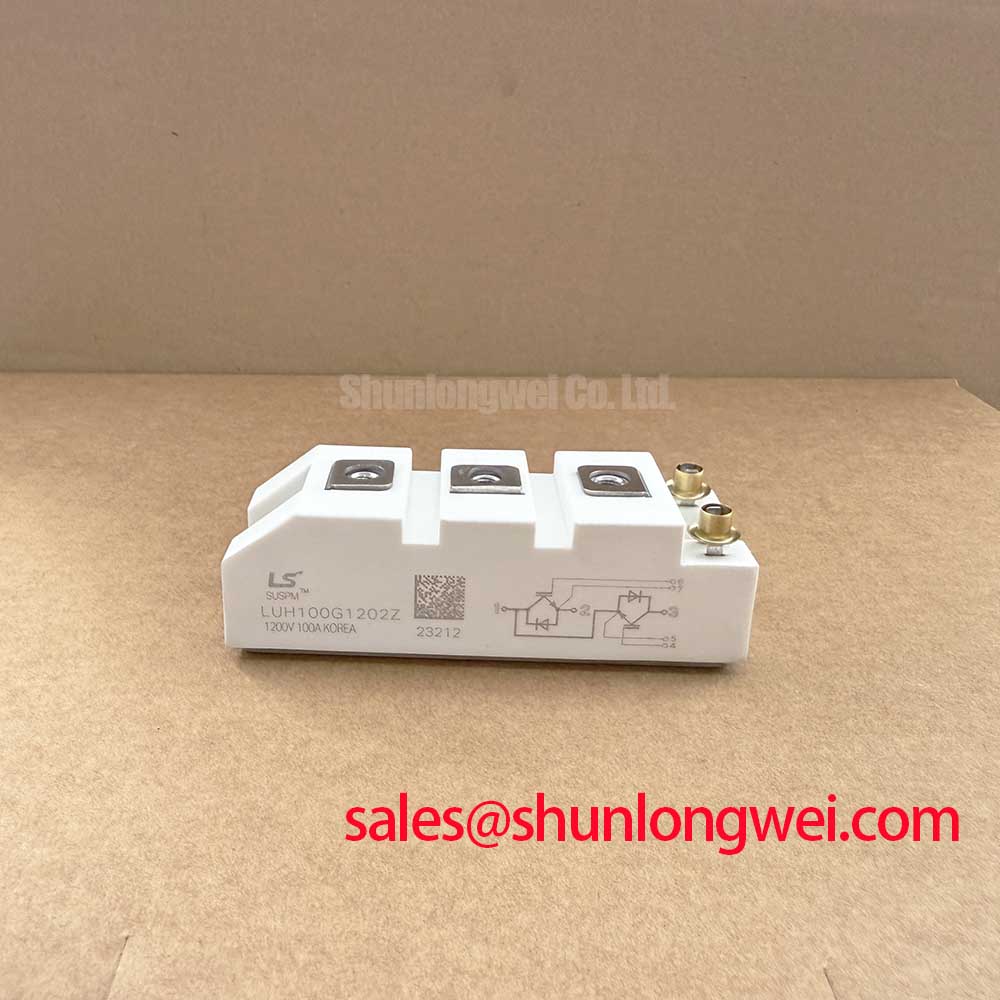
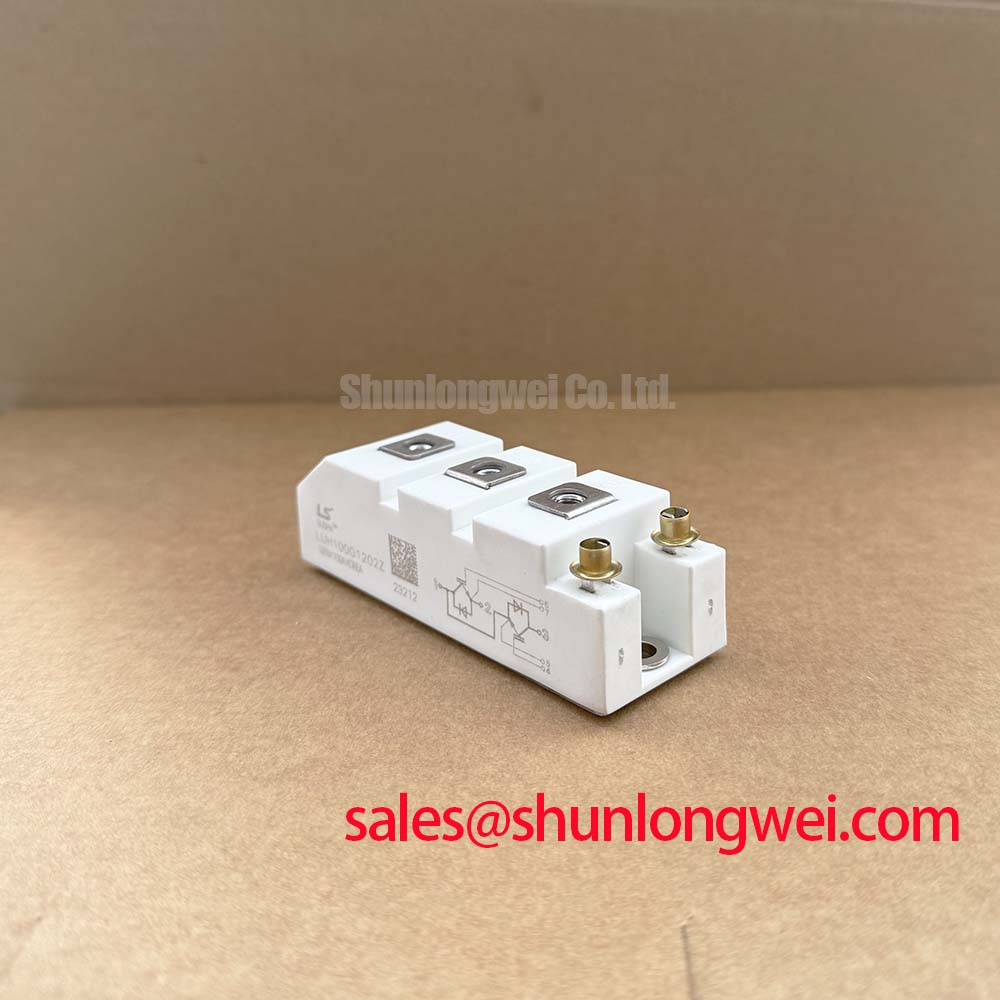
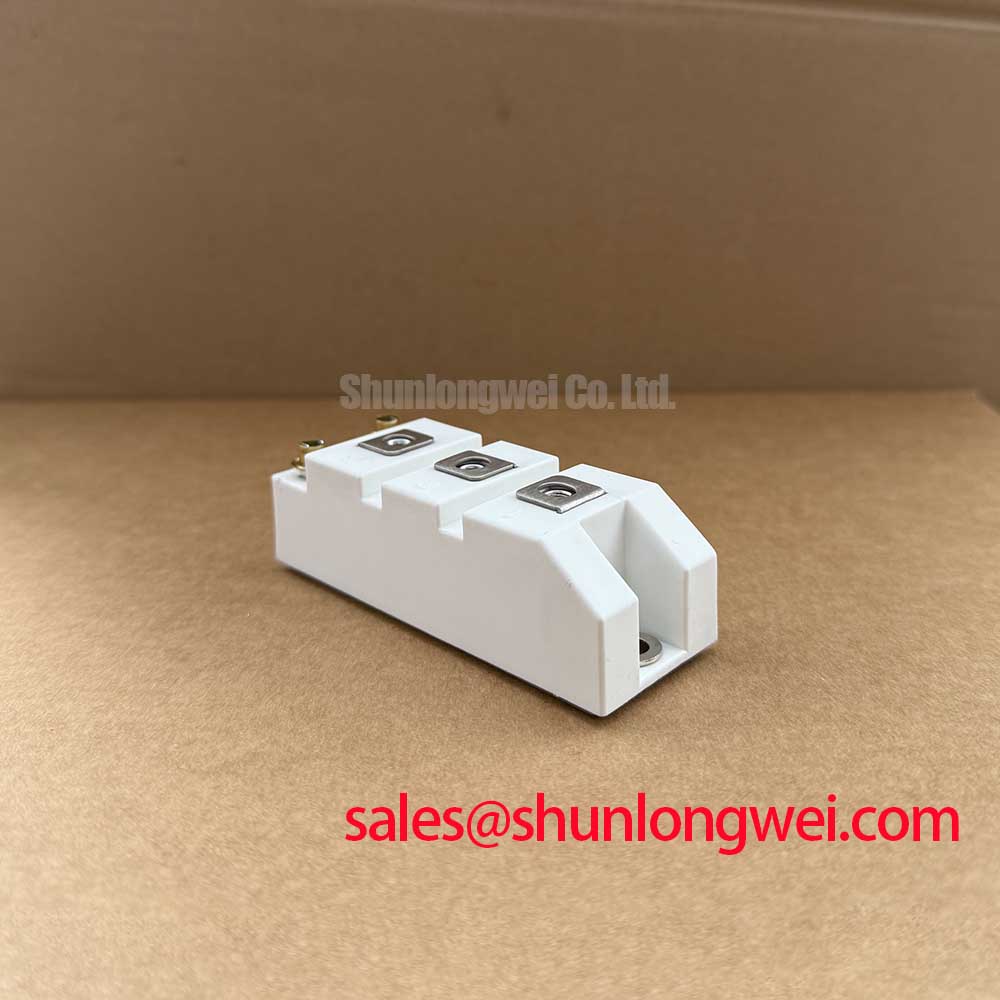
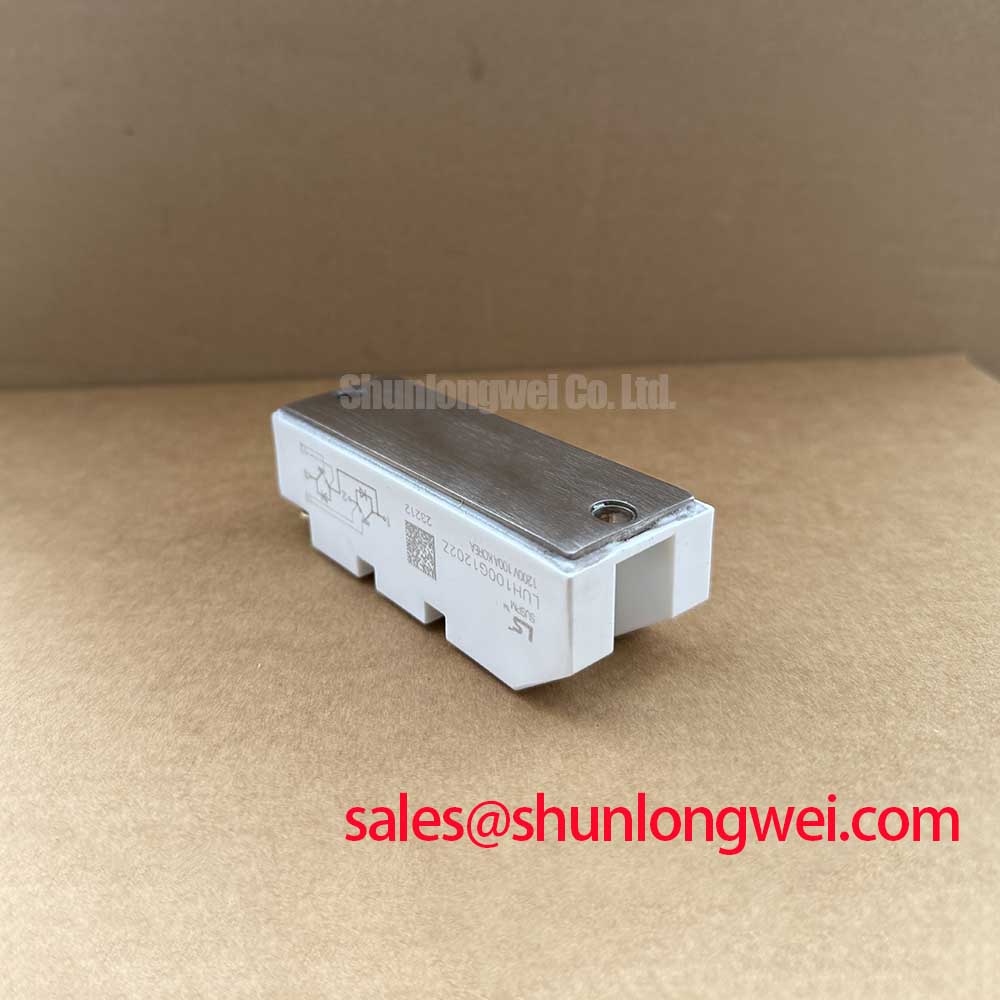
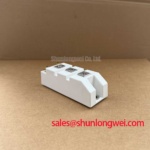
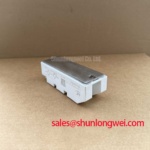
When designing high-power motor drives or solar inverters, engineers are frequently confronted with a critical trade-off: how to increase switching frequency to reduce filter size without incurring catastrophic thermal losses. The LUH100G1202Z, a 1200V | 100A IGBT module utilizing Trench Field Stop technology, directly addresses this challenge by minimizing both conduction and switching energy dissipations. What is the primary benefit of its trench-gate structure? It significantly lowers the collector-emitter saturation voltage ($V_{CE(sat)}$), effectively acting like a wider pipe for current, which reduces heat generation during the "on" state.
For industrial systems prioritizing thermal reliability and high power density, this 1200V module stands as a high-performance benchmark in the 100A class. By providing a robust Short Circuit Safe Operating Area (SCSOA) and a low thermal resistance $R_{th(j-c)}$, it empowers designers to push system boundaries while maintaining a safe operating margin. For systems requiring comparable current handling but different topology options, the SKM100GB123D offers a similar 1200V 100A rating in a standard dual configuration.
Frequently Asked Technical Questions
Evaluating Performance and Design Integration
How does the 1200V rating of the LUH100G1202Z provide a safety buffer for 400V–480V AC line applications?
In standard 480V AC industrial environments, the DC bus voltage typically reaches approximately 650V–700V. The 1200V $V_{CES}$ rating of this module provides nearly a 500V safety margin, which is essential for absorbing inductive voltage spikes (L di/dt) during fast switching transients without triggering an avalanche breakdown. This margin is critical for long-term reliability in environments with "noisy" power grids.
What impact does the low $V_{CE(sat)}$ of approximately 2.0V have on heatsink selection?
The collector-emitter saturation voltage is essentially the "toll booth fee" electrons pay when passing through the IGBT. A lower $V_{CE(sat)}$ means less power is dissipated as heat during the conduction phase. For a 100A load, even a 0.2V reduction in $V_{CE(sat)}$ translates to 20W less heat per switch. This reduction allows engineers to either downsize the aluminum heatsink or run the system at a higher ambient temperature without exceeding the 150°C maximum junction temperature.
Does the LUH100G1202Z feature a Kelvin Emitter terminal, and why does it matter?
Yes, this module architecture typically incorporates a Kelvin Emitter connection. This terminal bypasses the main power emitter's stray inductance, ensuring that the gate driver sees a "clean" signal. In high-speed switching scenarios, this prevents the $di/dt$ of the power circuit from inducing a voltage that could oppose the gate drive signal, thereby reducing switching losses and preventing unintended turn-off.
Key Parameter Overview
Critical Specifications for Engineering Assessment
| Parameter | Official Value | Engineering Significance |
|---|---|---|
| Collector-Emitter Voltage ($V_{CES}$) | 1200V | Maximum voltage withstand capability in "off" state. |
| Continuous Collector Current ($I_C$) | 100A (at $T_C=80^circ C$) | Rated current capacity for steady-state operation. |
| $V_{CE(sat)}$ (Typical) | 1.90V - 2.10V | Determines conduction loss; lower values improve efficiency. |
| Maximum Junction Temperature ($T_{jmax}$) | 150°C | Upper thermal limit for the silicon die before risk of failure. |
| Short Circuit Withstand Time ($t_{sc}$) | 10μs | Critical window for protection circuits to detect and shut down. |
| Package Housing | Standard Industrial Package | Ensures mechanical compatibility and optimized creepage distances. |
Download the LUH100G1202Z datasheet for detailed specifications and performance curves to finalize your thermal simulations.
Technical Deep Dive
The Physics of Loss Suppression in Trench Field Stop Architecture
The LUH100G1202Z leverages a Trench Field Stop (TFS) design, which represents a significant evolution over older non-punch-through (NPT) structures. In an NPT IGBT, the wafer must be relatively thick to block 1200V, which inherently increases conduction resistance. The TFS technology allows for a thinner silicon wafer by introducing a "Field Stop" layer at the back of the die. This layer acts like a brake for the electric field, allowing the device to stop the full 1200V over a much shorter distance.
Furthermore, the trench-gate structure increases the cell density on the surface of the chip. By aligning the gates vertically (in trenches) rather than horizontally, the module achieves a much higher current density. This architectural shift reduces the "on-resistance" of the device, similar to adding more lanes to a highway to prevent traffic congestion. For engineers, the result is a module that combines the fast switching characteristics of a MOSFET with the high current density of a Bipolar junction transistor. To better understand the positioning of such devices within a system, one might consider the FS100R12KE3 as a benchmark for comparison in integrated 1200V topologies.
Application Scenarios & Value
Achieving System-Level Benefits in High-Frequency Power Conversion
The LUH100G1202Z is frequently specified in Variable Frequency Drives (VFD) and Uninterruptible Power Supplies (UPS) where efficiency and thermal stability are paramount. Consider a high-fidelity engineering scenario involving an industrial conveyor belt system driven by a 45kW motor. During the initial motor start-up, the system experiences a high surge current. The 100A rating and the robust 10μs short-circuit withstand time of the LUH100G1202Z allow the drive to handle these transient surges without desaturation or catastrophic failure.
Beyond motor control, this module is an ideal fit for Solar Inverters and Welding Power Supplies. In these applications, the 1200V rating is essential for 3-phase grid tie-ins. The high power cycling capability ensures that the module can withstand the repeated thermal expansion and contraction cycles common in renewable energy systems, where solar output fluctuates throughout the day. In high-density designs, the LUH100G1202Z facilitates compliance with Infineon TRENCHSTOP™ IGBT3 class performance standards, providing a reliable foundation for modern power conversion. Related products often utilized in similar high-reliability power stages include the FF100R12RT4 for those seeking advanced switching characteristics.
For engineering teams designing EV charging infrastructure or PFC stages, selecting the right IGBT is the cornerstone of reliability. The LUH100G1202Z provides the necessary 1200V headroom and 100A capacity to meet the demands of next-generation industrial hardware. By balancing switching speed with low thermal resistance, it allows for a more compact and cost-effective inverter design.