
Content last revised on September 30, 2026
MG300Q1US41 Circuit Protection and Reliability: Calibrating DC Bus Voltage Headroom Derating
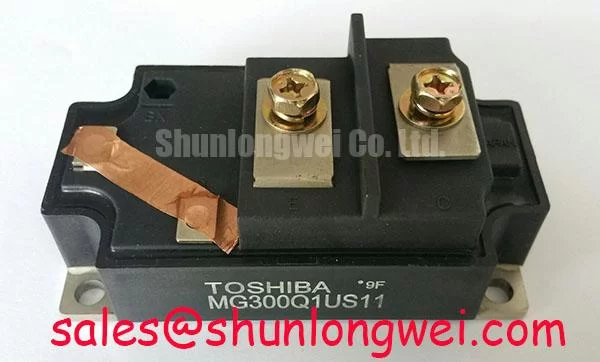
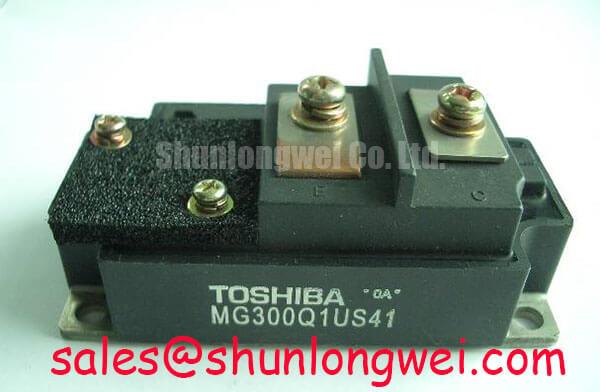
With the DC bus isolated and discharged, verify the installed module marking against the inverter bill of materials before reconnecting control wiring. The MG300Q1US41 is a Toshiba IGBT module with a specified 1200 V collector-emitter voltage rating and 300 A current rating, supplied in a Toshiba Module package. These specifications define the electrical identity that maintenance teams should preserve when assessing a traction inverter repair.
| Official specification | Value |
|---|---|
| Manufacturer | Toshiba |
| Collector-emitter voltage rating | 1200 V |
| Rated current | 300 A |
| Package | Toshiba Module |
The 1200 V rating is the primary boundary for evaluating DC bus operating conditions, including normal supply variation, regenerative events, switching overshoot, and motor cable reflections. The system integrator should capture collector-emitter voltage at the module during representative switching conditions, then compare measured peaks with the rated voltage boundary. This is an Engineering Recommendation, not a declared operating limit for a completed inverter assembly.
At elevated sites, engineers sometimes assess terrestrial neutron exposure and single event burnout risk as part of a wider reliability review. No FIT rate, altitude derating curve, or single event burnout performance figure is established here for the MG300Q1US41. A quantitative assessment requires device-specific manufacturer data and the actual voltage, location, mission profile, thermal condition, and switching waveform. Design Consideration: maintain appropriate DC bus voltage headroom, avoid uncontrolled overshoot, and document measured peak voltage during commissioning.
Inspect the DC link capacitor connections, laminated busbar interfaces, cable terminations, and snubber path before attributing an overvoltage trip to the module. Long motor cables can create transmission line reflections, with voltage excursions that can approach twice the incident wave under unsuitable termination conditions. The appropriate filter, cable treatment, and switching control must be selected and validated at system level. For broader three-phase switching context, see The 1200 V CoolSiC™ MOSFET Advantage in Three.
Field Diagnostics and Commissioning: Overvoltage Trip Prevention in MG300Q1US41 Topologies
During a regenerative fault investigation, establish whether the DC bus rise occurs during commanded deceleration, an uncontrolled load event, or a control sequence anomaly. Where the inverter includes a braking chopper, the braking IGBT and ballast resistor must be evaluated as a matched system. The resistor energy capability depends on the motor and load kinetic energy, deceleration profile, duty cycle, ambient condition, enclosure airflow, and the protection control threshold. Its final value and thermal rating are system determined and should be verified by measured DC bus and temperature results.
The MG300Q1US41 mounting interface deserves equal attention. A clean heatsink surface, controlled thermal interface material application, and an even tightening sequence help prevent localized contact loss. Use a controlled thermal interface material thickness where the applicable module assembly instructions permit that process. The specified module documentation and equipment service manual remain the authority for mounting hardware and torque.
⚠️ Maintenance Note: Monitor heatsink contact temperature rise and inspect cooling airflow, aged thermal material, loose terminals, moisture, and condensation during scheduled preventive maintenance.
A turn-off event combines commutation behavior, busbar inductance, and the reverse recovery behavior of the associated freewheel diode. Switching waveforms that show ringing or unexpected voltage peaks may indicate a gate loop, layout, clamping, or commutation issue; compare them with a known good inverter channel using correctly rated differential measurement equipment. Negative gate bias, where used by the original driver design, must be retained only after confirming the driver and module requirements from the equipment documentation.
MG300Q1US41 Circuit Protection and Reliability: Calibrating Symmetrical Busbar Geometry for High Current
At the specified 300 A current rating, conductor geometry and joint condition can materially affect the electrical environment surrounding the module. Keep parallel current paths geometrically balanced, with matched conductor length, comparable joint quality, and closely coupled outgoing and return bus paths. This Design Consideration reduces unequal parasitic inductance that can otherwise disturb switching balance between parallel positions.
Positive temperature coefficient behavior of IGBT saturation voltage can support steady-state current sharing under appropriate conditions, but it does not replace matched dynamic gate wiring. Gate resistor placement, return paths, driver timing, and common-emitter reference arrangement should remain symmetrical. Current sharing must be confirmed using suitable measurements over the intended operating envelope rather than inferred from static resistance alone.
For repair planning, do not treat another module as an automatic replacement solely because its family designation appears related. The MG150Q1JS40 can be reviewed as a separate Toshiba module reference, but engineers should compare voltage rating, current requirement, mechanical interface, drive conditions, protection coordination, and original inverter documentation before any redesign decision.
Field Diagnostics and Commissioning: Reinforced Insulation Barrier Integrity in MG300Q1US41 Topologies
Do not assign reinforced isolation voltage or common-mode transient immunity figures to the MG300Q1US41 without an applicable Toshiba specification. These characteristics often belong to the gate driver, isolated power supply, current sensor, connector system, and PCB spacing strategy rather than to the power module alone. When commissioning a traction inverter, inspect barrier spacing, contamination, moisture ingress, connector seating, and the isolation components specified by the original design.
Spurious gate pulses should be investigated with reference to the isolated driver output, gate-emitter waveform, and DC bus transient at the same operating event. Minimize common-mode coupling and parasitic loop inductance to suppress noise-induced triggering, then verify the result against the measured switching waveform. If a diagnostic display assembly is also being serviced, its communication path should be treated as a separate subsystem; Low Voltage Differential Signaling interface architecture describes differential signaling principles, while subpixel layout and color filter patterns relate to display image formation rather than IGBT gate-drive behavior.