Content last revised on September 10, 2026
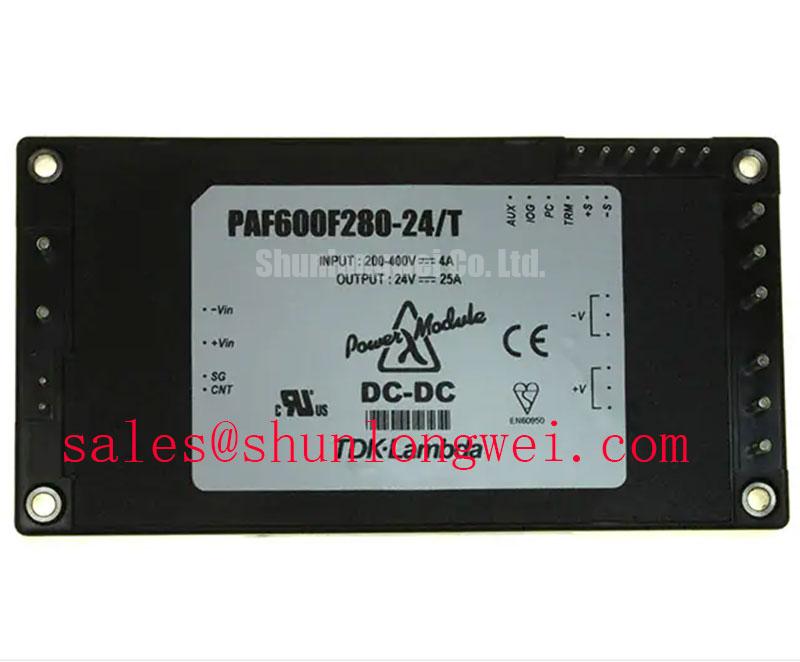
PAF600F280-24 TDK-Lambda 600W DC/DC Converter: Engineering Insights
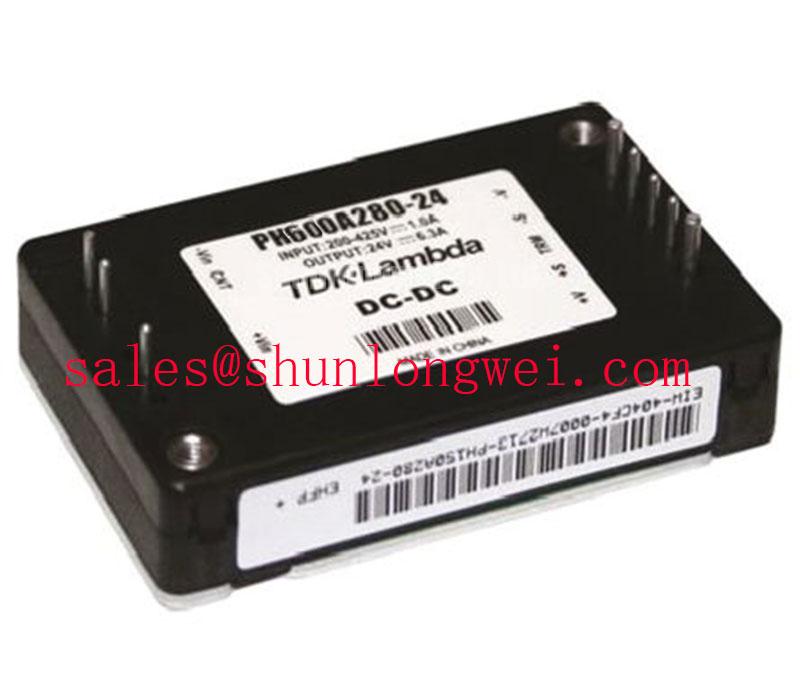
Built to withstand demanding industrial environments, this unit delivers robust thermal management and isolated power conversion within a compact full-brick package. Featuring a 200 to 400V DC input range, a stable 24V DC output at 25A, and an impressive 3000VAC isolation, the converter simplifies heatsink integration while supplying stable control logic power. The wide input tolerance reliably accommodates fluctuating voltages in nominal 280V systems, mitigating the risks of undervoltage lockouts. For high-voltage industrial systems prioritizing thermal margin and compact integration, this 600W DC/DC converter is the optimal choice.
Key Parameter Overview
Decoding the Specs for Enhanced Thermal Reliability
To support rigorous system-level assessments, the following functional groups detail the electrical and mechanical thresholds of this power conversion unit.
| Functional Group | Parameter | Specification |
|---|---|---|
| Input & Output Characteristics | Nominal Input Voltage | 280V DC (Range: 200 to 400V DC) |
| Rated Output Voltage | 24V DC (Adjustable 14.4 to 28.8V DC) | |
| Maximum Output Power | 600W (Current: 25A) | |
| Environmental & Isolation | Baseplate Temperature Range | Minus 40°C to 100°C |
| Withstanding Voltage (In-Out) | 3000VAC for 1 minute | |
| Typical Efficiency | 91% | |
| Mechanical Specifications | Package Size | Full Brick (61 x 12.7 x 116.8 mm) |
| Cooling Mechanism | Conduction via Baseplate |
Download the PAF600F280-24 datasheet for detailed specifications and performance curves.
Application Scenarios & Value
Achieving System-Level Benefits in High-Voltage Control Power
Engineers designing high-power UPS networks or electric vehicle charging infrastructure frequently face the challenge of generating stable low-voltage control power directly from a high-voltage DC link. The device addresses this by converting a volatile 200 to 400V DC bus down to a tightly regulated 24V supply. Think of its 3000VAC galvanic isolation as an impenetrable firewall between the hazardous traction voltage and the delicate microprocessors on the gate driver board.
In addition to protecting sensitive downstream logic, the 25A current capacity provides ample headroom for driving multiple contactors, cooling fans, and human-machine interfaces simultaneously. In heavy-duty inverter designs, while this converter reliably powers the PWM controller and sensor arrays, the main phase currents are handled by massive discrete components. For instance, systems requiring ultra-high current capability often deploy the CM600HA-24A to serve as the primary switching element. Conversely, for more integrated topologies, pairing this 24V supply with an intelligent module like the PM100RLA120 ensures that all internal Gate Drive ICs receive uninterrupted, clean power despite severe load transients. This separation of power and control generation is a cornerstone of compliance with stringent safety standards such as IEC 62368-1.
Technical Deep Dive
A Closer Look at Baseplate Cooling and Conduction Efficiency
The fundamental constraint in compact 600W conversion is extracting heat from dense planar magnetics and switching silicon. The converter utilizes a precision-machined aluminum baseplate rated for operation from minus 40°C to 100°C. What is the primary benefit of its baseplate design? It ensures superior heat dissipation for high-density power systems.
This conduction-cooling approach forces all thermal flux through a single, predictable plane, entirely eliminating the need for internal airflow. The baseplate acts much like a heavy-duty sponge, instantly soaking up thermal spikes and evenly transferring them to the external heatsink. This minimizes localized hot spots and improves the overall Thermal Resistance of the assembly.
Furthermore, relying on a solid physical interface rather than forced air dramatically increases the operational lifespan in environments saturated with dust or chemical contaminants. Proper surface mounting and the application of a high-performance thermal interface material are critical to maintaining the rated 91% efficiency. These deployment strategies closely mirror the thermal management best practices we discuss in our comprehensive guide to power stage design, where predictable thermal paths dictate long-term system reliability.
Frequently Asked Questions
Expert Answers to Common Engineering Inquiries
When integrating this DC/DC converter into high-stakes industrial environments, engineers must carefully evaluate its thermal and electrical boundaries. Below are technical resolutions to the most pressing deployment challenges.
- How does the 100°C maximum baseplate temperature influence heatsink selection?
It defines the absolute thermal boundary of the assembly. Operating at a 600W output with a typical efficiency of 91% generates roughly 60W of internal heat. The heatsink must dissipate this 60W into the ambient environment while maintaining the baseplate strictly below 100°C. Failure to account for the specific thermal resistance of the junction-to-case pathway can lead to thermal shutdown, highlighting the importance of strategies outlined in our guide on thermal management strategies. - Why is the 200 to 400V DC input range critical for battery-backed UPS systems?
During an extended grid outage, the nominal voltage of a UPS battery bank drops linearly as it discharges. This broad input window guarantees that the essential 24V DC output remains perfectly stable, keeping the critical communication and control logic alive until the batteries reach their minimum cutoff threshold.
To secure this component for your next power project, verify stock and request pricing through our distribution portal today.