Content last revised on September 10, 2026
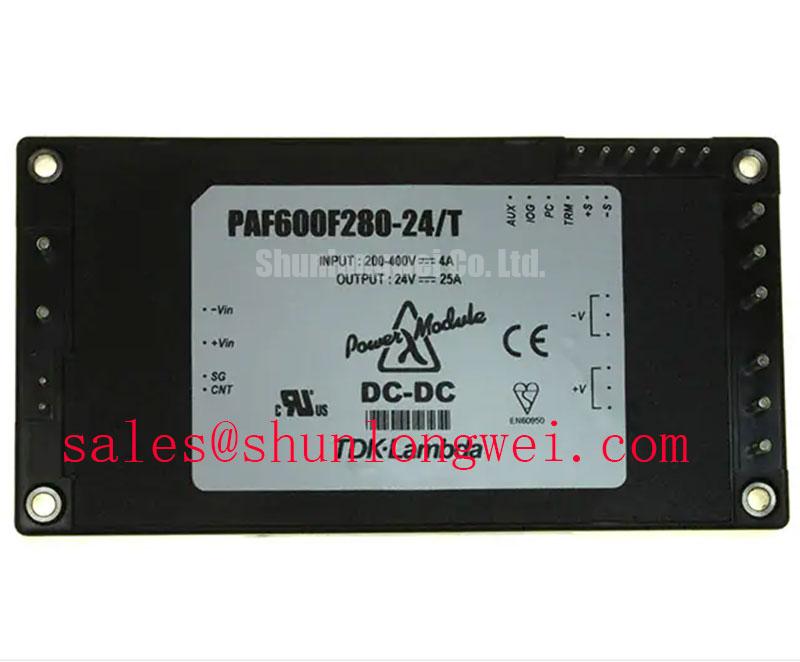
PAF600F280-24/T TDK-Lambda Isolated DC-DC Converter Module
High-Efficiency 600W Power Conversion for 280V DC Distributed Architectures
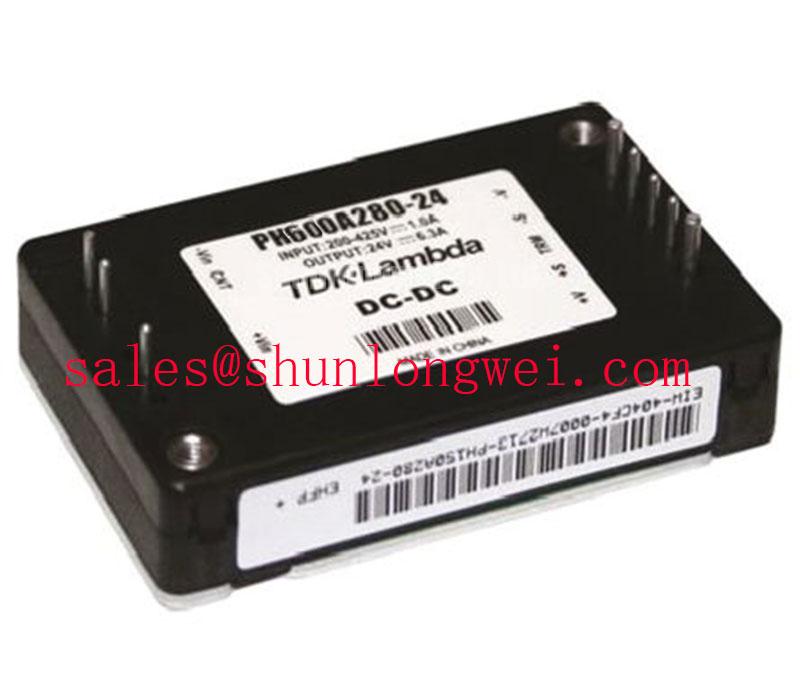
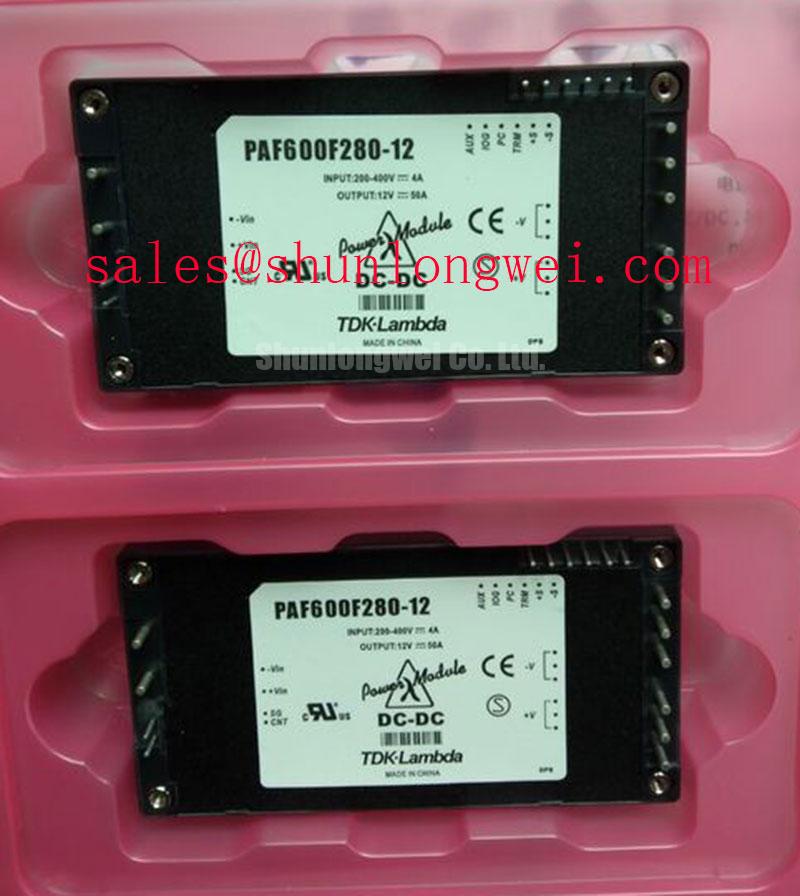
The PAF600F280-24/T from TDK-Lambda is an industrial-grade, full-brick isolated DC-DC converter designed to deliver stable 24V DC output at up to 25A from a wide 200–400V DC high-voltage input bus. Operating at an impressive 91% typical efficiency, it minimizes thermal dissipation across high-stress environments while supporting full-load baseplate operation up to 100°C. The specialized /T option designates non-threaded (clear) mounting inserts for flexible mechanical through-bolting. What is the primary function of the /T suffix? It provides non-threaded mounting holes for through-bolt mechanical fastening. For 280V DC distributed architectures requiring 24V conversion up to 600W, this high-density module delivers unmatched conversion efficiency.
Application Scenarios & Value
Delivering Stable Low-Voltage Power in High-Voltage DC Environments
Engineers often face severe thermal and spatial constraints when converting high-voltage DC distribution lines (such as 280V or 380V rectified buses) down to stabilized intermediate 24V rails. In demanding systems like centralized UPS (Uninterruptible Power Supply) architectures, telecommunication rectifiers, and high-performance server power shelves, bulk step-down converters must handle broad input swings without degrading line regulation. The PAF600F280-24/T addresses these challenges by operating seamlessly across a 200V to 400V DC range, maintaining a line and load regulation of 56mV maximum.
Consider an industrial power enclosure where auxiliary control electronics require 24V power drawn directly from a high-voltage battery bank. Sudden load spikes can induce voltage dips over long distribution traces. Utilizing the dedicated Remote Sense (+S, -S) terminals, the PAF600F280-24/T compensates for distribution voltage drops directly at the point of load. Think of this feature like a dedicated feedback sensor in a closed-loop servo system, constantly adjusting output drive so the actual target load receives exact voltage regardless of line resistance.
Furthermore, when system requirements expand beyond 600W, designers can connect the Parallel Pin (PC) across multiple modules to achieve balanced current sharing. How does the module handle high power demands? Up to multiple units can be paralleled using the active current-share pin. In complex power networks integrating high-voltage switching, understanding thermal dissipation principles via the core trio of power module thermal management ensures reliable sub-system co-existence.
Technical & Design Deep Dive
Conduction Cooling Mechanics and Control Integration
The internal topology of the PAF600F280-24/T uses high-frequency isolated conversion stages that yield up to 91% power efficiency. By converting power with minimal internal loss, thermal management shifts from bulky internal fans to direct conduction via its aluminum baseplate. Baseplate temperature can safely reach 100°C without failure, giving mechanical engineers freedom to mount the unit onto cold plates or system chassis walls.
To visualize the efficiency impact: at full 600W output, a 91% efficient module dissipates approximately 59W of heat, whereas an 84% conventional converter would waste over 114W. This ~55W difference acts like eliminating an entire incandescent heater from inside an enclosed, sealed industrial cabinet. Integrating these converters alongside switching modules discussed in our guide on power stage design strategies helps streamline overall electromagnetic and thermal layout.
The control interface provides comprehensive supervisory signals, including an Inverter Good (IOG) open-collector status monitor, remote ON/OFF control, a wide output trim span of 14.4V to 28.8V, and an auxiliary bias supply delivering 10–14V DC. The module also provides high-voltage galvanic safety with an input-to-output isolation rating of 3000VAC for 1 minute and input-to-baseplate isolation of 2500VAC.
Key Parameter Overview
Technical Specifications and Engineering Relevance
| Parameter | Rated Value | Engineering Value & Context |
|---|---|---|
| Manufacturer | TDK-Lambda | Tier-1 industrial power supply design and manufacturing. |
| Input Voltage Range (Vin) | 200 – 400V DC | Broad tolerance for 280V nominal high-voltage DC distribution. |
| Nominal Output Voltage (Vout) | 24V DC | Industry-standard voltage for industrial automation and auxiliary rails. |
| Output Voltage Trim Range | 14.4 – 28.8V DC | Permits custom voltage trimming without requiring custom converter builds. |
| Maximum Output Current (Iout) | 25A | Supplies robust current capacity for high-density loads. |
| Maximum Output Power (Pout) | 600W | High power density packaged in an industry-standard full-brick footprint. |
| Typical Efficiency | 91% | Reduces waste heat, lowering required heatsink surface area. |
| Baseplate Operating Temp. | -40°C to +100°C | High thermal ceiling enables reliable conduction cooling. |
| Mounting Hole Format (/T Suffix) | Non-threaded (Clear) | Simplifies pass-through screw mounting onto custom heatsinks. |
| Isolation Voltage (In to Out) | 3000VAC (1 min) | Complies with safety agency standards (IEC/EN/UL 62368-1). |
Download the PAF600F280-24/T datasheet for detailed specifications and performance curves.
Frequently Asked Questions
Addressing Design and Integration Queries
What is the difference between the standard PAF600F280-24 and the /T model?
The standard PAF600F280-24 comes with M3 tapped female threads in the mounting baseplate inserts. The /T option features non-threaded (clear) mounting holes, allowing through-bolts to pass directly through the module body into a threaded cold plate or external nuts.
Can the output voltage be adjusted beyond the nominal 24V setting?
Yes. The TRIM terminal allows the output voltage to be trimmed across a wide range of 14.4V to 28.8V DC using external resistors, enabling precise adaptation to custom battery charging or intermediate bus requirements.
How does the current-sharing parallel function operate?
Connecting the PC (Parallel Control) pins of multiple modules links their internal pulse-width modulation control circuits, forcing the converters to share total output current proportionally and preventing individual unit overload.
What thermal management strategies are recommended for baseplate cooling?
Because the module relies on conduction cooling, it must be mounted to an adequate heatsink or liquid cold plate using high-grade thermal interface material (TIM). The baseplate temperature must remain below 100°C under all operating load scenarios.
What protection mechanisms are built into the PAF600F280-24/T?
The converter integrates Overcurrent Protection (OCP) rated at 105% to 140%, Overvoltage Protection (OVP) set between 125% and 145%, and comprehensive input-to-output galvanic isolation rated at 3000VAC.
From an engineering implementation perspective, matching the high-voltage bus stability of the PAF600F280-24/T with properly sized input filtering and robust conduction heatsinking provides a dependable, high-density 24V power foundation for industrial systems.