

Content last revised on August 28, 2026
PFE500SA-28: Engineering an In-Depth Analysis of the 500W Full-Brick AC-DC Power Module
Product Overview: PFE500SA-28
A High-Density Power Solution for Demanding Industrial Systems
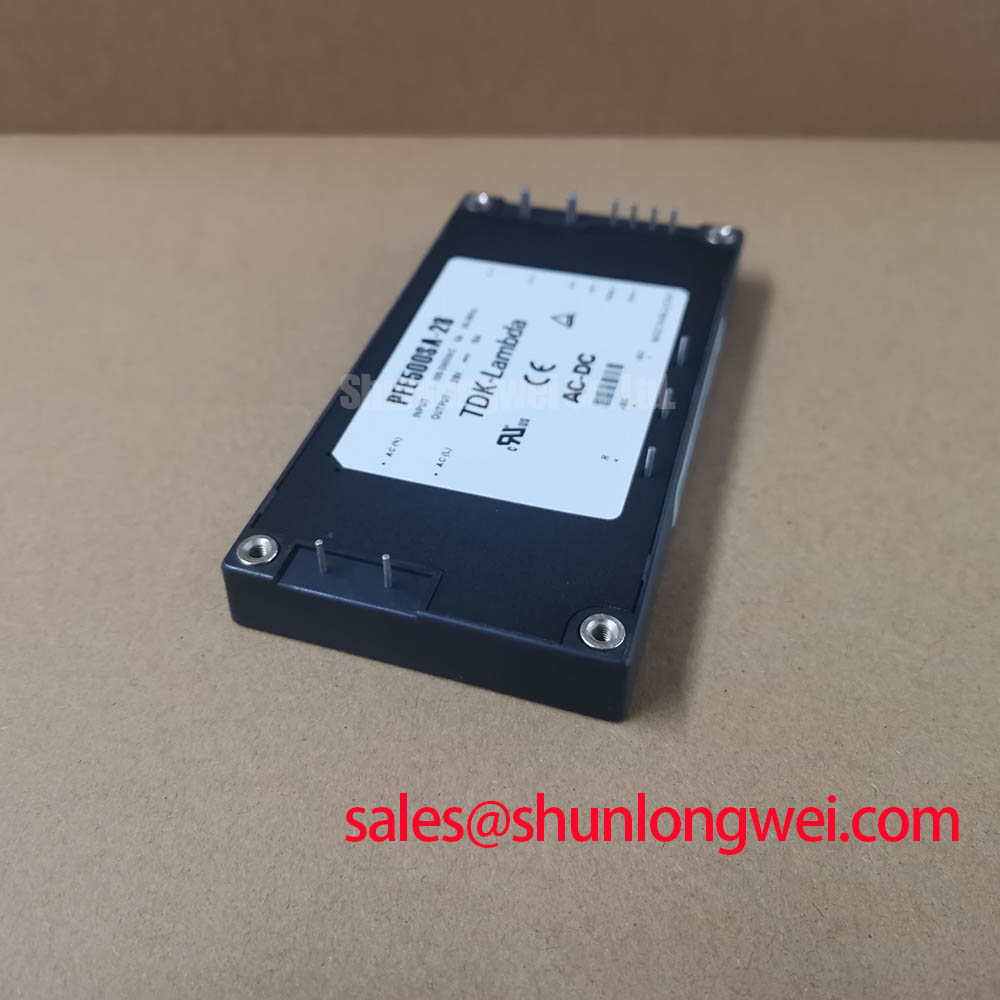
The PFE500SA-28 is a high-density, full-brick AC-DC power module delivering a tightly regulated 28V output, engineered for space-constrained and thermally demanding industrial applications. Key Specifications: 85-265V AC Input | 28V / 18A Output | 88% Typical Efficiency. It integrates critical functions to deliver significant system-level benefits, including a high-efficiency power factor correction (PFC) front-end and a robust full-bridge converter. This integrated design directly addresses the engineering challenge of building compact, reliable, and compliant power systems by minimizing the need for external components and simplifying thermal management. What is the primary benefit of its integrated design? Simplified system development and enhanced power density by combining PFC and DC-DC conversion in a single, conductively cooled package. For systems requiring robust performance in a compact footprint, the PFE500SA-28 provides a streamlined path to a reliable power architecture.
Key Parameter Overview
Decoding the Specs for High-Efficiency Power Conversion
The technical specifications of the PFE500SA-28 are tailored for high-reliability industrial power systems. Each parameter is a critical factor in system design, influencing everything from thermal performance to overall efficiency and electromagnetic compatibility (EMC).
| Parameter | Value | Engineering Significance |
|---|---|---|
| Input Specifications | ||
| Input Voltage Range | 85 - 265 V AC (47-63 Hz) | Universal input capability allows for global deployment without modification, simplifying inventory and logistics. |
| Power Factor | 0.95 (Typ) at 230V AC, Full Load | Active Power Factor Correction (PFC) minimizes harmonic distortion, ensuring compliance with standards like IEC 61000-3-2 and improving energy efficiency. |
| Efficiency | 88% (Typ) at 230V AC, Full Load | High efficiency reduces waste heat. For a 500W output, this means only ~68W is dissipated as heat, simplifying heatsink selection and enabling higher power density. |
| Output Specifications | ||
| Output Voltage | 28 V DC | A standard voltage for a wide range of industrial control, automation, and communication equipment. |
| Maximum Output Current | 18 A | Provides substantial current capacity for powering multiple downstream loads or high-power devices. |
| Maximum Output Power | 504 W | Delivers over 500 watts of continuous power in a compact full-brick format. |
| Line/Load Regulation | ±1% Max | Ensures a stable output voltage under varying input line and load conditions, critical for sensitive electronics. |
| Protection & Control | ||
| Overcurrent Protection | Included (Hiccup mode, automatic recovery) | Protects the module and the load from damaging overcurrent events without requiring manual intervention. |
| Overvoltage Protection | Included (Latched) | Prevents damage to downstream components in the case of an output overvoltage fault. |
| Overtemperature Protection | Included (Shutdown, automatic recovery) | Enhances long-term reliability by preventing thermal runaway. |
Disclaimer: The parameters listed above are for reference purposes. For complete and verified specifications, please consult the official manufacturer's documentation.
Download the PFE500SA-28 datasheet for detailed specifications and performance curves.
Application Scenarios & Value
System-Level Benefits in Industrial Power Architectures
The PFE500SA-28 is an optimal choice for engineers developing power systems for industrial automation, process control, and high-power LED lighting. Its value proposition is centered on simplifying design complexity and enhancing reliability in environments where space and thermal performance are critical constraints.
High-Fidelity Engineering Scenario: Powering a Distributed Control System (DCS) Cabinet
Consider the challenge of designing the power architecture for a sealed NEMA-rated DCS cabinet on a factory floor. Airflow is restricted, and internal ambient temperatures can be high. The primary engineering challenge is delivering over 500W of reliable 28V power for PLCs, I/O modules, and network switches without creating a thermal hotspot that could compromise system longevity. Using discrete components for PFC and DC-DC conversion would require significant PCB area and complex thermal management for multiple heat-generating components. The PFE500SA-28 directly solves this. Its full-brick, baseplate-cooled design allows for efficient heat transfer directly to the cabinet's chassis or a heatsink. The module's 88% efficiency is critical here; it directly translates to less waste heat being generated within the sealed enclosure. This integrated approach not only saves valuable DIN rail or panel space but also centralizes the primary heat source, simplifying the thermal design into a single, predictable interface. For applications demanding similar power levels but with a focus on intelligent monitoring, an Intelligent Power Module (IPM) might be considered for its integrated drive and protection features.
Technical Deep Dive
Inside the PFE500SA-28: A Look at its Integrated PFC and Full-Bridge Design
The performance of the PFE500SA-28 is rooted in its sophisticated internal topology, which combines two critical power conversion stages into one thermally efficient package. The front-end consists of an active Power Factor Correction (PFC) boost converter. This is not merely a passive filter; it actively shapes the input current waveform to be sinusoidal and in phase with the input voltage. Think of it like a skilled conductor ensuring the orchestra (the current) plays in perfect time with the music (the voltage). This process dramatically increases the power factor to typical values of 0.95, satisfying stringent international regulations on harmonic currents and maximizing the real power drawn from the mains.
Following the PFC stage is a highly efficient, fixed-frequency full-bridge DC-DC converter. This stage is responsible for stepping down the high-voltage DC bus from the PFC stage to the regulated 28V output. The use of a full-bridge topology allows for efficient power transfer and enables the high power density achieved in the full-brick form factor. The module's internal control circuitry manages both stages, providing the specified tight regulation and integrating the full suite of protection features—overcurrent, overvoltage, and overtemperature—that are essential for building a truly resilient power system.
FAQ
Addressing Design-Critical Questions on the PFE500SA-28
What is the key advantage of the module's 88% efficiency rating in a real-world application?
Its 88% efficiency directly reduces the amount of waste heat generated. For every 100 watts of input power, only 12 watts are lost as heat. This is analogous to a highly efficient water pump that moves more water with less energy lost to friction and heat. This lower heat dissipation simplifies the thermal design, allowing for smaller heatsinks or even chassis-mount cooling, which saves space and reduces system cost and complexity.
How does the integrated Power Factor Correction (PFC) benefit my system design?
The integrated PFC circuit ensures your equipment meets international standards for harmonic emissions, such as IEC 61000-3-2. This eliminates the need for you to design, test, and qualify a separate, bulky external PFC stage, saving significant development time and board space. It makes the PFE500SA-28 a pre-compliant solution for global markets.
Can the PFE500SA-28 be used in parallel to increase output power?
The official datasheet should always be consulted for specific guidance on paralleling. Generally, modules intended for parallel operation include a current share function. If not explicitly stated, paralleling may require external circuitry, such as ORing diodes, to ensure proper load balancing and prevent back-feeding between modules. Always verify this capability in the manufacturer's application notes.
What does the "hiccup mode" overcurrent protection mean for my system's reliability?
Hiccup mode is an intelligent form of protection. When an overcurrent fault is detected, the module shuts down and then periodically tries to restart. If the fault condition persists, it remains off. If the fault clears, it automatically recovers. This prevents the continuous high-stress conditions that could damage the power module or the load during a sustained short circuit, enhancing the overall robustness of the system.
To make a well-informed decision for your power system design, we encourage you to review the detailed specifications and application notes. For inquiries regarding this component, please contact our technical support team for further assistance.