

Content last revised on September 10, 2026
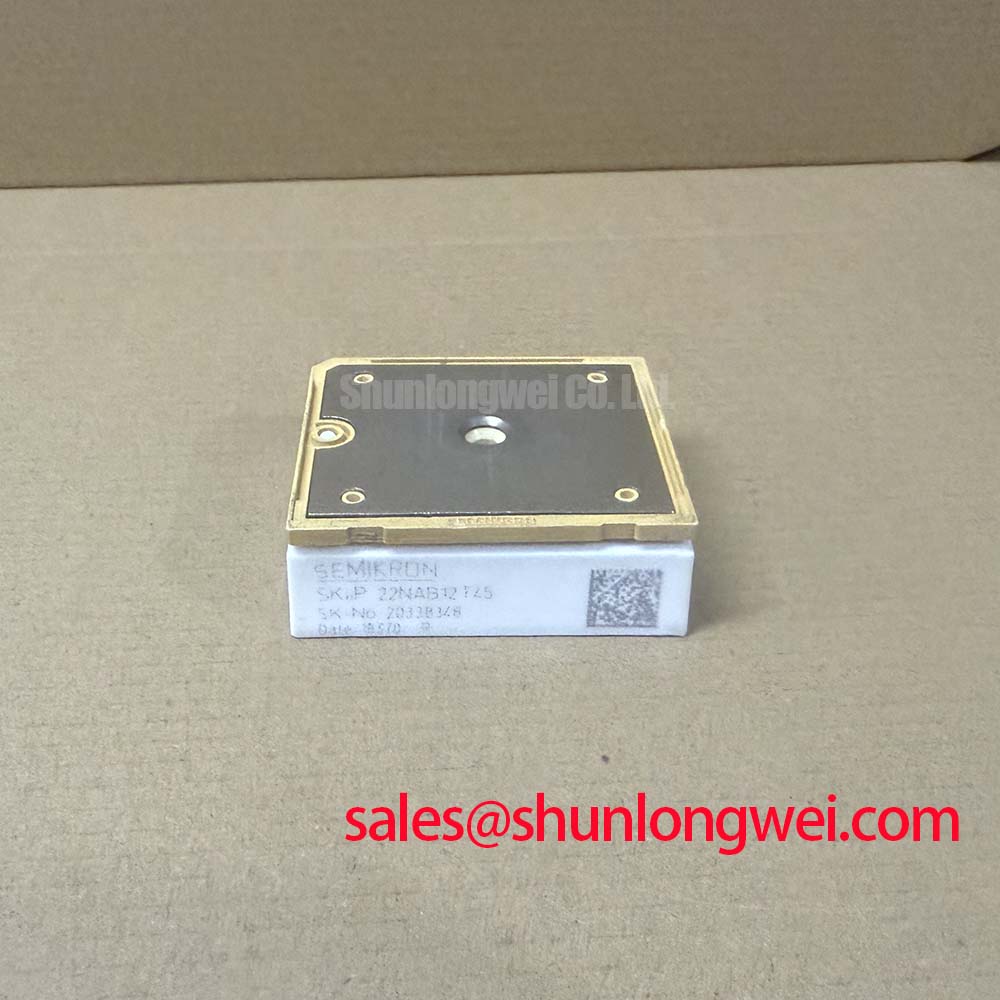
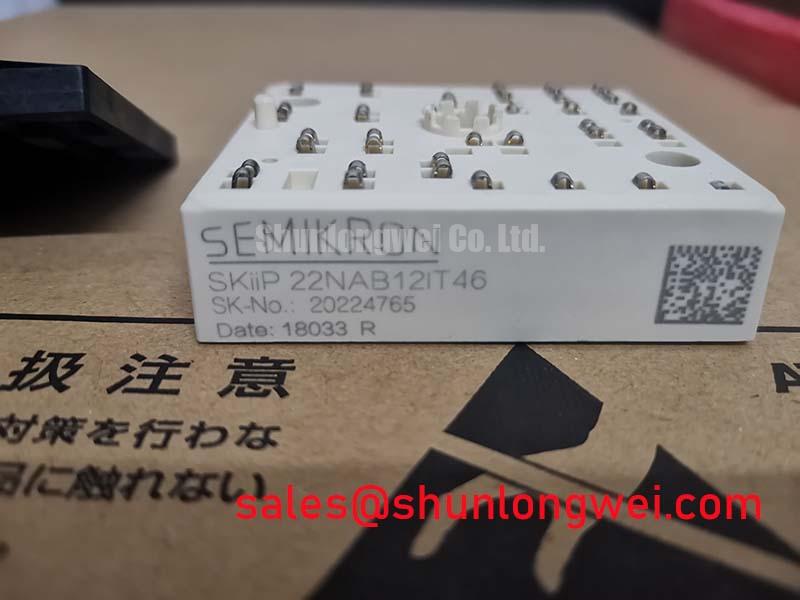
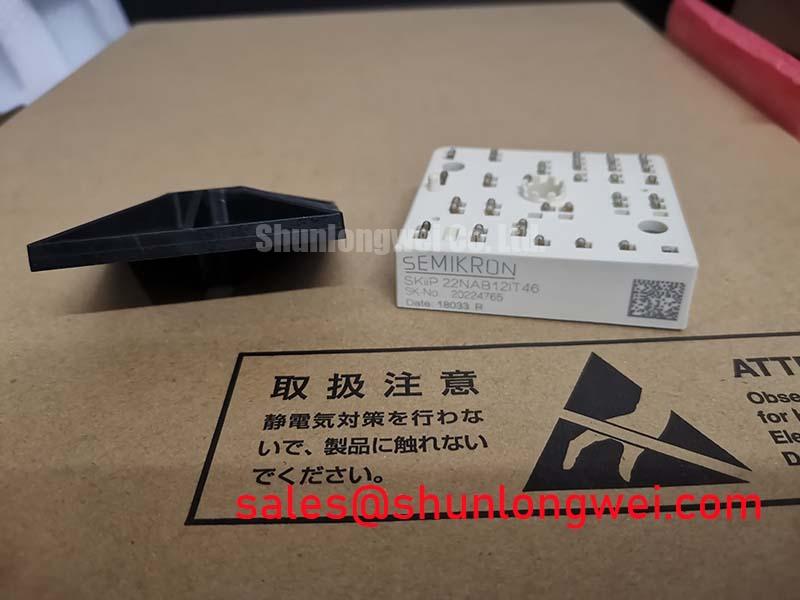
SKIIP 22NAB12IT46 Semikron 1200V 22A MiniSKiiP 2 CIB IGBT Module
Overview & Problem Context
Resolving Space Constraints and Thermal Fatigue in Compact Industrial Inverters
How can power electronics design engineers reduce PCB thermal stress and component count in 400V AC industrial motor drives without compromising long-term reliability? Traditional discrete layouts require separate input rectifiers, braking circuits, and inverter power switches, leading to excessive board real estate usage and increased parasitic inductance. The SKIIP 22NAB12IT46 from Semikron addresses this thermal and mechanical bottleneck by integrating a 3-phase uncontrolled diode rectifier bridge, a brake chopper stage, and a 3-phase inverter bridge into a single MiniSKiiP 2 CIB (Converter-Inverter-Brake) housing.
Engineers seeking high power density benefit from the module's core ratings of 1200V collector-emitter voltage, continuous collector current up to 22A, and low thermal resistance Rth(j-h) of 1.4 K/W per IGBT. Utilizing solderless spring contact connections, the SKIIP 22NAB12IT46 eliminates solder fatigue on gate driver boards while delivering robust thermal cycling performance. This comprehensive layout streamlines inverter drive design by providing an integrated, space-efficient power core. For deeper technical concepts on integrated modules, explore our guide on in-depth analysis of IGBT modules.
Frequently Asked Questions
Engineering Insights on Thermal Interface, Switching Performance, and Spring Contacts
What is the primary benefit of the solderless spring contact interface in the SKIIP 22NAB12IT46?
It eliminates solder joint thermal fatigue and speeds up PCB assembly process. By pressing the driver PCB directly against the spring contacts, mechanical stresses caused by thermal expansion differences between the PCB and the heat sink are completely decoupled.
How does the integrated CIB topology simplify system architecture?
It integrates the input rectifier, braking unit, and 3-phase inverter into one compact package. This significantly reduces board interconnect footprint, minimizes parasitic stray inductance, and simplifies overall bill-of-materials (BOM) management.
How does the Trench 4 IGBT chip technology impact switching losses at 1200V operation?
The Trench 4 IGBT technology features optimized gate-charge kinetics and lower saturation voltage VCE(sat). This design minimizes both conduction losses and switching energy dissipation (Eon + Eoff), allowing higher pulse-width modulation (PWM) switching frequencies with reduced cooling requirements.
What role do CAL freewheeling diodes play in inductive load switching safety?
Semikron Controlled Axial Lifetime (CAL) diodes provide extremely soft turn-off reverse recovery characteristics. This soft-recovery behavior suppresses transient voltage spikes (dv/dt) across the 1200V IGBT switches, lowering electromagnetic interference (EMI) and protecting motor windings from voltage degradation.
Key Parameter Overview
Decoding Specifications for Compact Inverter Integration
| Parameter Symbol | Technical Specification Description | Rated Value / Parameter |
|---|---|---|
| VCES | Collector-Emitter Voltage (Inverter IGBT) | 1200V |
| IC | Continuous Collector Current (Ts = 70°C) | 22A |
| VCE(sat) | Collector-Emitter Saturation Voltage (IC = 15A, Tj = 25°C) | 2.5V (typ) |
| VRRM | Repetitive Peak Reverse Voltage (Rectifier / Freewheeling) | 1200V / 1500V |
| Rth(j-h) | Thermal Resistance Junction-to-Heatsink (per IGBT) | 1.4 K/W |
| Visol | AC Insulation Voltage (1 minute) | 2500V |
| Tj | Operating Junction Temperature Range | -40°C to +175°C |
Technical Deep Dive
Pressure Contact Architecture and Loss Suppression in CIB Topologies
The engineering philosophy behind the SKIIP 22NAB12IT46 revolves around physical integration and pressure-contact thermal efficiency. Standard power modules rely on thick copper baseplates soldered to ceramic substrates, which can suffer from delamination under continuous power cycling. In contrast, Semikron SKiiP® Technology utilizes direct pressure contact to clamp the Direct Copper Bonded (DCB) ceramic substrate directly onto the system heatsink.
To understand the thermal advantage of this pressure structure, consider a highway thermal traffic bottleneck: heat generated inside silicon junctions must flow seamlessly into the cooling structure. Traditional solder layers act like road construction zones, creating thermal bottlenecks over time as microscopic cracks form under thermal expansion stress. The direct pressure assembly in the MiniSKiiP 2 package eliminates this solder layer entirely, keeping thermal resistance low across millions of operating cycles.
Simultaneously, the electrical spring contact system functions like mechanical shock absorbers on a heavy industrial machine. During rapid temperature transitions from full-load motor acceleration, the PCB and power substrate expand at different rates. The spring contacts continuously flex to maintain constant, vibration-proof electrical connection without applying destructive mechanical shear forces onto solder pads. This makes the SKIIP 22NAB12IT46 an exceptional platform for demanding industrial environments operating under tight thermal limits. Learn more about optimizing thermal designs in our guide on thermal management and gate drive design.
Application Scenarios & Value
Optimizing Industrial Motor Drives and Compact Inverter Systems
For 400V industrial VFD designs demanding high power density and reliable solderless assembly, this 1200V CIB module is the optimal choice.
Industrial variable frequency drives (VFDs) powering conveyor systems, pumps, and HVAC machinery frequently endure sudden load variations and severe ambient temperature swings. In a typical 7.5 kW to 11 kW inverter system, space inside the control cabinet is tightly restricted. Integrating input rectification, dynamic braking chopper, and 3-phase output inverter into the compact MiniSKiiP 2 package saves over 40% of internal system volume compared to discrete design approaches. During heavy motor braking, the integrated chopper switch safely dumps regenerative energy into external braking resistors, maintaining stable DC-link voltage levels.
In high-efficiency machinery such as high-efficiency inverter drives, maintaining low electromagnetic noise and steady thermal performance is critical. The soft switching CAL diodes prevent destructive voltage overshoots during high dv/dt commutations, protecting sensitive digital control logic.
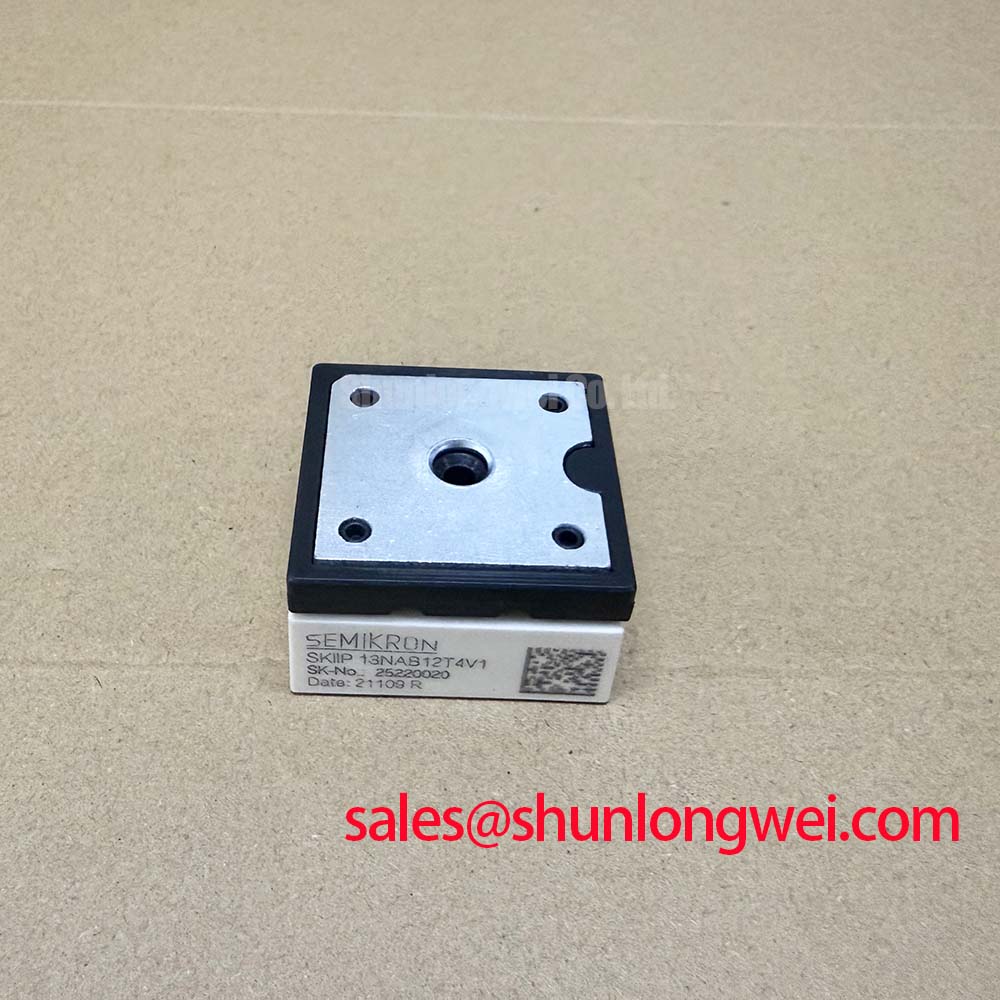
For designs requiring different power ratings within the same physical framework, related offers within the series provide tailored current capacities. For smaller power requirement designs, the related SKiiP 11NAB12T4V1 provides a lower current rating in a matching voltage class. Conversely, for higher current capacity requirements, the related SKIIP32NAB12T49 offers expanded current handling capabilities for larger drive designs.
From a strategic engineering perspective, standardizing on solderless pressure-contact CIB modules streamlines automated assembly lines, eliminates manual soldering errors, and substantially reduces long-term maintenance costs for industrial equipment deployed in field applications.