Content last revised on September 10, 2026
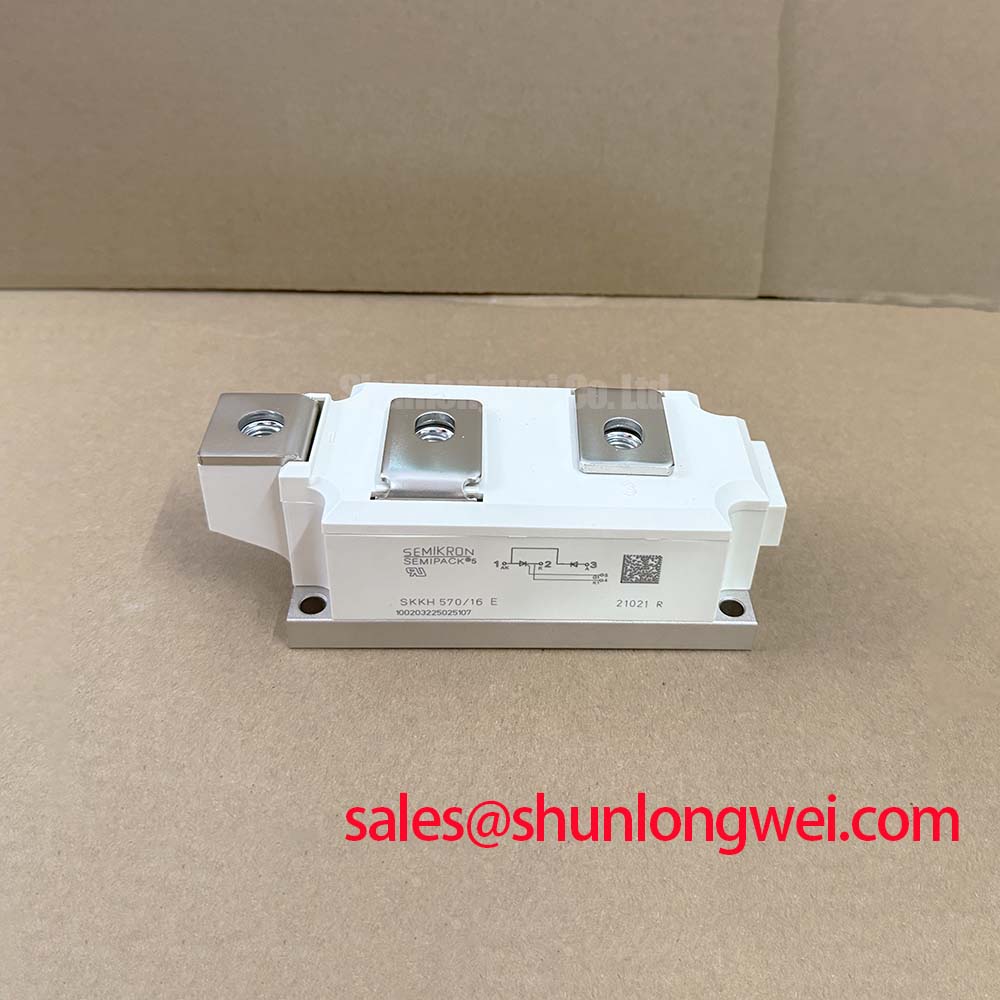
SKKH250/08E Semikron 800V 250A Thyristor/Diode Module
The SKKH250/08E, part of the Semikron SEMIPACK 3 family, is a high-reliability Thyristor/Diode Module designed for phase control and power switching in demanding industrial environments. Utilizing a combination of one thyristor and one diode in a single integrated package, this module provides a robust solution for engineers looking to balance power density with superior thermal cycling performance. What is the primary benefit of its hard-soldered construction? It significantly extends service life by preventing solder fatigue during frequent thermal cycles. For industrial soft starters requiring 800V blocking and high surge robustness, the SKKH250/08E is the industry standard.
Application Scenarios & Value
Achieving System-Level Benefits in High-Inertia Motor Control
Engineers often face the challenge of managing massive inrush currents when starting high-inertia industrial motors. The SKKH250/08E addresses this specifically through its high peak surge forward current (ITSM) of 9100A. This rating acts as a critical structural safety buffer, ensuring that the Thyristor/Diode Module survives the initial 10ms surge without degradation of the silicon junction. In applications such as variable frequency drives (VFDs) and motor soft starters, this robustness reduces the need for oversized protection circuitry, thereby lowering the total cost of ownership (TCO). How does the 9100A surge rating impact design? It provides a massive safety margin for high-inertia motor starts, preventing module failure during initial inrush.
Beyond motor control, this module is frequently integrated into power controllers and AC/DC converters for industrial heating and battery charging. The 800V VDRM/VRRM rating is perfectly suited for 230V to 400V AC line applications, providing sufficient headroom against line voltage transients. For systems requiring even higher voltage handling, the related SKKH250/18E offers a Vces (or blocking voltage) of 1800V. Meanwhile, for lower current requirements, engineers might consider the SKKH106/16E to optimize space and cost. Integrating these modules into a system designed for IEC 61800-3 compliance ensures that electromagnetic compatibility and reliability standards are met in harsh industrial grids.
Technical Deep Dive
A Closer Look at the SEMIPACK 3 Pressure-Contact Reliability
The internal architecture of the SKKH250/08E utilizes an aluminum oxide ceramic isolated metal baseplate. This design ensures an isolation voltage of 3000V AC, allowing multiple modules to be mounted on a single common heatsink without the risk of electrical short circuits. A defining technical feature is the use of hard soldered joints. Unlike traditional soft-soldered modules that are prone to aging and "solder creep" under high thermal stress, the hard-soldered construction in this Thyristor/Diode Module offers vastly improved power cycling capability. This is critical for applications involving frequent start-stop cycles, as it prevents the mechanical delamination of layers that typically leads to catastrophic failure.
Furthermore, the Rth(j-c) (thermal resistance junction-to-case) is maintained at a low 0.11 K/W per thyristor. Think of thermal resistance like a highway bottleneck; a lower value means heat can "drive" away from the sensitive silicon junction at a much higher speed, allowing the module to maintain its 250A current rating at a case temperature of 85°C. This efficiency allows for more compact heatsink designs, which is a significant advantage in the development of modern, high-efficiency power systems as discussed in our guide to power modules. Understanding these thermal dynamics is essential for ensuring long-term reliability in power electronics.
Key Parameter Overview
Decoding the Specs for Enhanced Thermal Reliability
| Parameter | Official Value | Engineering Interpretation |
|---|---|---|
| VDRM / VRRM | 800V | Maximum repetitive peak voltage. Suitable for 400V AC grid transients. |
| IT(AV) | 250A | Average on-state current at Tc = 85°C; defines continuous workload capacity. |
| ITSM | 9100A | 10ms peak surge current; critical for surviving motor startup or short-circuits. |
| Rth(j-c) | 0.11 K/W | Indicates how efficiently the module sheds heat to the heatsink. |
| Visol | 3000V AC | Isolation between the baseplate and terminals, ensuring safe chassis mounting. |
Download the SKKH250/08E datasheet for detailed specifications and performance curves from the Semikron official technical repository.
FAQ
How does the ITSM of 9100A specifically benefit motor drive designs?
The 9100A ITSM (surge current) allows the module to withstand the initial 6-8x current spikes common in motor starts without overheating the silicon. This reduces the reliance on fast-acting fuses for protection against transient overloads, allowing for a more rugged system design.
What is the significance of the 800V VDRM for 400V AC applications?
While 400V is the nominal RMS voltage, peak voltages reach 565V. An 800V VDRM provides a safety margin against voltage spikes and surges commonly found in industrial environments, ensuring the Thyristor/Diode Module does not enter breakdown during normal fluctuations.
Why does the SKKH250/08E use a hard-solder joint instead of soft-solder?
Hard-soldering is utilized to maximize power cycling capability. It prevents the formation of intermetallic compounds and cracks that occur in soft-soldered joints under repeated thermal expansion, making it ideal for 24/7 industrial operations.
Can I mount multiple SKKH250/08E modules on the same heatsink?
Yes. Thanks to the 3000V AC isolation voltage provided by the internal ceramic baseplate, the module terminals are electrically isolated from the metal base, allowing safe, shared mounting on a single grounded heatsink.
How does the Rth(j-c) of 0.11 K/W affect heatsink selection?
A low Rth(j-c) of 0.11 K/W means the module transfers heat very effectively. For the designer, this translates to either a smaller heatsink requirement for a given power level or a higher current overhead if using a standard-sized cooling solution.
For further technical insights into power semiconductors and their roles in industrial reliability, consult our comprehensive resource library.