Content last revised on September 10, 2026
SKKH56/12D Semikron 1200V 56A Thyristor/Diode Module
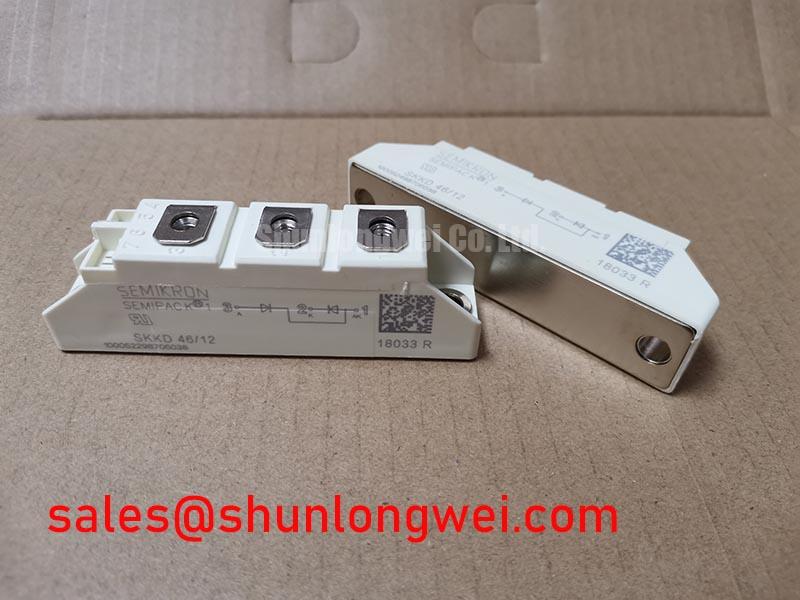
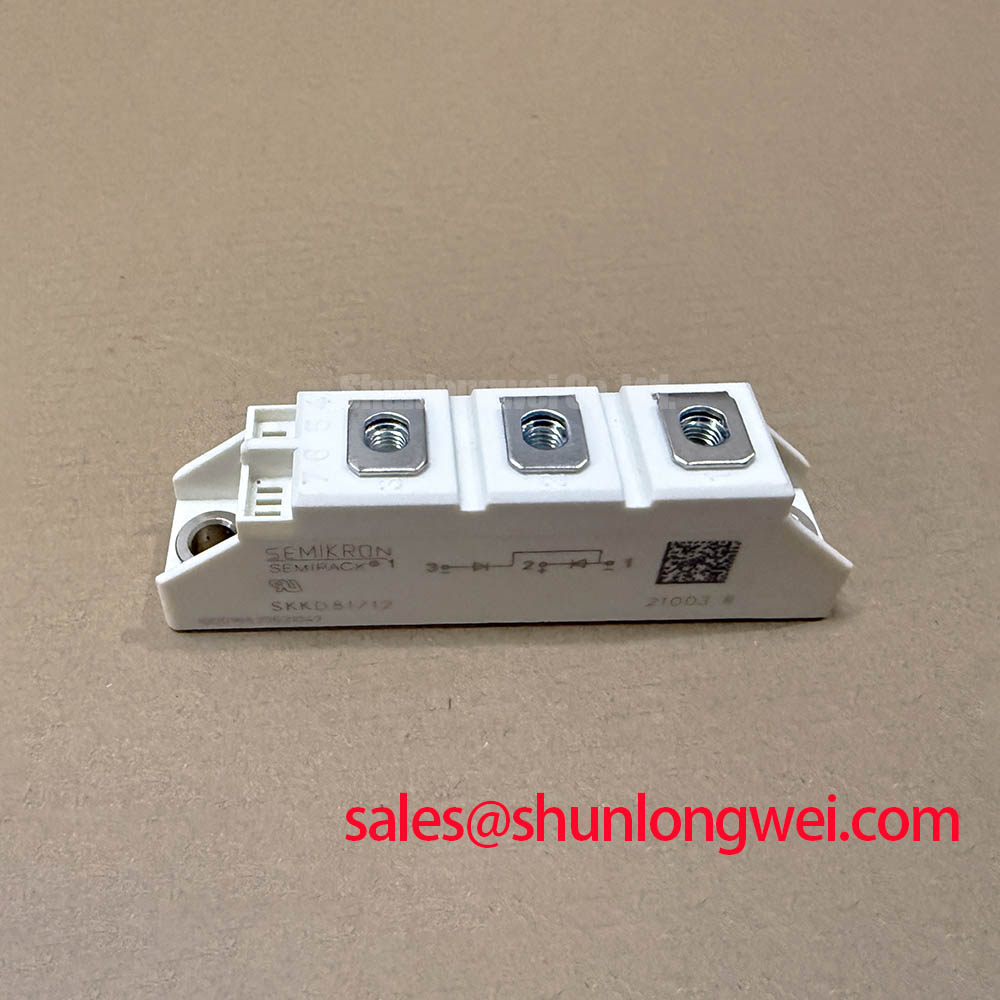
The SKKH56/12D is a high-performance Thyristor/Diode Module from Semikron, part of the SEMIPACK 1 family, specifically engineered for phase control and industrial AC power switching. This module integrates one thyristor and one diode into a single, compact housing, offering a robust solution for power density and thermal reliability. Its primary value lies in its hard-soldered joints, which significantly enhance thermal cycling capability and long-term mechanical stability in demanding industrial environments.
Top Specs: 1200V | 56A (at Tc = 85°C) | Rth(j-c) 0.55 K/W
Key Benefits: Superior thermal cycling endurance and simplified mechanical integration for heat sinks.
What is the primary benefit of the hard-soldered design in the SKKH56/12D? It ensures consistent electrical contact and heat dissipation under repeated thermal stress. For industrial motor soft starters prioritizing thermal margin in 400V to 440V networks, this 1200V module is the optimal choice.
Key Parameter Overview
Decoding the Specs for Enhanced Thermal Reliability
To support engineering decisions, the following technical data is extracted directly from the official Semikron documentation. These values represent the operational limits and performance characteristics of the SKKH56/12D.
| Symbol | Parameter Description | Value (Unit) |
|---|---|---|
| V_RRM / V_DRM | Repetitive Peak Reverse/Off-state Voltage | 1200V |
| I_T(AV) | Average On-state Current (Tc = 85°C) | 56A |
| I_RMS | RMS On-state Current | 90A |
| I_TSM | Surge On-state Current (10ms, 25°C) | 1500A |
| I2t | I2t value for fusing (10ms, 25°C) | 11250 A²s |
| (dv/dt)cr | Critical Rate of Rise of Off-state Voltage | 1000 V/µs |
| Rth(j-c) | Thermal Resistance Junction to Case (Thyristor) | 0.55 K/W |
Download the SKKH56/12D datasheet for detailed specifications and performance curves.
Application Scenarios & Value
Achieving System-Level Benefits in High-Power Industrial Conversion
The SKKH56/12D is widely utilized in Variable Frequency Drives (VFD) and soft starters, where robust phase control is essential for managing inductive loads. Its 1200V rating provides a critical safety buffer for 400V AC line voltages, effectively handling transient spikes commonly found in heavy machinery environments. Engineers often face the challenge of voltage surges during motor startup; the high I_TSM of 1500A allows this module to absorb significant peak currents without degradation.
In power supply designs, such as battery chargers or UPS systems, the SEMIPACK 1 footprint allows for high power density. For systems requiring even greater current handling, the related SKKH106/16E offers a similar topology with a higher I_T(AV) rating. Reliability in these scenarios is often a function of thermal management. To ensure long-term field stability, designers should consult resources on ensuring power module reliability to prevent common failure modes related to overtemperature.
Technical Deep Dive
Engineering for Extremes: The Value of High Surge Current Capability
A critical differentiator for the SKKH56/12D is its surge handling capability. The I_TSM rating of 1500A is not just a safety figure; it represents the module's ability to survive catastrophic system events, such as short circuits or extreme load imbalances, before protective fuses can blow. This is particularly vital in IEC 61800-3 compliant motor drives where system uptime is paramount.
Think of the I2t rating of 11250 A²s as the module's "thermal shock absorber." Just as a vehicle’s suspension absorbs a pothole's impact to protect the chassis, the high I2t allows the silicon die to absorb energy spikes without reaching the critical junction temperature that leads to thermal runaway. For field engineers, understanding the health of these modules is vital. Utilizing a practical guide to testing power modules can help diagnose whether a module has been stressed near its limits during commissioning or maintenance.
Frequently Asked Questions
What makes the SEMIPACK 1 housing suitable for the SKKH56/12D in high-vibration applications?
The SEMIPACK 1 package uses an insulated metal baseplate and hard-soldered internal connections. This design minimizes mechanical fatigue compared to spring-contact or purely pressure-contact modules, making it exceptionally reliable in industrial equipment subject to constant mechanical stress.
How does the Rth(j-c) of 0.55 K/W impact heat sink selection for the SKKH56/12D?
The 0.55 K/W thermal resistance determines how efficiently heat moves from the junction to the case. A lower resistance allows for smaller heat sinks or higher ambient operating temperatures. When designing the cooling system, engineers must account for the sum of Rth(j-c) and Rth(c-s) to keep the junction temperature below the 125°C limit.
Can the SKKH56/12D handle line voltages higher than 480V AC?
While the repetitive peak voltage V_RRM is 1200V, it is industry practice to maintain a safety margin. For 480V AC lines, 1200V is standard. However, for 690V AC lines, the peak voltage often exceeds 1000V, leaving insufficient margin for transients; in such cases, a higher voltage-rated module would be necessary for system safety.
From a strategic procurement and engineering perspective, selecting the SKKH56/12D is a decision to prioritize established reliability over experimental form factors. As the industry moves toward higher efficiency and tighter integration, the SEMIPACK standard remains a cornerstone due to its predictable thermal performance and widespread ecosystem support. Integrating these modules requires a holistic view of the power stage, balancing current capacity with robust protection circuitry to ensure a 10-year+ service life in the field.