Content last revised on September 23, 2026
Assembly Integrity & Layout Architecture: High di/dt Rectifier Replacement Considerations for VBO13-08NO2
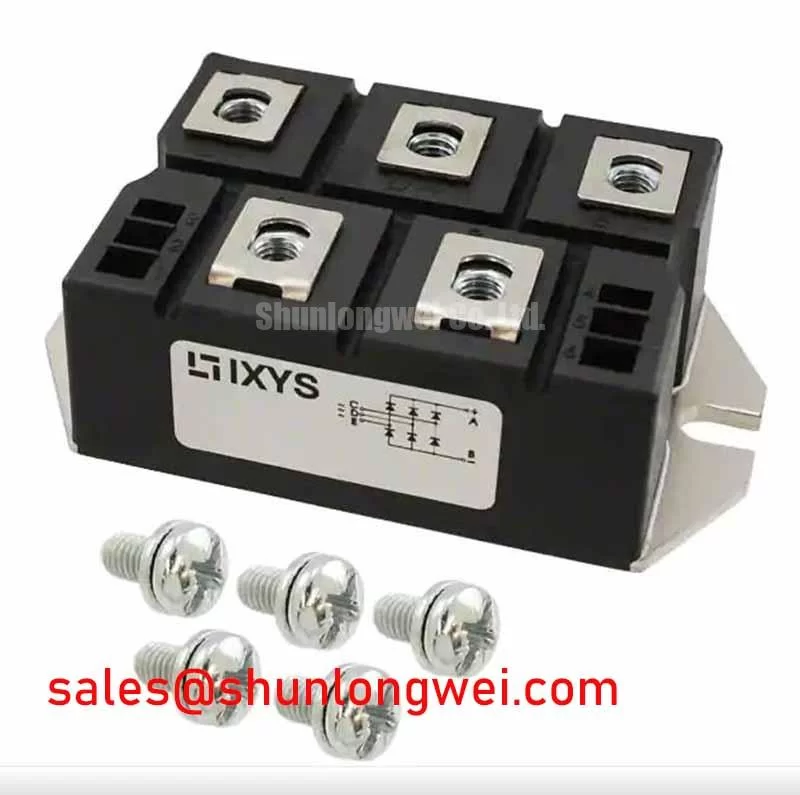
Before reconnecting the rectifier assembly, isolate the DC bus, inspect the module body and terminals for heat discoloration or cracked insulation, then verify that the installed nameplate reads VBO13-08NO2. This IXYS unit is identified as a Bridge Rectifier Module with an official voltage rating of 800.0 V and an official current rating of 13.0 A.
| Parameter | Official Specification |
|---|---|
| Manufacturer | IXYS |
| Product type | Bridge Rectifier Module |
| Rated voltage | 800.0 V |
| Rated current | 13.0 A |
| Package | Module |
Gate firing pulse rise time, holding current, and pulse train triggering are controls associated with thyristors and other gated power devices. They are not control requirements for a diode bridge rectifier module. The VBO13-08NO2 has no gate firing function stated in the supplied official product information. If an induction heating power supply drawing shows gate drive wiring at the same rectifier location, maintenance personnel should verify whether the original assembly includes separate controlled rectifiers, thyristor modules, or driver boards that must be serviced independently.
For rectifier replacement work, terminal identity should be confirmed directly against the equipment schematic and module marking before any conductor is moved. AC input conductors and DC output conductors serve different circuit functions, and an incorrect reconnection can create an immediate short circuit or leave the DC link without the expected polarity. Inspect terminal lugs for fretting, oxidation, looseness, or insulation damage, then check that cable routing does not transfer mechanical stress into the module terminals.
⚠️ Maintenance Note: After returning the equipment to service, monitor terminal contact temperature and verify that cooling airflow remains unobstructed during normal load operation.
Fuse coordination is a Design Consideration rather than an official VBO13-08NO2 parameter provided here. The fuse selection must be checked against the furnace power supply documentation, expected inrush conditions, conductor rating, fault clearing capability, and the protection coordination record for the installed system. No fuse I²t value should be assigned to this module without the applicable manufacturer documentation and system level fault study.
VBO13-08NO2 Circuit Protection & Reliability: Assessing Reverse-Recovery Behavior with Temperature
A bridge rectifier transfers energy through its diode paths, so commutation behavior can influence switching stress elsewhere in a power conversion assembly. In a medium frequency induction melting or hardening furnace supply, the rectifier may feed a DC link that is subsequently switched by a separate inverter stage. Any switching waveform assessment should therefore distinguish between the rectifier module and the inverter devices that create the high frequency power output.
The supplied official data identifies the 800.0 V and 13.0 A ratings, but does not provide reverse recovery charge, reverse recovery peak current, recovery time, softness factor, thermal resistance, or transient thermal impedance values. These characteristics must not be assumed from a similar IXYS family member. Where commutation loss or conducted noise is under investigation, engineers should obtain the applicable original module datasheet and observe the installed circuit with suitable isolated measurement methods.
As a Design Consideration, temperature can alter diode switching behavior and conduction loss. A waveform that appears stable at one operating temperature can change as cabinet temperature, heatsink condition, airflow, or load duty changes. Instead of attributing noise or repeated fuse operation to one cause, inspect the DC bus waveform, AC supply balance, connection quality, and inverter switching behavior against a known healthy system path where available.
In single-phase power conversion stages, understanding standard diode bridge rectifier topologies is fundamental for assessing forward conduction losses, ripple factor, and peak inverse voltage (PIV) ratings under steady-state operation.
When maintenance records indicate repeated rectifier stress, check the condition of surge suppression parts, DC link capacitors, busbar insulation, and cooling surfaces without assuming that the bridge itself is the initiating fault. A deteriorated capacitor bank, poor AC connection, or abnormal inverter load can each change the stress seen by the rectifier stage.
Preventing Spurious Faults: Inrush and Current-Rise Limiting Guidelines for VBO13-08NO2
The VBO13-08NO2 does not have a gate terminal, so spurious dv/dt turn on is not an applicable gate control failure mode for this bridge rectifier module. The relevant maintenance question is whether external circuit transients, inrush current, commutation conditions, or incorrect wiring are forcing the diode bridge beyond the conditions intended by the equipment designer.
RC snubbers, saturable reactors, precharge circuits, and surge protection devices are system components whose values and placement are determined by the complete power topology. An Engineering Recommendation is to preserve the original circuit arrangement unless the responsible system engineer has verified changes through switching tests, peak voltage measurement, thermal checks, and protection coordination review. Adding a snubber or changing a reactor without that verification can move stress to another part of the supply.
During fault investigation, begin with deenergized continuity checks of the bridge paths according to the equipment service procedure, followed by inspection of upstream fuses and downstream DC link connections. A result that differs from the expected bridge conduction pattern may indicate an internal fault or an external parallel path. Disconnecting associated circuitry as specified by the service documentation can help separate those possibilities without relying on unsupported diode drop thresholds.
For material planning, SKD82/18 can be reviewed as a separate power semiconductor option, but electrical topology, terminal arrangement, thermal interface, voltage rating, current rating, and equipment approval requirements must be compared before any replacement decision. It should not be treated as a direct substitute for the VBO13-08NO2 solely because both parts are used in power conversion environments.
Where an upstream rectification stage is being reviewed as part of the same service event, SKD 25/14 is another separately specified module that may be relevant for comparison with the documented system topology. The original schematic remains the controlling reference for component function and connection order.
Transient Dynamics & Electrical Design: Ensuring Uniform Heatsink Contact Pressure on VBO13-08NO2
Before reinstalling the module, clean the mating cooling surface and inspect it for debris, corrosion, burrs, or flatness damage that could prevent uniform contact. The supplied product information identifies the enclosure only as a Module; it does not provide an official baseplate construction, mounting torque, thermal resistance, transient thermal impedance curve, or thermal interface material thickness. Those details must be verified from the original IXYS documentation and the equipment mechanical drawing.
A Design Consideration for any power module mounted to a heatsink is to distribute clamping force evenly according to the approved mechanical sequence. Uneven fastening can reduce thermal contact in part of the interface or mechanically distort the package. Use only the fastener type, torque procedure, and thermal interface material specified for the original assembly. Do not apply a generic mounting torque as if it were an official requirement for VBO13-08NO2.
Thermal paste condition deserves routine attention in equipment exposed to repetitive heating cycles, airborne dust, humidity, or condensation risk. Old compound can dry, migrate, or become contaminated, while blocked fins and fan degradation can raise heatsink temperature. During planned maintenance, inspect the cooling path, replace degraded interface material in accordance with the service procedure, and confirm that enclosure seals and drainage arrangements suit the local operating environment.
Transient thermal impedance and peak junction temperature margin cannot be calculated from the supplied data because no official thermal curves or maximum junction temperature values are provided. When the module is used in a rectifier stage feeding an induction heating inverter, the system engineer should verify actual case temperature, heatsink performance, AC input condition, DC link behavior, and duty cycle under the intended operating load.
For a broader discussion of how modular power architectures affect efficiency and service planning, see The Race for Efficiency. Its system level discussion should not be interpreted as a substitute for the VBO13-08NO2 product documentation or the furnace manufacturer’s maintenance instructions.