
Content last revised on April 25, 2026
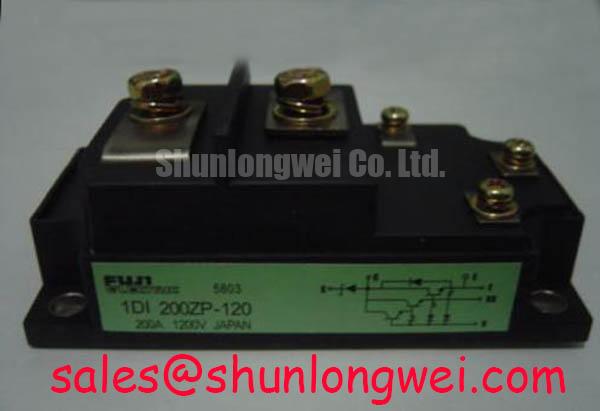
1DI200ZP-120 Fuji Electric: 1200V 200A Darlington Power Module Analysis
Delivers robust 1200V high-current switching, ensuring exceptional fault tolerance for heavy-duty industrial inverters and legacy motor drives. Key specifications include a 1200V V(BR)CEO, a 200A I(C) continuous current rating, and a highly reliable single Darlington configuration. This component offers high surge tolerance and a predictable base drive mechanism. With its 1200V rating, it provides substantial voltage headroom, making it a reliable direct replacement for legacy 400V-480V industrial motor drives. What is the primary advantage of its Darlington configuration? It provides high current gain, enabling robust switching for heavy industrial loads without complex gate drivers. For industrial inverters prioritizing ruggedness under high thermal stress, this 1200V module is the optimal choice.
Application Scenarios & Value
Mastering High-Inertia Loads in Industrial Drives
For industrial inverters prioritizing ruggedness under high thermal stress, this 1200V module is the optimal choice. Engineers often face critical challenges when dealing with high-inertia industrial loads, such as massive conveyor belts or heavy-duty pumps. During motor startup, the inrush current can easily exceed steady-state parameters, threatening delicate silicon structures. The 1DI200ZP-120, a rugged Darlington BJT Power Module, is specifically designed to absorb these brutal overcurrent conditions. Its 200A I(C) rating provides the raw current-carrying capacity necessary to ride through heavy induction motor startups without catastrophic failure.
Furthermore, in environments struggling with unstable power grids, the module's 1200V V(BR)CEO acts as a critical buffer against voltage transients, securing the system's operational continuity. This makes it highly prevalent in legacy UPS systems and heavy-duty VFD designs striving for strict IEC 61800-3 compliance regarding immunity. While this model perfectly handles robust 200A requirements, for systems requiring higher current handling with newer topologies, the related 1MBI300SA-120B offers a 300A capability.
Intra-Series Comparison & Positioning
Evaluating the GTR Advantage in High-Inertia Environments
While the power electronics industry has largely shifted toward Insulated Gate Bipolar Transistors (IGBTs) for high-frequency switching, the Fuji Electric Giant Transistor (GTR) architecture in the 1DI200ZP-120 holds distinct structural advantages for specific operating regimes. Modern IGBTs prioritize ultra-fast switching, which is excellent for efficiency but can introduce severe dv/dt stress on motor windings. In contrast, the Darlington configuration inherently switches at a more deliberate pace.
Think of a modern IGBT as a high-performance sports car—fast, efficient, but sensitive to extreme terrain. This Darlington module is like a heavy-duty diesel truck—built to pull massive, high-inertia loads without faltering under pressure. The slower turn-on and turn-off times naturally suppress high-frequency electromagnetic interference (EMI), easing the path to system-level EMC compliance.
Additionally, driving a BJT module relies on current rather than voltage. Its base drive requirement is akin to a mechanical lever—simple, predictable, and completely immune to the high-frequency parasitic gate oscillations that sometimes plague voltage-driven devices in noisy industrial cabinets. This predictable saturation characteristic ensures extreme ruggedness during prolonged overload conditions. For broader insights into managing these thermal and electrical parameters, consult this practical guide to voltage, current, and thermal management.
Key Parameter Overview
Decoding the Specs for Enhanced System Reliability
The following table outlines the foundational specifications of the 1DI200ZP-120, mapped directly to their system-level engineering value.
| Parameter | Value | Engineering Value |
|---|---|---|
| V(BR)CEO (Collector-Emitter Voltage) | 1200V | Provides substantial margin for 400V/480V AC line applications, easily absorbing inductive voltage spikes and grid transients. |
| I(C) (Continuous Collector Current) | 200A | Sustains heavy continuous loads, ensuring stable operation for high-torque industrial motor drives. |
| Configuration | 1-Pack (Single Darlington) | Offers maximum PCB layout flexibility, allowing engineers to physically separate phases to optimize thermal dissipation. |
| Technology | Darlington BJT (GTR) | Delivers extremely high current gain with robust forward voltage characteristics, ideal for low-frequency, high-power switching. |
Frequently Asked Questions
Addressing Critical Design Considerations
- What is the primary difference between the 1DI200ZP-120 Darlington module and a modern IGBT?
The 1DI200ZP-120 is a current-controlled Bipolar Junction Transistor (Darlington configuration), whereas an IGBT is voltage-controlled. The Darlington module provides exceptional ruggedness and natural EMI suppression due to softer switching, making it ideal for legacy drives and high-inertia loads. - How does the 1200V rating benefit 480V AC industrial systems?
In a 480V AC system, the peak rectified DC bus voltage sits around 680V. The 1200V rating provides a nearly 2x safety margin, protecting the silicon from destructive back-EMF and switching transients generated by heavy inductive loads. - What makes this module suitable for high-surge industrial applications?
Its large silicon die area and inherent bipolar conduction characteristics allow it to tolerate massive short-term overcurrents without localized thermal runaway, which is crucial for clearing motor start-up hurdles. - Can this single-pack module be paralleled for higher current requirements?
While possible, paralleling BJT modules requires careful matching of current gain and forward voltage drop to prevent current hogging. Adequate emitter balancing resistors are strongly recommended by field engineers. - How should the thermal management be approached for this 200A module?
Due to the slightly higher switching losses associated with BJT technology at frequency, prioritizing a heatsink with low thermal resistance and applying high-quality thermal interface material (TIM) is critical. Ultimately, mastering the thermal and drive parameters of this robust module allows engineers to extend the operational life of heavy industrial infrastructure indefinitely.