Content last revised on September 10, 2026
7MBP150VDA060-50 Fuji Electric IPM: Revolutionizing System Integration for 600V Motor Drives
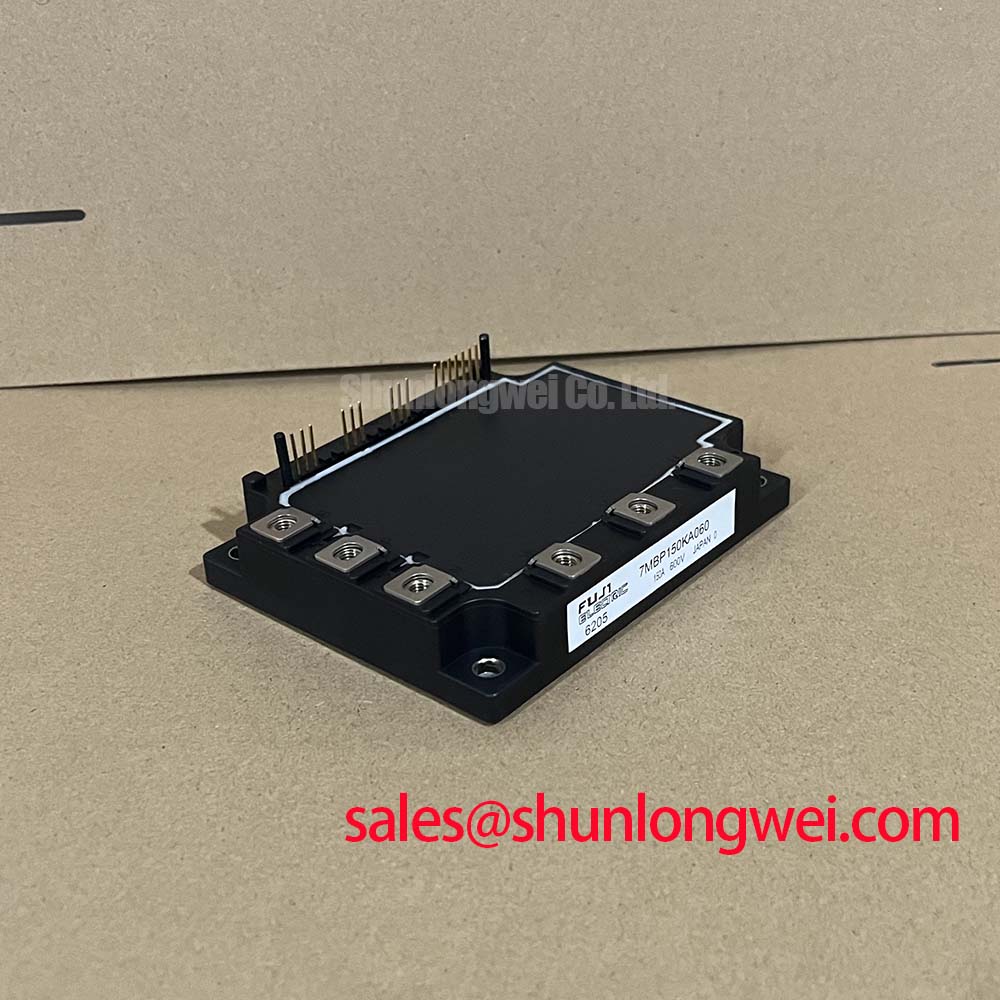
The 7MBP150VDA060-50 Intelligent Power Module simplifies 600V motor drive designs by integrating high-efficiency IGBTs with precision gate control and comprehensive fault protection. Featuring a 600V VCE, 150A current rating, and a 7-pack configuration with an integrated brake chopper, this Fuji Electric V-Series module eliminates the need for complex external gate drivers. It drastically reduces PCB footprint while preventing thermal runaway through direct junction temperature sensing. By addressing the challenge of parasitic inductance found in discrete designs, this module ensures cleaner switching. For 600V servo systems prioritizing rapid deployment and footprint reduction, this 150A module is the optimal choice.
Key Parameter Overview
Decoding the Specs for Integrated Drive Reliability
| Functional Group | Parameter | Value / Description |
|---|---|---|
| Power Characteristics | Collector-Emitter Voltage (VCE) | 600V |
| Continuous Collector Current (IC) | 150A | |
| Topology | 7-Pack (3-Phase Inverter + Brake Chopper) | |
| Control & Protection | Overcurrent Protection (OC) | Built-in (Self-shutdown) |
| Over-Temperature Protection (TjOH) | Direct IGBT Junction Sensing | |
| Under-Voltage Protection (UV) | Built-in Control Supply Monitoring | |
| Fault Reporting | Independent P-side & N-side Alarm Outputs |
Download the 7MBP150VDA060-50 datasheet for detailed specifications and performance curves.
Application Scenarios & Value
Achieving System-Level Benefits in High-Frequency Motor Control
Engineers often face the challenge of managing overvoltage spikes and EMI in compact Variable Frequency Drives (VFDs). In high-stress industrial conveyor systems, motor starting surges demand robust silicon. The 7MBP150VDA060-50 solves this by integrating the gate drive directly adjacent to the IGBT chip, minimizing gate loop inductance. When handling severe deceleration, the built-in dynamic braking circuit safely dissipates regenerative energy without requiring an external chopper component.
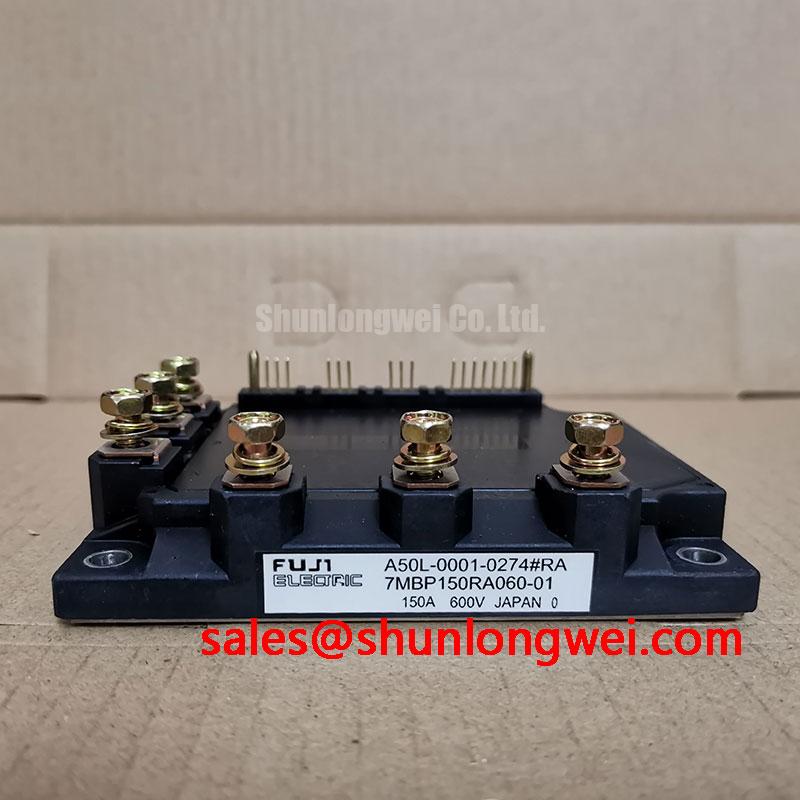
This integrated protection functions much like a localized immune system, detecting anomalies such as short circuits and executing a safe shutdown before catastrophic failure can propagate across the power stage. If your design requires a legacy alternative, the related 7MBP150RA060 offers similar 600V/150A capabilities for earlier generation systems, while systems scaling to higher line voltages might consider the PM150CVA120. Understanding these options is critical when evaluating IPM vs discrete IGBT architectures.
Technical Deep Dive
A Closer Look at Direct Junction Temperature Sensing
What is the primary advantage of its thermal design? It utilizes direct junction temperature sensing for instantaneous protection. Traditional modules monitor the baseplate temperature via an NTC thermistor, which inherently involves a thermal lag due to the physical distance from the semiconductor die. The 7MBP150VDA060-50 integrates a temperature sensing element directly on the active IGBT chip itself. This is akin to placing a thermometer directly on a patient's heart rather than guessing their core temperature by touching their skin.
This instantaneous feedback allows the internal control IC to execute an over-temperature (TjOH) shutdown immediately during a stalled rotor event. Furthermore, the internal sensing elements provide discrete P-side and N-side fault alarm outputs, accelerating diagnostic routines. For field engineers, testing an IGBT module that features internal intelligence requires specific procedures compared to standard components, as the built-in control circuitry alters traditional pin-to-pin resistance readings.
Frequently Asked Questions
Addressing Common Field Engineering Inquiries
- How does the integrated gate drive of the 7MBP150VDA060-50 improve switching efficiency?
By locating the driver circuit in the same package as the silicon, the module minimizes parasitic gate loop inductance. This ensures optimized turn-on and turn-off dv/dt rates, enabling soft switching that mitigates both power dissipation and electromagnetic interference. - Why is the separated P-side and N-side fault alarm critical for system diagnostics?
Providing independent alarms allows the host controller to immediately determine whether an under-voltage or overcurrent event occurred on the high side or low side of the inverter bridge. This granularity significantly reduces troubleshooting time in automated factory environments.
Contact our technical sales team today to check availability, request a datasheet, or discuss how this Intelligent Power Module can streamline your next motor drive design.