


Content last revised on September 12, 2026
Shielded FFC and FPC Flat Flexible Cable Grounding across 360 Degree Connector Shells
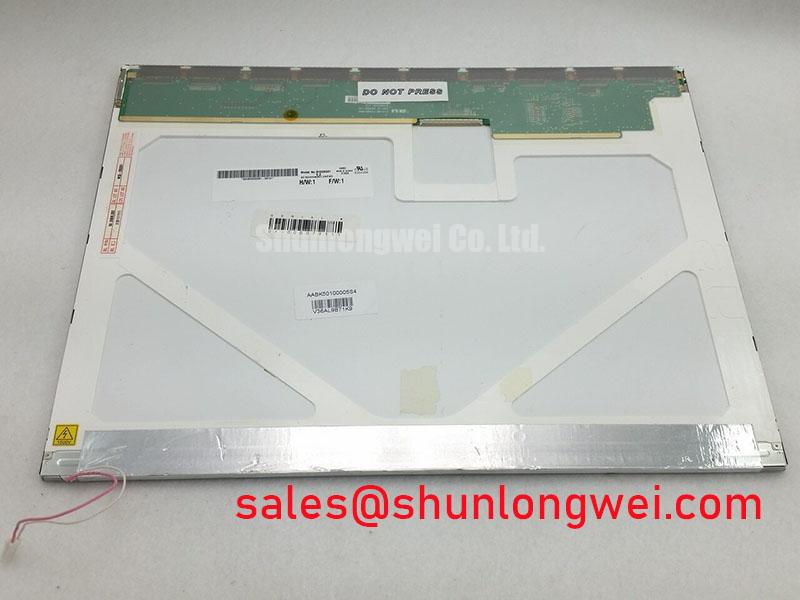
| Model | B150XG01 V2 |
| Manufacturer | AUO |
| Product Category | Industrial Grade LCD and HMI Panel |
| Display Construction | TFT LCD Active Matrix Color Display Module |
| Specification Status | Basic Identity Verified from Supplied Factory Information |
With the equipment isolated from power, inspect the B150XG01 V2 display cable at both connector ends for an unlocked latch, uneven insertion depth, folded contact fingers, or a damaged shield termination before investigating the panel itself. Horizontal noise bands, intermittent pixel movement, and image instability can originate in the signal path when a display cable crosses a cabinet containing variable frequency motor drives, switching power supplies, or other high energy electrical equipment.
The B150XG01 V2 AUO TFT LCD Active Matrix Color Display Module should be treated as part of a complete display assembly rather than as an isolated optical part. Cable routing, enclosure grounding, controller board condition, and power rail behavior all influence the visible result. A 360 degree cable shield connection is a Design Consideration for systems using shielded flex or LVDS harnesses. The practical objective is to provide a continuous low impedance path from the cable shield to the intended enclosure ground reference, subject to the equipment grounding architecture.
Where common mode interference is suspected, first compare the fault with the cable positioned away from motor leads and inverter output conductors. If the image becomes stable after rerouting, the observation supports further investigation of coupling paths rather than an immediate panel replacement decision. A ferrite installed around a cable is also a Design Consideration, not an official B150XG01 V2 requirement. Its material, location, and effectiveness depend on the measured noise spectrum and the complete cabinet layout.
Inspect flat flexible cable bend areas closely. Repeated folding at the same point can weaken conductors or change contact pressure at the connector, particularly when the display assembly is opened frequently during service. Keep the bend path broad, avoid sharp folds near the contact tail, and secure the cable so vibration does not transfer directly into the connector latch.
⚡ Field Alert: Disconnect system power and allow stored supply energy to discharge before releasing or reconnecting a display cable, because signal pins can be exposed to unintended voltage differentials during live handling.
Cold ambient conditions require a separate observation. Liquid crystal response can slow as temperature falls, creating visible trailing, delayed transitions, or temporary tonal changes that are not necessarily caused by the panel interface. For evaluation around minus 20 to minus 30 degrees Celsius, observe a known stable test image after the enclosure reaches thermal equilibrium. Heater strip control, if used by the host equipment, remains a system level Design Consideration; its placement, supply method, sensing method, and enable logic must be verified against the original display assembly documentation.
For broader service references on panel interfaces, thermal behavior, and industrial display selection factors, consult The Ultimate Guide to Industrial TFT LCD Technology. This reference supports the inspection workflow but does not replace the original interface documentation for this exact AUO panel.
Controlled 100 Ohm Differential Impedance Flex Routing to Suppress High Frequency Jitter
Probe the panel supply rail and display data path at the controller connector while the split screen or white screen symptom is present, then compare the capture with a known stable machine where possible. A display that powers but shows duplicated image areas, color displacement, or unstable vertical content can point to timing, mapping, or signal integrity issues upstream of the LCD module.
The B150XG01 V2 factory information supplied here confirms its identity as an AUO industrial grade TFT LCD and HMI panel, but it does not establish a specific logic supply voltage, pinout, resolution, interface connector, or data mapping mode. The system integrator should verify the required supply voltage from the original panel documentation. Do not select between 3.3 V and 5.0 V logic assumptions from appearance, connector size, or a similarly named panel revision.
A controlled 100 ohm differential route is a Design Consideration where the confirmed host interface uses differential display signaling. The principle is to maintain pair consistency and minimize discontinuities that can distort the received waveform. Connector adapters, folded flex sections, unshielded extensions, poorly grounded transition boards, and damaged cable conductors can all affect the signal path. The controller board, cable assembly, and panel input must be evaluated as one channel.
Power sequencing also deserves direct observation. Use an oscilloscope to inspect whether the logic rail rises cleanly, remains stable during backlight startup, and falls in a controlled manner during shutdown. A host design may specify a particular supply-rail rise-time range, but no such range is verified as an official B150XG01 V2 specification in the available factory information. White screen behavior, retained image fragments, or a delayed recovery after restart may require examination of controller reset timing, panel enable timing, and the host supply regulation path.
JEIDA and VESA mapping must be verified from the original display controller and panel documentation before any replacement assembly is connected. A mapping mismatch can present as unusual colors, bit shifted gradients, or divided picture regions, but the visible symptom alone does not prove the cause. Check controller configuration registers, cable pin continuity, and the known good signal path before changing hardware.
For equipment that places display electronics near forced air cooling hardware, airflow changes can influence the temperature of controller boards and power components. Computational fluid dynamics is commonly used at system level to examine airflow behavior, but it does not establish any thermal rating or enclosure approval for the B150XG01 V2 panel.
Full Screen Primary Color AOI Screening: Stuck Sub Pixels and Background Uniformity Audit
Feed full screen red, green, and blue test fields from a confirmed display source, then inspect each image at normal viewing distance and at close range for fixed bright points, fixed dark points, vertical line artifacts, or uneven background areas. This three image bench sequence helps separate source generated color errors from defects that remain fixed at the same panel location.
Use a clean, stable test source and allow the display assembly to reach its normal operating state before judging background uniformity. A weak power rail, unstable video transmitter, damaged flex cable, or a backlight related issue can change the visual result between power cycles. Record whether the artifact moves with the image content, stays at a physical panel location, appears only after warmup, or changes when the cable is gently supported without stressing the connector.
A 45 degree flashlight inspection can help reveal a faint image when the screen appears dark. If image content is visible under oblique light while normal illumination is absent, investigate the host backlight power path, inverter or driver section, enable control, and cabling. If no image is visible, continue with input power, controller timing, and video signal checks. Neither observation alone establishes a single component level failure.
Do not attribute a persistent line immediately to an internal panel defect. Inspect the external cable and connector first, then compare the panel with a validated controller board and known good harness if available. A line that changes when cable pressure changes may indicate an interface issue. A line that remains fixed across different sources and cable sets may justify further panel evaluation, but the repair decision should be based on documented test results.
Long term static HMI screens can also create temporary visual retention depending on image content, operating conditions, and panel behavior. Where the host application allows it, designers should evaluate screen blanking, controlled image changes, or interface status views that avoid leaving high contrast static elements unchanged for extended intervals. These are application Design Considerations and are not a claim of a specific retention characteristic for the B150XG01 V2.
For railway passenger information displays or cab signalling terminals, the B150XG01 V2 can be evaluated as a replacement candidate only after checking mechanical fit, mounting arrangement, original panel interface, controller configuration, and enclosure requirements. The equipment role alone does not establish electrical compatibility.
Optical Luminance Degradation Curve and CCFL to LED Modernization Retrofit Pathways
Measure the original backlight supply behavior at startup and during steady display operation before deciding whether a dark screen is caused by the panel, its illumination assembly, the host inverter, or the controller enable circuit. A display that briefly illuminates and then goes dark can require inspection of protection behavior, lamp or LED load continuity, enable timing, and supply stability.
The supplied official factory information identifies the B150XG01 V2 as a TFT LCD Active Matrix Color Display Module, but it does not confirm the backlight type, lamp count, LED arrangement, operating voltage, current requirement, dimming method, luminance value, or operating lifetime. The system integrator should verify these details from the original panel documentation and the existing display assembly before connecting any external backlight driver.
CCFL cold-ignition voltage values and LED driver features such as PWM dimming ratios are system-specific reference conditions, not verified B150XG01 V2 specifications. They must not be transferred to this model without documentation. A CCFL inverter and a constant current LED driver use different electrical architectures, protection methods, connectors, dimming signals, and load expectations. Substituting one approach for the other requires an engineering review of the complete optical and electrical assembly.
A claimed long backlight half-life also cannot be assigned to this panel without an applicable manufacturer specification or test source. Instead of relying on an assumed life value, document the present condition through repeatable checks: compare illumination stability after warmup, inspect for audible inverter behavior, verify dimming response from the host, and observe whether brightness changes follow supply variation or temperature changes.
Where a modernization retrofit is being considered, preserve the original panel interface and mechanical clearances until the replacement backlight architecture has been validated. Review heat distribution, optical alignment, electrical isolation, brightness control compatibility, and controller fault reporting. Acoustic buzz may be associated with an inverter, magnetic component, mechanical resonance, or mounting condition; confirm the source by testing rather than assigning a cause from sound alone.
In systems linked to power conversion equipment, display behavior should not be confused with the operating method of the conversion controller. Maximum power point tracking describes a control approach used in photovoltaic power systems and does not define any electrical or optical property of the B150XG01 V2. Keep panel diagnostics focused on the verified display supply, input signal, cable path, and backlight subsystem.