

Content last revised on September 10, 2026
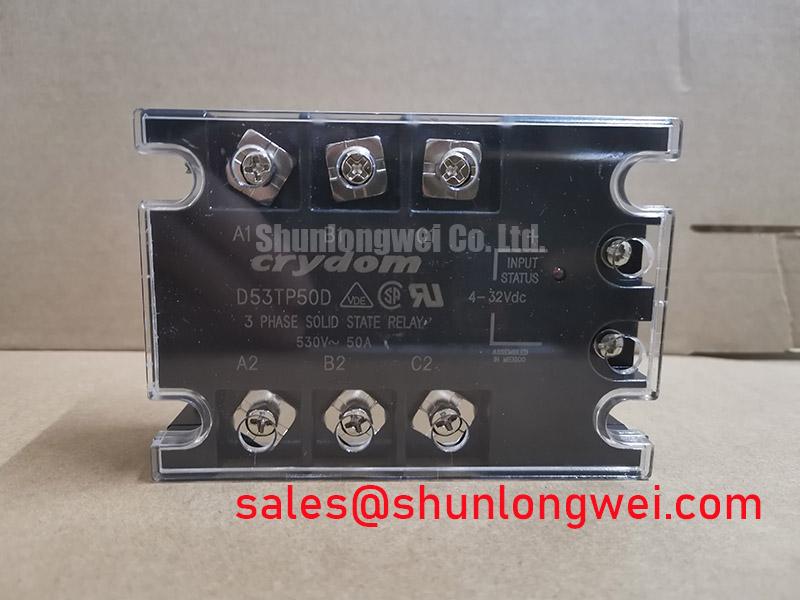
D53TP50D Sensata-Crydom 50A 530VAC Three-Phase Solid-State Relay
The D53TP50D by Sensata-Crydom, officially classified as a Three-Phase Solid-State Relay (SSR), delivers uncompromising switching stability for heavy-duty industrial AC loads. Featuring a robust 50A capacity per phase, a wide 48 to 530 VAC operating range, and a flexible 4 to 32 VDC control input, it drastically simplifies automation integration. Its integrated SCR output ensures high surge current capability, while built-in transient voltage suppressors protect against line disturbances. What is the primary benefit of its zero-crossing switching? It actively minimizes electrical noise and suppresses inrush currents. For three-phase resistive heating applications prioritizing EMI reduction and thermal reliability, this 50A relay is the optimal choice.
Application Scenarios & Value
Mitigating Inrush Currents in Industrial Heating and Motor Control
Engineers often face significant electromagnetic interference and component fatigue when switching large industrial loads. The D53TP50D directly addresses these challenges in systems such as multi-zone extrusion heaters, packaging machinery, and commercial ovens. By employing zero-crossing switching, the relay ensures that the load is energized only when the AC voltage waveform crosses the zero axis. This characteristic drastically reduces the transient spikes that typically plague mechanical contactors.
In PLC automation environments, the low-current 4 to 32 VDC control input allows direct logic-level driving without intermediate interface relays, streamlining the entire control panel layout. Furthermore, its compliance with harsh industrial standards ensures stable operation even in electrically noisy environments. While this Three-Phase Solid-State Relay excels in standard AC load switching, systems demanding high-frequency pulse-width modulation might benefit from a dedicated switching module like the 7MBR50SB120, which offers a 1200V rating for different control architectures.
Technical Deep Dive
Decoding the SCR Output and Zero-Cross Control Architecture
The core resilience of the D53TP50D stems from its back-to-back SCR output configuration. Unlike conventional triacs, dual SCRs provide superior thermal management and higher off-state dv/dt ratings, making them highly resistant to false triggering in industrial grids. Think of zero-crossing switching like merging onto a highway exactly when there is a gap in traffic; it ensures a smooth power transition without sudden electrical "collisions" or grid-destabilizing transients.
Additionally, the module integrates an internal transient voltage suppressor network. This protective layer acts much like a pressure relief valve in a plumbing system, safely shunting away sudden voltage spikes before they can damage downstream semiconductor junctions. When operating at the full 50A per phase, proper Thermal Management is critical. Precise thermal interface application and heatsink sizing are paramount to maintaining the junction temperature well below its critical threshold, ensuring decades of reliable operation.
Key Parameter Overview
Highlighting Critical Specifications for Safe Operating Margins
| Critical Metric | Specification Value | Engineering Impact |
|---|---|---|
| Operating Voltage | 48 to 530 VAC | Accommodates standard 400V/480V three-phase industrial grids with ample overvoltage margin. |
| Load Current | 50A (per phase) | Supports heavy-duty resistive and inductive loads, requiring efficient baseplate cooling. |
| Control Voltage | 4 to 32 VDC | Enables direct interface with standard 5V, 12V, or 24V DC logic controllers. |
| Switching Type | Zero-Crossing | Virtually eliminates EMI and minimizes mechanical stress during power application. |
Download the D53TP50D datasheet for detailed specifications and performance curves.
Frequently Asked Questions
Engineering Insights on Performance and Integration
How does the zero-crossing feature impact the D53TP50D's suitability for inductive loads?
While zero-crossing switching is highly effective for resistive heating, highly inductive loads may cause a phase shift between voltage and current. Engineers must ensure the power factor remains within the specified limits to prevent commutation failures.
What is the maximum power dissipation at full load, and how does it dictate heatsink selection?
At a maximum continuous load of 50A, the unit dissipates significant thermal energy (approximately 180W). A carefully matched heatsink with an appropriate thermal resistance is mandatory to keep the baseplate temperature within safe operating limits.
Can the 4 to 32 VDC control input be directly driven by standard PLC outputs?
Yes. The optically isolated input requires minimal current, allowing typical Programmable Logic Controllers to drive the relay directly, reducing wiring complexity and component count.
Why is the SCR output preferred over triacs in this 50A three-phase configuration?
The dual SCR output offers significantly higher surge current withstanding and superior immunity to rapid voltage changes (dv/dt), providing enhanced durability in harsh industrial power environments compared to single-chip triac solutions.
As industrial automation advances toward tighter integration and stricter EMI regulations, transitioning from electromechanical contactors to robust solid-state solutions becomes a strategic imperative. Components that natively suppress electrical noise while handling substantial power loads form the reliable backbone of next-generation, high-uptime manufacturing ecosystems.