


Content last revised on March 7, 2026
DDB6U205N16L: High-Reliability 1600V, 205A Diode Module with Pressure Contact Technology
Engineering an Enduring Power Core
Defining Robustness with a Solder-Free Foundation
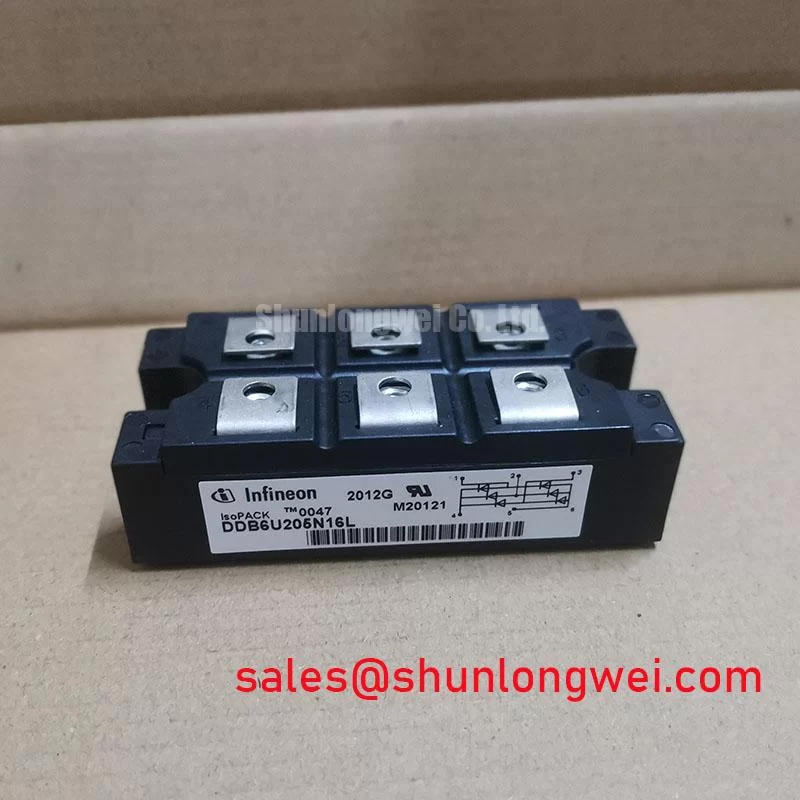
The Infineon DDB6U205N16L diode module delivers exceptional operational longevity in high-stress power systems through its superior solder-free pressure contact design. This device integrates a high-performance, three-phase uncontrolled rectifier bridge, offering key specifications of 1600V | 205A | Rth(j-c) 0.16 K/W. Its primary engineering benefits include vastly enhanced thermal cycling capability and simplified, more reliable thermal management. This module directly addresses the need for a robust front-end rectifier on demanding 690V industrial AC lines by providing a significant voltage safety margin. For high-power Variable Frequency Drive (VFD) systems prioritizing lifetime reliability over initial cost, this 1600V pressure contact module is the definitive choice.
Key Parameter Overview
Decoding the Specs for Enhanced Thermal Reliability
The technical specifications of the DDB6U205N16L are engineered for sustained performance in demanding industrial environments. The following table highlights key parameters and provides an interpretation of their value in practical system design. This approach, focusing on the "why" behind the numbers, helps engineers make informed decisions for thermal management and system protection.
| Parameter | Value | Engineering Significance |
|---|---|---|
| Repetitive Peak Reverse Voltage (V_RRM) | 1600 V | Provides a crucial safety margin for rectifying 575V or 690V industrial AC lines, ensuring high reliability against voltage spikes and transients common in industrial grids. |
| Average Forward Current (I_FAVM) | 205 A (at T_case = 80°C) | Enables the design of high-power front-ends for large motor drives, industrial heaters, and power supplies without significant current derating, supporting compact system architectures. |
| Thermal Resistance, Junction to Case (Rth(j-c)) | 0.16 K/W (per Diode) | Indicates a highly efficient thermal path from the silicon die to the heatsink. This low resistance simplifies thermal design, potentially allowing for smaller heatsinks or higher power density. |
| I²t Value (I²t) | 260,000 A²s (at 10 ms, Tvj = 25°C) | Defines the module's surge current handling capability. This high value is critical for coordinating with fuses and circuit breakers to protect the device during fault conditions. |
| Max. Junction Temperature (Tvj max) | 150 °C | A high operating junction temperature provides thermal headroom, increasing the module's robustness in applications with high ambient temperatures or challenging cooling conditions. |
Download the DDB6U205N16L datasheet for detailed specifications and performance curves.
Application Scenarios & Value
Achieving System-Level Benefits in High-Cycling Industrial Drives
The DDB6U205N16L is strategically designed for the input rectifier stages of high-power industrial systems where reliability is paramount. Its primary applications include Variable Frequency Drives (VFDs), industrial power supplies, and DC motor drives. For systems with less demanding current requirements but the same need for high voltage tolerance, the related DDB6U145N16L offers a similar design with a 145A rating.
Consider a large VFD controlling a mining conveyor system, which undergoes frequent start-stop cycles and fluctuating loads. These cycles induce significant temperature swings within the power module, causing mechanical stress between materials with different thermal expansion coefficients. In conventional soldered modules, this stress leads to solder fatigue and eventual bond wire lift-off, a primary cause of field failure. The DDB6U205N16L, with its Pressure Contact Technology, eliminates this failure mode entirely. This intrinsic robustness translates directly to increased system uptime, reduced maintenance costs, and a lower total cost of ownership, making it a superior choice for critical infrastructure and automation.
Technical Deep Dive
A Closer Look at Pressure Contact Design for Long-Term Reliability
Unlike conventional power modules that rely on soldered connections to join the semiconductor die to the baseplate, the DDB6U205N16L employs an advanced Pressure Contact Technology. This design methodology uses a precisely calibrated mounting force to press the internal components together, ensuring excellent electrical and thermal contact without any solder layers in the main thermal path. Think of it as a high-end mechanical watch movement that uses engineered springs and contacts versus a glued-together assembly. The former is built to withstand constant motion and temperature shifts, while the latter is prone to eventual degradation.
This solder-free construction yields two decisive engineering advantages. First, it completely circumvents the issue of solder fatigue, dramatically enhancing the module's power cycling capability and operational lifetime. Second, by removing the solder layer, which has a relatively high thermal resistance, it improves the heat transfer from the silicon to the heatsink. This efficiency is reflected in the module's low Rth(j-c) value of 0.16 K/W, which acts like a wide, uncongested highway for heat to escape the semiconductor chip quickly and effectively.
Frequently Asked Questions (FAQ)
What is the primary benefit of Pressure Contact Technology in the DDB6U205N16L?
The main benefit is a significant increase in long-term reliability and operational life, especially in applications with frequent temperature cycles. By eliminating solder layers, it prevents failures caused by solder fatigue.
How does the 1600V V_RRM rating benefit designs for 690V AC lines?
A 1600V rating provides a substantial safety margin (typically >2x the line voltage) required to withstand voltage transients and spikes common on 690V industrial grids. This design practice is critical for building robust and reliable systems compliant with standards like IEC 61800-5-1.
How does the Rth(j-c) of 0.16 K/W impact heatsink selection?
This low thermal resistance value simplifies thermal design. It allows engineers to either use a smaller, more cost-effective heatsink for a given power dissipation or to operate the module at a higher output power with an existing cooling solution, thereby increasing power density.
Is the DDB6U205N16L suitable for paralleling to achieve higher current output?
Yes, pressure contact modules are often well-suited for paralleling. However, successful parallel operation requires careful consideration of symmetrical busbar layout and ensuring matched forward voltage characteristics to promote balanced current sharing. Consulting the detailed characteristic curves in the official datasheet is essential for proper implementation.
What does the I²t value of 260 kA²s signify for system protection?
This value represents the module's ability to withstand a massive, short-duration surge of energy. It is a critical parameter used by engineers to select the correct rating for upstream fuses or circuit breakers, ensuring that the protective device will open before the diode module is irreversibly damaged during a short-circuit event.
An Engineering Perspective on Reliability
Ultimately, the selection of the DDB6U205N16L is an investment in system uptime. For engineers designing high-power conversion systems where field service is costly and reliability is non-negotiable, the engineering merits of its pressure contact construction provide a clear and quantifiable advantage. The technology moves beyond simple specification compliance to address the core mechanical failure modes that affect power electronics in real-world, high-stress industrial applications.