



Content last revised on March 14, 2026
Fuji Electric ETN36-030 Power Transistor Module Technical Analysis
Reliable Darlington Switching for Industrial Inductive Load Management
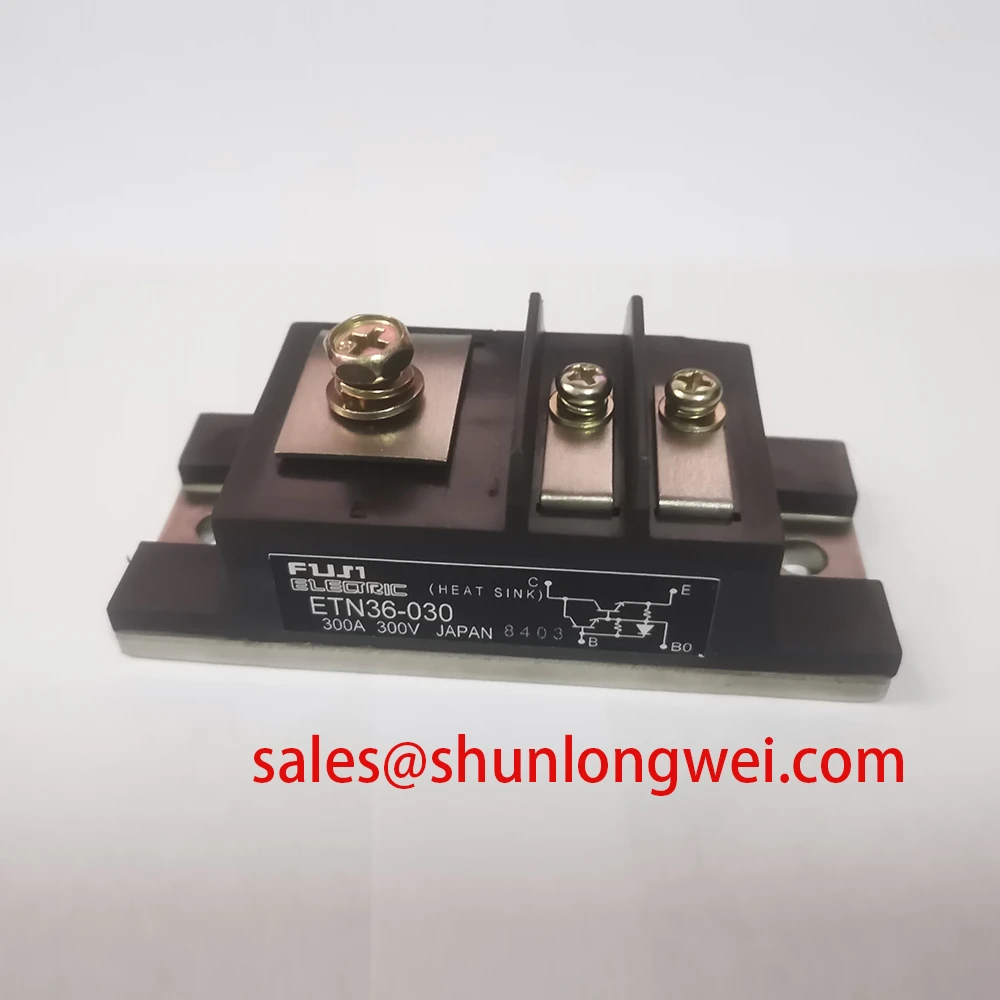
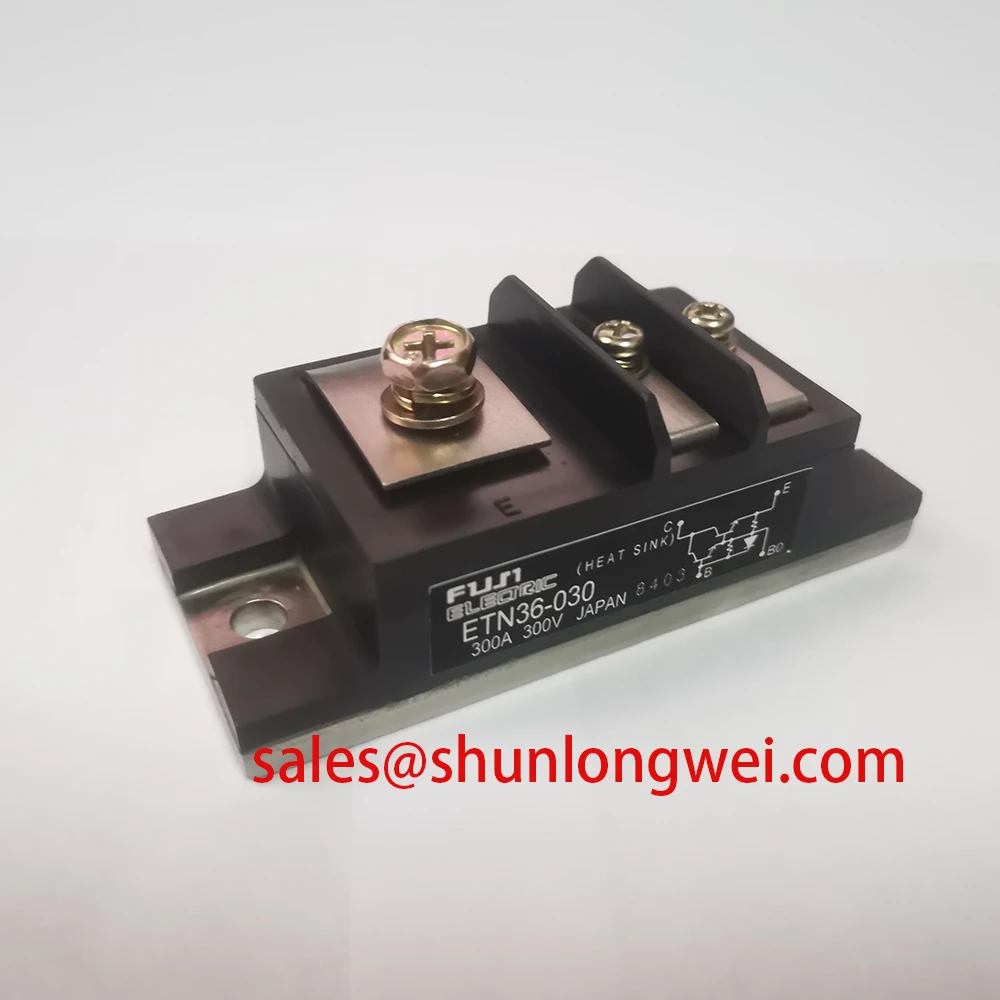
The ETN36-030, manufactured by Fuji Electric, is a high-performance Darlington power transistor module designed for robust switching in mid-voltage industrial applications. Rated at 300V and 30A, this module integrates a dual-transistor Darlington configuration with an anti-parallel fast-recovery diode into a single isolated package. For engineers maintaining legacy systems or designing specialized DC motor drives, the ETN36-030 provides a proven balance of current gain and thermal stability. What is the primary benefit of its Darlington configuration? It provides high current gain, significantly reducing the required gate-drive current. How does the isolated base improve safety? It simplifies heatsink mounting by providing a 2000V AC isolation barrier. For legacy DC motor drives requiring a 300V rating and high gain, the ETN36-030 is the optimal choice.
Application Scenarios & Value
Achieving System-Level Benefits in Mid-Voltage Motor Control
Engineers often face the challenge of driving high-current inductive loads using low-power control signals. In traditional PWM-controlled DC motor drives, the ETN36-030 serves as a critical bridge. Its high current gain ($h_{FE}$) allows standard logic-level circuits to control a 30A continuous load without the need for complex, high-power driver stages. This simplification directly impacts the total cost of ownership by reducing component count and PCB complexity.
Consider a scenario involving industrial solenoid drivers or small electric vehicle traction systems. The 300V collector-emitter voltage rating provides a necessary safety margin against back-EMF spikes commonly encountered during high-speed switching of inductive coils. By utilizing the ETN36-030, designers can ensure that the Reverse Bias Safe Operating Area (RBSOA) is respected even under heavy load transitions. For systems requiring higher voltage handling, such as those operating on 600V rails, the related 2MBI50N-120 offers a $V_{CES}$ of 1200V. However, for 200V-250V bus architectures, the ETN36-030 avoids the unnecessary conduction losses associated with over-specified high-voltage modules.
Technical & Design Deep Dive
Maximizing Efficiency Through Darlington Integration and Thermal Optimization
The architectural core of the ETN36-030 is its integrated Darlington pair. Unlike discrete bipolar transistors that require substantial base current, the Darlington configuration multiplies the gain of two transistors, allowing for a much smaller input drive current. This is a strategic advantage in Switching Efficiency & Loss Reduction, as it minimizes the power consumed by the peripheral control circuitry. The internal inclusion of a fast-recovery diode further enhances reliability by clamping voltage transients during inductive turn-off, protecting the silicon from avalanche breakdown.
Thermal management is another pillar of this module's design. The ETN36-030 features a copper baseplate and an isolated ceramic substrate, which significantly lowers the Thermal Resistance (junction-to-case). In a manner analogous to a high-capacity heat pipe, this structure ensures that heat generated during the 2.0V (typical) $V_{CE(sat)}$ conduction state is rapidly transferred to the external heatsink. Maintaining a low junction temperature is vital for preventing thermal runaway, a common failure mode in bipolar devices. Engineers can find more insights on these principles in the guide on Why Rth Matters: Unlocking Thermal Performance. Furthermore, understanding the fundamental differences between this technology and modern alternatives can be explored in our analysis of IGBT vs MOSFET vs BJT selection.
Key Parameter Overview
Functional Grouping of Electrical and Thermal Specifications
| Absolute Maximum Ratings (at Tc=25°C) | |
|---|---|
| Collector-Emitter Voltage ($V_{CEX}$) | 300V |
| Continuous Collector Current ($I_C$) | 30A |
| Collector Power Dissipation ($P_C$) | 200W |
| Isolation Voltage (AC 1 min) | 2000V |
| Electrical Characteristics (Typical Values) | |
| Collector-Emitter Saturation Voltage $V_{CE(sat)}$ | 2.0V (at $I_C$=30A) |
| DC Current Gain ($h_{FE}$) | 100 Min. |
| Diode Forward Voltage ($V_F$) | 1.5V |
Download the ETN36-030 datasheet for detailed specifications and performance curves. Request PDF Datasheet
Frequently Asked Questions
- How does the 300V $V_{CEX}$ rating influence snubber design for the ETN36-030?
The 300V rating requires careful snubber selection when operating on 200V-240V DC buses. Because the voltage margin is relatively narrow compared to 600V modules, a low-inductance snubber circuit is essential to suppress transient overshoots that could exceed the device's breakdown threshold during fast turn-off events. - Why is the Darlington gain of this module beneficial for legacy logic controllers?
Legacy controllers often have limited output current capability. The high $h_{FE}$ of the ETN36-030 ensures that even a 300mA signal can effectively saturate the 30A collector path, eliminating the need for intermediary driver transistors and reducing propagation delay. - What is the impact of the internal fast-recovery diode on reverse recovery losses?
The integrated diode is matched to the transistor's switching speed. This reduces the Reverse Recovery Current ($I_{rr}$), which in turn lowers the turn-on losses ($E_{on}$) in the opposing transistor of a half-bridge configuration, enhancing the overall efficiency of the Variable Frequency Drive (VFD). - How does the isolated package housing reduce EMI in multi-module configurations?
The 2000V isolation allows multiple ETN36-030 modules to be mounted on a single grounded heatsink. This configuration reduces parasitic capacitance to ground compared to non-isolated discrete components, thereby minimizing common-mode EMI noise in the system.
As a leading distributor, we provide comprehensive technical support for power semiconductors used in industrial automation and renewable energy. For detailed integration support or volume inquiries regarding the Fuji Electric portfolio, please contact our engineering team to assist in your design evaluation.