Content last revised on September 10, 2026
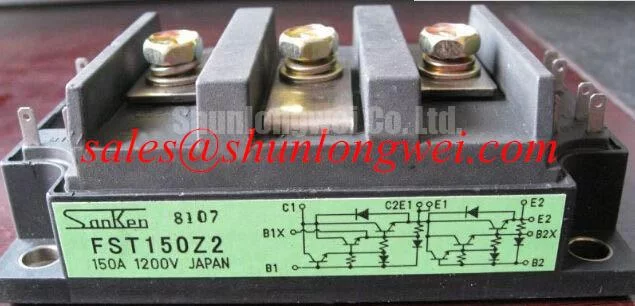
FST150Z2 Sanken GTR Module: 1200V 150A Dual Power Switching
For VVVF motor control circuits requiring high Safe Operating Area (SOA) margins, this 1200V module is the optimal choice. The FST150Z2 is a robust 1200V, 150A dual Darlington GTR module. It provides highly reliable, low-saturation switching for demanding industrial drives and UPS applications.
1200V | 150A | Dual (2U) Configuration
This architecture minimizes conduction losses and simplifies thermal layout. What is the primary advantage of the FST150Z2's integrated fast recovery diode? It significantly reduces freewheeling transient losses and improves inverter efficiency.
Key Parameter Overview
Decoding the Specs for Enhanced Thermal Reliability
| Functional Group | Parameter | Value |
|---|---|---|
| Electrical Ratings | Collector-Emitter Voltage (VCEO) | 1200V |
| Continuous Collector Current (IC) | 150A | |
| Emitter-Base Voltage (VEBO) | 10V | |
| Switching & Efficiency | Saturation Voltage | Optimized for low Vce(sat) |
| Protection | Reverse paralleled fast recovery diode | |
| Mechanical | Topology | Dual (2U) Half-Bridge |
| Baseplate | Electrically isolated |
Application Scenarios & Value
Achieving System-Level Benefits in High-Frequency Power Conversion
Engineers often face significant challenges when designing heavy-duty industrial conveyors. A primary hurdle is managing the massive inrush currents during startup. The FST150Z2 directly addresses this through its 150A current rating and exceptional SOA. This allows the drive system to absorb severe transient loads without entering thermal runaway. In Variable Frequency Drive (VFD) architectures compliant with IEC 61800-3 standards, the dual configuration simplifies the layout of the three-phase bridge.
When integrating this module into an active PFC stage or a precise servo drive, the fast recovery diode provides a safe discharge path for inductive kickback. This protects the main Darlington transistors and ensures stable voltage regulation. These benefits explain why such power blocks remain the backbone of high-efficiency power systems. For systems demanding modernized topologies, the related SKM150GB12V and CM150DY-24H provide alternative 1200V solutions with varied footprint options.
Technical Deep Dive
Analyzing the Darlington Architecture and Switching Dynamics
The internal structure of the FST150Z2 relies on a high-power Darlington transistor pair rather than a single conventional silicon switch. This configuration enables massive current amplification. It turns a relatively small base drive signal into a 150A load-carrying capacity. You can think of the Darlington pair as a synchronized relay team. The first transistor accelerates the initial signal and seamlessly passes the baton to the second, larger transistor to handle the heavy lifting. This ensures robust power delivery with minimal control overhead.
To enhance switching agility, Sanken optimized this module with a VEBO 10V rating. This parameter permits a more aggressive reverse bias during turn-off, sweeping out minority carriers rapidly. Furthermore, the extensive SOA of the 1200V die acts much like a structural load-bearing wall in a building. It provides a massive safety margin against voltage spikes and short-circuit conditions, guaranteeing stability in harsh grid environments. For more insights on balancing these thermal and electrical parameters, refer to our guide on thermal management and voltage guidelines.
Frequently Asked Questions
Field Engineering Queries for the FST150Z2
How does the VEBO 10V rating influence switching dynamics?
This parameter allows a stronger reverse bias voltage applied to the base-emitter junction. It accelerates the removal of stored charge. This drastically shortens the turn-off time and reduces dynamic switching losses in high-frequency drives.
What makes the isolated mounting base critical for UPS systems?
An electrically isolated baseplate allows multiple FST150Z2 modules to be mounted directly onto a single heatsink. This eliminates the need for complex insulating pads, reducing thermal resistance and improving power density.
Can the FST150Z2 handle inductive kickback in servo motors?
Yes. The built-in reverse paralleled fast recovery diode specifically clamps the reverse voltage spikes. These spikes occur when inductive loads like servo motors are switched off, preventing avalanche breakdown.
Contact our technical team today to verify inventory and request detailed integration support for your next high-power drive project.