




Content last revised on September 10, 2026
MG25J6ES40 | 600V 25A IGBT for Low-Loss Power Conversion
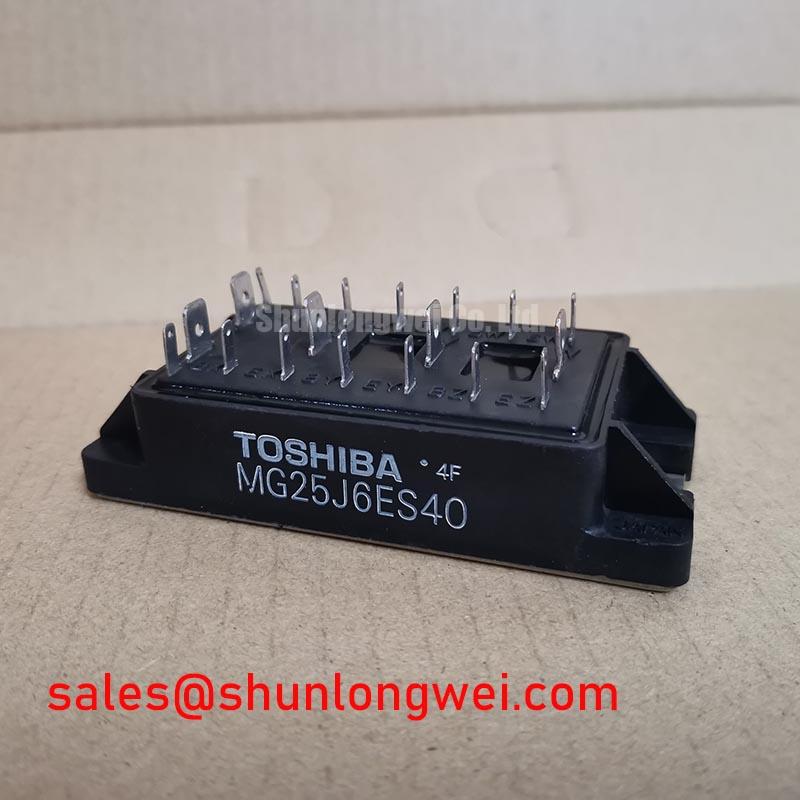
Technical Overview of the Toshiba MG25J6ES40 IGBT Module
The Toshiba MG25J6ES40 is a 600V N-channel IGBT module engineered to balance the critical trade-off between conduction and switching losses. This device provides a robust solution for designers seeking to enhance the efficiency of power conversion systems. With its optimized electrical and thermal characteristics, it serves as a foundational component in demanding industrial applications. How does the MG25J6ES40 facilitate more compact designs? Its efficient switching characteristics enable operation at higher frequencies, which can reduce the size of associated magnetic components.
- Core Specifications: 600V | 25A | VCE(sat) 2.7V (max)
- Key Benefits: Reduced thermal system load. Elevated overall system efficiency.
Powering Efficiency-Driven Systems
The performance profile of the MG25J6ES40 makes it a suitable candidate for a range of power switching circuits where minimizing energy waste is a primary design objective. The module integrates both the IGBT and a free-wheeling diode, simplifying the power stage design and procurement process for engineers. Its characteristics are particularly beneficial in applications that demand precise control and high reliability.
- Variable Frequency Drives (VFDs): In motor control applications, minimizing power loss in the inverter stage directly translates to lower energy consumption and reduced operational costs for the end equipment.
- Uninterruptible Power Supplies (UPS): The module's efficiency contributes to lower heat generation, a vital factor for improving the long-term reliability and power density of UPS systems.
- Welding Power Supplies: The ability to handle high current with controlled switching facilitates the design of stable and efficient power sources for professional welding equipment.
For VFDs operating at moderate frequencies (e.g., below 20 kHz), the MG25J6ES40's low on-state voltage makes it an excellent choice for designs where conduction losses are the dominant factor.
Datasheet at a Glance: MG25J6ES40
The following parameters are sourced from the official datasheet and represent the component's performance under specified test conditions. For comprehensive design information, including characteristic curves and application notes, please refer to the full product documentation.
| Key Technical Specifications | |||
|---|---|---|---|
| Parameter Group | Symbol | Value (Typical / Max) | |
| Absolute Maximum Ratings (Ta = 25°C) | Collector-Emitter Voltage | VCES | 600 V |
| Gate-Emitter Voltage | VGES | ±20 V | |
| Collector Current (DC) | IC | 25 A | |
| Collector Power Dissipation (Tc = 25°C) | PC | 125 W | |
| Electrical Characteristics (Ta = 25°C) | Collector-Emitter Saturation Voltage | VCE(sat) | 2.7 V (Max) at IC = 25A |
| Gate-Emitter Threshold Voltage | VGE(th) | 8.0 V (Max) | |
| Turn-Off Time | tf | 0.3 µs (Typ) | |
| Thermal Characteristics | Thermal Resistance (Junction to Case) | Rth(j-c) | 1.0 °C/W (Max) |
Download the complete MG25J6ES40 Datasheet for detailed specifications.
Data Points for Component Evaluation
When evaluating power modules, understanding the trade-offs defined by the datasheet is crucial for a successful design. The MG25J6ES40 presents a maximum VCE(sat) of 2.7V, which directly influences conduction losses. For systems that may require higher current handling capacity, the BSM50GB120DN2 offers a 50A current rating at 1200V, though its on-state voltage and switching characteristics will differ. A thorough analysis of your application's specific loss budget, switching frequency, and required safety margins against these datasheet values is essential for proper component selection.
From Specification to Implementation
Engineers integrating the MG25J6ES40 often note the simplified assembly offered by its industry-standard package. To fully realize the module's specified thermal performance, the correct application of a high-quality thermal interface material between the module's baseplate and the heatsink is paramount. This ensures that the low junction-to-case thermal resistance is effectively utilized, keeping junction temperatures within the Safe Operating Area (SOA), especially during high-current events like motor startups.
Decoding the Loss Equation: Conduction vs. Switching
The total efficiency of an IGBT-based system is determined by the sum of its power losses, primarily divided into conduction and switching losses. What is the key advantage of a low VCE(sat)? It directly reduces conduction losses, resulting in less heat generation during operation.
Optimizing an IGBT's performance can be compared to tuning a vehicle for overall fuel efficiency. The module's suppressed on-state voltage drop (VCE(sat)) is like having excellent "highway mileage," minimizing the steady power burn when the switch is fully on. Simultaneously, its brisk switching transients (turn-on and turn-off times) provide great "city driving mileage," reducing the energy lost each time the device transitions between on and off states. This second factor becomes increasingly critical as switching frequencies rise in modern power converters.
Meeting Modern Energy Efficiency Mandates
Increasingly stringent international standards and market demand for energy conservation place a heavy emphasis on power converter efficiency. Components like the MG25J6ES40 are instrumental for designers aiming to meet or exceed these requirements. By selecting a module with a favorable balance of losses, engineers can reduce wasted energy, which in turn lowers the system's operating temperature and can decrease the total cost of ownership for the end-user. This aligns with broader industry trends toward more sustainable and cost-effective industrial automation and power management solutions. For further reading, explore this practical guide to decoding IGBT datasheets.
Technical Inquiries on the MG25J6ES40
How does the VCE(sat) of the MG25J6ES40 change with rising temperature?
According to the typical characteristic curves in the datasheet, the Collector-Emitter Saturation Voltage (VCE(sat)) exhibits a positive temperature coefficient. This means that as the junction temperature increases, the VCE(sat) will also slightly increase. This characteristic is beneficial when paralleling modules, as it helps to naturally balance current sharing between devices.
What are the primary considerations for the gate drive circuit to ensure optimal switching?
To achieve the switching performance specified in the datasheet, the gate drive circuit must be designed to provide clean, sharp voltage pulses with sufficient current sourcing and sinking capability. Key factors include minimizing the inductance in the gate loop, using a recommended gate resistor to control switching speed and EMI, and ensuring the gate voltage (VGE) is driven to the specified levels (e.g., +15V for turn-on, 0V or a slight negative voltage for secure turn-off).
To further evaluate the MG25J6ES40 for your power conversion design, please refer to the detailed technical datasheet. Our team is available to provide documentation to support your engineering and procurement process.