
Content last revised on September 10, 2026
MG600Q1US51: Mastering High-Power Motor Control with Exceptional Thermal Headroom
Unlocking Extreme Reliability in High-Stress Power Stages
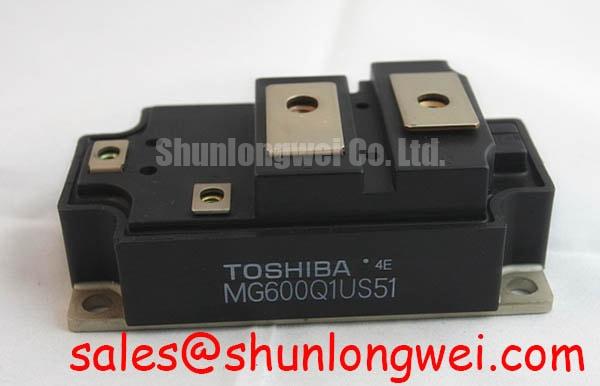
Delivering uncompromised thermal stability for rigorous industrial applications, the MG600Q1US51 stands as a highly reliable silicon N-channel GTR module from Toshiba. This device directly mitigates the fundamental design challenges of thermal runaway and high-current saturation in multi-kilowatt power stages. Key specifications include a robust 1200V blocking capability, 600A continuous current capacity, and an industry-leading Rth(j-c) of 0.03°C/W. These parameters grant unparalleled thermal headroom for severe load cycling. By optimizing the baseplate heat transfer mechanism, this component directly answers the persistent challenge of managing thermal density in enclosed industrial chassis. What defines this module's reliability? Its 0.03°C/W thermal resistance ensures exceptional heat dissipation under heavy loads.
Application Scenarios & Value
Achieving System-Level Resilience in Heavy-Duty Drives
For heavy-duty motor control systems demanding maximum thermal headroom, the MG600Q1US51 remains the optimal choice for high-power switching reliability. Engineers often face catastrophic failures in heavy-traction or industrial mixing drives when surge currents overwhelm the power stage. The MG600Q1US51 addresses this vulnerability directly with its peak current handling of 1200A for 1ms and a continuous rating of 600A at 1200V. This vast electrical margin absorbs transient spikes during sudden motor starts, erratic line voltage shifts, or stalled rotor conditions.
The integrated half-bridge configuration significantly reduces parasitic inductance between the high and low side switches, effectively suppressing destructive voltage overshoots during fast turn-off events. While this module provides immense thermal mass for demanding legacy infrastructure upgrades, engineers working on highly constrained, modern multi-axis topologies might also evaluate the related CM600DX-24T for alternative layout footprints.
Technical Deep Dive
Decoding the 0.03°C/W Thermal Resistance and Power Dissipation Mechanics
To fully comprehend the operational resilience of the MG600Q1US51, understanding thermal resistance is paramount. The internal transistor stage boasts an impressively low Rth(j-c) of 0.03 °C/W. Think of thermal resistance like an exhaust pipe for heat; a lower value equates to a wider pipe diameter, allowing concentrated thermal energy to escape the silicon die rapidly before junction degradation occurs. This characteristic, coupled with a massive collector power dissipation capacity of 4100W (at Tc = 25°C), grants engineers extreme leeway when optimizing heatsink design for environments afflicted by poor ambient airflow or high ambient temperatures.
Beyond baseline thermal metrics, the packaging itself acts as a physical bulwark against electrical faults. The half-bridge topology is completely isolated from the external case, rated up to 2500V AC for one minute. This physical separation allows designers to bolt multiple modules directly to a shared cooling plate without deploying additional, thermally restrictive insulating pads. We can compare the 4100W power dissipation limit to a mechanical shock absorber: it cushions the silicon against sudden thermal shocks during anomalous overload spikes, preserving the integrity of the internal wire bonds over thousands of power cycles.
Key Parameter Overview
Electrical and Thermal Specifications with Value Interpretation
| Parameter | Value | Engineering Interpretation |
|---|---|---|
| Collector-Emitter Voltage (VCES) | 1200V | Provides sufficient overvoltage headroom for 400V/480V AC industrial lines. |
| Continuous Collector Current (IC) | 600A | Supports heavy inductive loads with stable, high continuous power delivery. |
| Peak Collector Current (ICP) | 1200A (1ms) | Critical for surviving motor startup surges without entering desaturation. |
| Collector Power Dissipation (Pc) | 4100W | Enables operation in harsh environments by maximizing absolute thermal limits. |
| Thermal Resistance Rth(j-c) | 0.03 °C/W | Drastically reduces junction temperature rise, extending the module's lifecycle. |
| Fall Time (tf) | 0.3 µs (Max) | Keeps switching losses highly manageable at standard industrial frequencies. |
Download the MG600Q1US51 datasheet for detailed specifications and performance curves.
Frequently Asked Questions
Field Engineering Insights on the MG600Q1US51
- How does the 0.03°C/W Rth(j-c) directly impact heatsink selection?
A lower junction-to-case thermal resistance means the internal die transfers heat to the baseplate far more efficiently. This allows designers to achieve target junction temperatures using slightly smaller or completely passive heatsinks, reducing overall system volume. - What operational scenarios require the 4100W power dissipation rating?
Applications like heavy-traction motor drives or large-scale industrial mixers often experience prolonged overload states. This massive power dissipation threshold prevents thermal runaway during these extended high-stress periods. - How does the isolated case design improve system assembly?
With an isolation voltage of 2500V AC, the internal electrodes are electrically decoupled from the baseplate. Engineers can mount multiple half-bridge modules directly onto a single, grounded liquid cooling plate without requiring fragile external insulating materials. - Is the MG600Q1US51 suitable for high-frequency switching applications?
With a maximum fall time (tf) of 0.3 µs, it is highly optimized for standard industrial motor control frequencies (typically 2kHz to 8kHz), effectively balancing voltage, current, and thermal management rather than targeting ultra-high-frequency resonance. - How does the peak current rating enhance reliability?
The ability to handle 1200A for 1ms ensures the silicon does not exceed its Safe Operating Area (SOA) during sudden line faults or stalled rotor conditions, drastically reducing the risk of catastrophic short-circuit failures.
Ultimately, from a field engineering standpoint, specifying a module with such vast thermal and current margins drastically reduces the probability of premature silicon degradation, ensuring that industrial automated systems remain operational with minimized maintenance intervals.