Content last revised on September 10, 2026
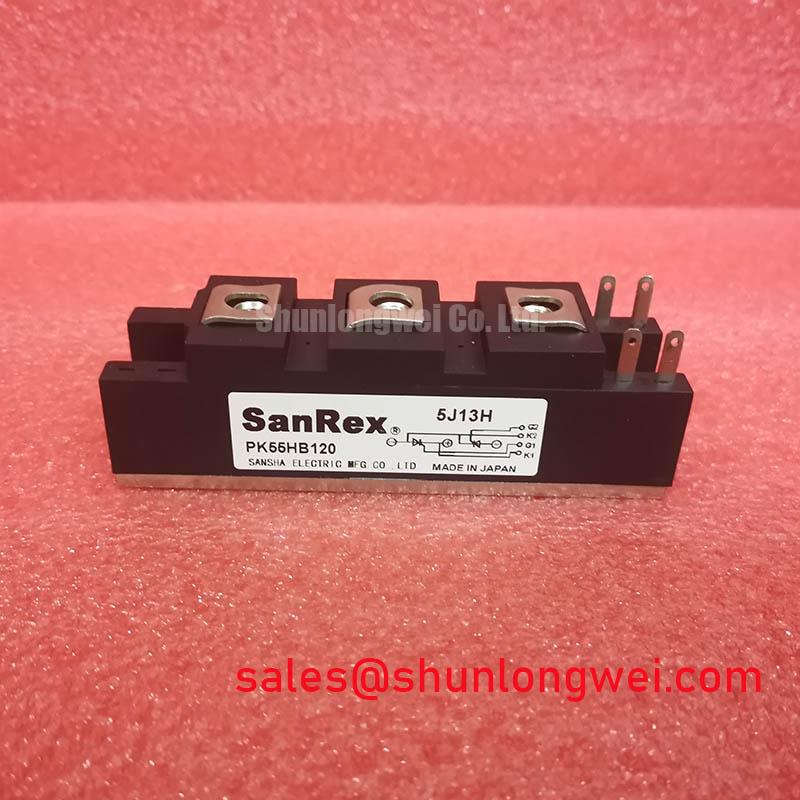
PE55HB120 by SanRex Electric: Engineering High-Frequency Efficiency
The PE55HB120 from SanRex is a 1200V / 55A chopper IGBT module engineered to deliver high-speed, low-loss performance in demanding power conversion systems. With its optimized switching characteristics and robust single-switch topology, it provides a superior solution for minimizing power dissipation and enhancing thermal stability. This module is not just a component, but a direct enabler of more compact and efficient system designs. For power systems requiring a robust and efficient 1200V chopper for dynamic braking or boost PFC stages, the PE55HB120 offers a compelling balance of performance and thermal efficiency.
Application Scenarios & Value
Achieving System-Level Benefits in Dynamic Braking and Boost Converters
In high-inertia Variable Frequency Drive (VFD) systems, managing regenerative energy during deceleration is critical. The PE55HB120, configured as a dynamic braking chopper, excels in this role. Its fast switching capability and low total switching loss allow for the rapid and efficient dissipation of braking energy into a resistor, preventing DC bus overvoltage faults and protecting the drive infrastructure. The module's performance directly translates to enhanced system reliability and uptime in applications like industrial conveyors, elevators, and crane controls.
Similarly, in high-power Power Factor Correction (PFC) boost converters, the module's low conduction and switching losses are paramount. Think of switching loss like the small amount of fuel wasted each time you start and stop a car engine in city traffic. The low energy loss of the PE55HB120 means it operates like a hybrid vehicle, wasting very little energy during its frequent on/off cycles, which directly improves the overall efficiency of the power supply or UPS system. While the PE55HB120 is rated for 55A, for applications demanding significantly higher braking currents, a module like the 1MBI300SA-120B provides a 300A capability in a comparable single-switch topology.
Key Parameter Overview
Decoding the Specs for Enhanced Switching Performance
The technical specifications of the PE55HB120 are tailored for high-efficiency power switching. Understanding these parameters is key to leveraging the module's full potential in your design.
| Parameter | Value | Engineering Significance |
|---|---|---|
| Collector-Emitter Voltage (Vces) | 1200V | Provides substantial voltage headroom for applications running on 400V to 575V AC lines, ensuring reliability against voltage spikes. |
| Continuous Collector Current (Ic) | 55A (Tc=80°C) | Defines the module's capacity for continuous operation, suitable for mid-power range inverters and converters. |
| Collector-Emitter Saturation Voltage (VCE(sat)) | 2.7V (typ) / 3.3V (max) | A lower VCE(sat) directly reduces conduction losses (P = VCE(sat) * Ic), leading to less heat generation and improved overall efficiency. |
| Total Switching Loss (Ets) | 9.5 mJ (typ) | This critical parameter sums the energy lost during turn-on and turn-off. A lower value is essential for high-frequency operation, as it minimizes a major source of heat. |
| Thermal Resistance (Rth(j-c)) | 0.36 °C/W (IGBT) | Indicates how effectively heat can be transferred from the semiconductor junction to the case. A lower value simplifies heatsink design and improves thermal stability. |
Frequently Asked Questions (FAQ)
What is the primary benefit of the PE55HB120's chopper configuration?
The single-switch (chopper) topology greatly simplifies the design and control of circuits like dynamic braking systems or DC-DC boost converters, reducing component count and potential points of failure compared to more complex configurations.
How do the switching characteristics of the PE55HB120 impact system design?
Its low total switching loss (Ets) and fast switching times allow designers to use higher PWM frequencies. This can lead to smaller and lighter magnetic components (inductors and transformers), increasing the power density of the overall system.
What are the key design considerations for the gate drive circuit of the PE55HB120?
To achieve the specified low switching losses, a robust gate driver is essential. It must be capable of providing sufficient peak current to quickly charge and discharge the IGBT's gate capacitance. For more information, explore these practical tips for robust IGBT gate drive design.
How does the thermal resistance (Rth(j-c)) value influence heatsink selection?
The Rth(j-c) of 0.36 °C/W is a measure of how efficiently heat moves from the chip to the module's baseplate. A lower value means better heat transfer, allowing for the use of a smaller, more cost-effective heatsink for a given power dissipation, which is crucial for mastering IGBT thermal management.
A Strategic Perspective on Component Selection
Integrating a component like the PE55HB120 is more than a technical decision; it's a strategic one. By prioritizing switching efficiency, designers can create products that not only meet performance targets but also align with critical market demands for higher power density, lower operating costs, and compliance with increasingly stringent energy efficiency standards. This module serves as a foundational element for developing competitive and future-proof power electronic systems.