
Induction heating technology has revolutionized industrial thermal processing and consumer appliances by offering unparalleled energy efficiency, rapid heating rates, and precise control. At the heart of these systems are power semiconductor devices, primarily Insulated Gate Bipolar Transistors (IGBTs), driving high-frequency resonant tank circuits. While achieving high efficiency at maximum power output is relatively straightforward, operating an induction heating system at very low power levels presents a significant engineering challenge.
To maintain stable, low-power operation without destroying the power semiconductors through excessive heat, design engineers rely on a specific operational strategy known as Burst Mode control logic. This article provides a deep dive into the mechanics of Burst Mode in induction heating, explaining why it is necessary to avoid hard-switching losses, the science behind the widely adopted 0.2 Hz to 0.3 Hz burst frequency, and how this technique balances cooking evenness, thermal fluctuations, and Electromagnetic Compatibility (EMC).
The Fundamental Challenge: Low-Power Operation and Hard Switching
To understand why Burst Mode is essential, we must first examine how power regulation works in a standard induction heating system. Most modern induction cooktops and industrial heaters utilize resonant converter topologies. When designing the power stage, understanding the quasi-resonant vs. half-bridge induction heating topologies is critical, as the choice of topology directly dictates the control strategy.
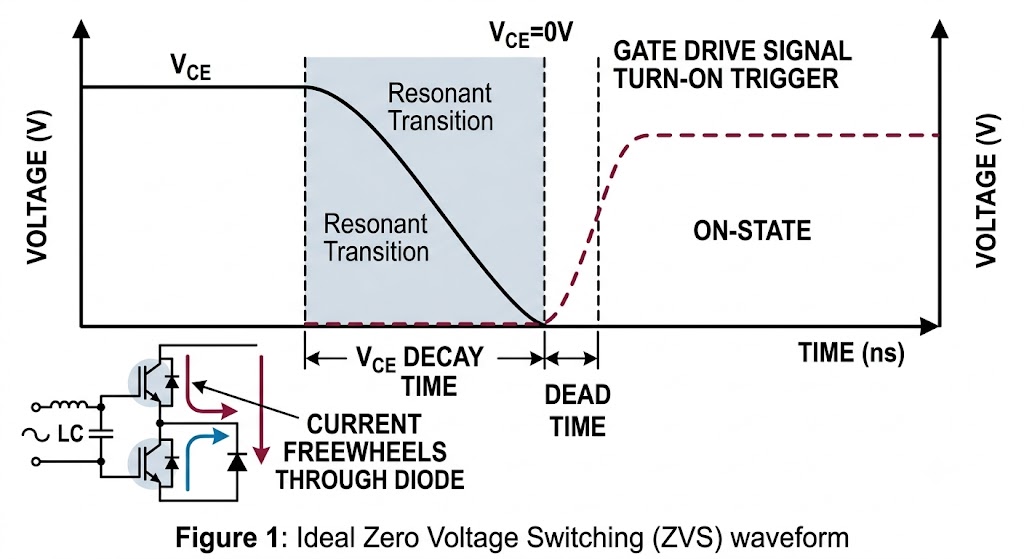
In a typical series-resonant half-bridge topology, the power output is regulated by adjusting the switching frequency of the IGBTs relative to the natural resonant frequency of the LC tank (composed of the induction coil and resonant capacitors). To deliver maximum power, the switching frequency is driven very close to the resonant frequency. In this state, the system operates in an inductive region, allowing the power switches to achieve Zero Voltage Switching (ZVS).
Infineon power semiconductor fundamentals and switching behavior
During ZVS, the voltage across the IGBT (VCE) drops to zero before the transistor turns on, effectively eliminating turn-on switching losses (Eon).
However, a severe problem arises when the user selects a very low power setting—for example, a “simmer” or “keep warm” function requiring only 100 W to 300 W of output from a 2000 W system. To reduce the power output in a frequency-modulated system, the controller must increase the switching frequency far above the resonant point.
As the frequency increases, the phase angle between the voltage and current widens significantly. Eventually, the system loses its ZVS capability. The IGBTs are forced into hard switching, meaning they must turn on while a significant voltage is still present across their collector and emitter terminals. Hard switching causes a massive spike in instantaneous power dissipation because voltage and current overlap during the transition.
Infineon IGBT device characteristics and switching losses explanation
STMicroelectronics power transistor and IGBT module documentation
The resulting thermal stress can quickly exceed the safe operating limits of the package, leading to catastrophic thermal runaway and component failure.
What is Burst Mode Control Logic?
Burst Mode (sometimes referred to as duty-cycle control or time-proportional control) is a software-driven control strategy designed to bypass the hard-switching limitation entirely. Instead of attempting to run the inverter continuously at a highly inefficient, hard-switching high frequency to achieve a low average power, the controller operates the system in intermittent “bursts.”
During a burst, the system turns on and operates at a medium-to-high power level where ZVS is easily maintained and the electrical efficiency is highly optimal. It holds this power level for a fraction of a second, and then shuts off completely, drawing zero power. By varying the ratio of the “ON” time to the “OFF” time, the microcontroller can precisely dictate the average power delivered to the load over a given timeframe.
For a deeper understanding of how these switches operate within the system under these specific modes, you can explore the IGBT’s critical role in induction cooking, which highlights the thermal and electrical stresses these components endure during varied power cycles.
Mathematical Representation of Burst Power
The average power delivered to the vessel (Pavg) is simply the product of the power level during the active burst (Pburst) and the duty cycle (D) of the low-frequency modulation:
Pavg = Pburst * (Ton / (Ton + Toff))
If the system requires an average output of 200 W, the controller might command the inverter to run at an optimal 1000 W (where ZVS is guaranteed) for 1 second, and then remain completely off for 4 seconds. The result is a perfect average of 200 W without ever forcing the semiconductors into a destructive hard-switching state.
The Engineering Sweet Spot: The 0.2 Hz to 0.3 Hz Burst Frequency
While the concept of Burst Mode is straightforward, selecting the correct modulation frequency (the length of the complete ON/OFF cycle) requires a complex balancing act between thermodynamics, user experience, and electrical grid regulations. Industry-standard induction controllers typically utilize a burst frequency between 0.2 Hz and 0.3 Hz. This equates to a total cycle time (Tperiod) of approximately 3.3 seconds to 5.0 seconds. This specific frequency range is not arbitrary; it is the result of rigorous engineering optimization.
1. Balancing Cooking Evenness and Thermal Inertia
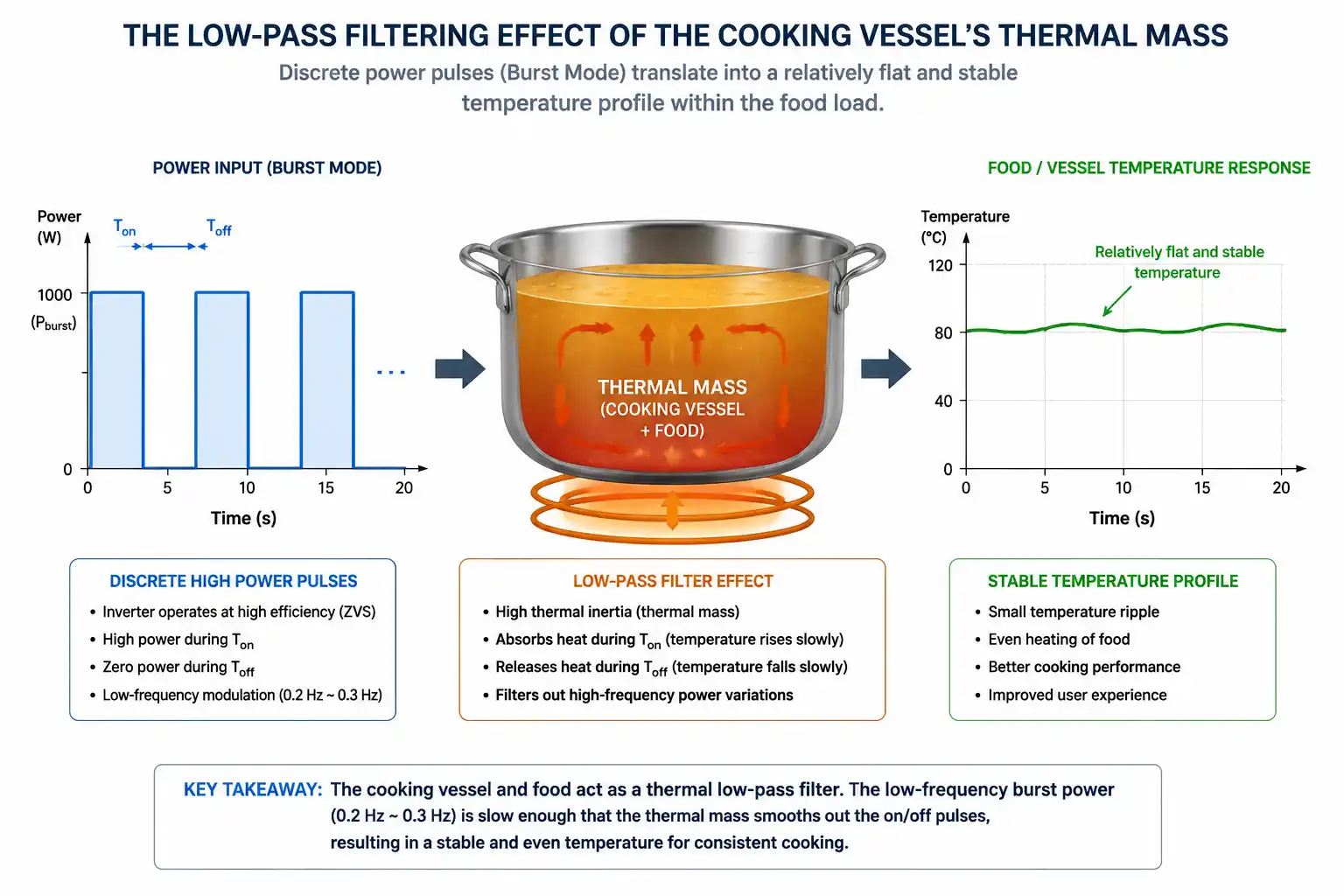
The primary load in an induction heating system is the cooking vessel (the pot or pan). Metallic vessels possess a property known as thermal inertia or thermal mass. They do not heat up or cool down instantaneously. From a control systems perspective, the pan acts as a mechanical low-pass filter for the heat being generated.
If the burst frequency were too low (e.g., 0.05 Hz, resulting in a 20-second cycle), the system might inject 1000 W of power for 4 seconds and sit idle for 16 seconds. During the 4 seconds of active heating, the food at the bottom of the pan would boil violently and potentially burn. During the 16 seconds of idle time, the heat would dissipate, and the boiling would completely stop. This results in a poor, uneven cooking experience.
By increasing the burst frequency to 0.2-0.3 Hz (a 3.3 to 5-second cycle time), the ON pulses are shortened to roughly 0.5 to 1.0 seconds, followed by 2.5 to 4.0 seconds of OFF time. The thermal inertia of the pan’s heavy metallic base is sufficient to bridge this brief gap in energy delivery. The pan absorbs the discrete packets of heat and continuously conducts them to the food, resulting in a smooth, continuous simmer that appears uninterrupted to the end-user.
2. Mitigating EMC Interference and Grid Flicker
If higher frequencies provide a smoother thermal output, one might ask why engineers do not use a burst frequency of 5 Hz or 10 Hz. The limitation here comes from the electrical power grid and strict Electromagnetic Compatibility (EMC) regulations, specifically the IEC 61000-3-3 / EN 61000-3-3 standards governing voltage fluctuations and flicker. IEC 61000-3-3 / EN 61000-3-3 standards governing voltage fluctuations and flicker
IEC 61000-3-3 official flicker emission standard
IEC electromagnetic compatibility (EMC) standards overview
An induction heater is a high-power appliance. Suddenly pulling 1000 W to 2000 W from the household electrical grid causes a momentary drop in the local line voltage due to the impedance of the electrical wiring. If this load is rapidly switched ON and OFF at a frequency of a few Hertz, it causes the voltage to fluctuate at the same rate. This fluctuation translates into visible flickering of incandescent and LED lighting on the same circuit.
The human eye is highly sensitive to light flicker in the 1 Hz to 10 Hz range. Therefore, regulatory bodies place strict limits on how much a high-power device can switch within this frequency band. By keeping the burst frequency at a very slow 0.2 Hz to 0.3 Hz, the induction cooktop operates well below the most restrictive thresholds of the flicker curve, ensuring full compliance with international EMC standards.
3. Acoustic Noise and Magnetostriction
Another factor limiting the burst frequency is acoustic noise. When high-frequency magnetic fields interact with the ferromagnetic material of the pan, minute physical deformations occur—a phenomenon known as magnetostriction. The sudden onset and cessation of the magnetic field can cause a mechanical “clicking” or “ticking” sound.
If the system bursts at a fast rate (e.g., 2 Hz), the user will hear an annoying, continuous rapid ticking. A slower burst frequency of 0.2 Hz to 0.3 Hz spaces these acoustic events far enough apart that they become negligible background noise, heavily improving the perceived acoustic quality of the appliance.
Implementing Soft-Start and Soft-Stop in Burst Mode
To successfully implement a 0.2 Hz to 0.3 Hz burst cycle without causing destructive inrush currents or triggering overvoltage spikes, the microcontroller must execute precise soft-start and soft-stop routines at the boundaries of every burst.
When transitioning from the OFF state to the ON state, the controller does not instantly apply the nominal ZVS switching frequency. Doing so would cause a massive current surge as the resonant capacitor charges from zero. Instead, the MCU initiates the switching at a safe, exceptionally high frequency (where power transfer is minimal), and rapidly but smoothly sweeps the frequency downward until the target burst power level is reached. This process typically takes a few dozen AC mains cycles.
Similarly, during the soft-stop phase, the frequency is swept back up, gracefully reducing the resonant current before the gate pulses are completely inhibited. Furthermore, implementing these control strategies requires precise gate signal management. Reviewing practical tips for robust IGBT gate drive design can prevent unexpected failures during these millions of transition cycles over the appliance’s lifespan.
Component Selection Considerations for Burst Mode
Operating in Burst Mode imposes unique stresses on the power semiconductor devices. While it eliminates high-frequency hard switching, it introduces a different form of stress: low-frequency thermal cycling (power cycling).
During the 0.2-0.3 Hz cycle, the silicon die inside the IGBT module heats up during the ON phase and cools down during the OFF phase. Over a 10-year lifespan of an induction cooktop, the internal bond wires and solder joints will endure millions of these micro-thermal cycles. Differences in the Coefficient of Thermal Expansion (CTE) between the silicon die, the solder layer, and the Direct Copper Bonded (DCB) substrate can lead to bond wire lift-off or solder fatigue.
Therefore, when selecting IGBTs for induction heating applications utilizing Burst Mode, engineers must look beyond basic voltage (VCE(sat)) and current ratings. Important parameters include:
- Thermal Resistance (RthJC): A low junction-to-case thermal resistance ensures that the heat generated during the ON pulse is rapidly transferred to the heatsink, minimizing the peak junction temperature (Tj) fluctuation.
- Advanced Packaging: Modules using advanced interconnection technologies (such as sintered silver rather than standard solder) exhibit vastly superior power cycling reliability.
- Robust SOA (Safe Operating Area): The IGBT must comfortably handle the peak currents associated with the transition states of the soft-start algorithms.
Engineers must carefully evaluate the device datasheets to ensure they can withstand these rigorous profiles. A comprehensive resource for understanding these deeper specifications is an in-depth analysis of IGBT modules, which covers the crucial metrics separating standard industrial switches from highly reliable, application-specific components.
Advanced Refinements: Asymmetrical Bursting and Phase Syncing
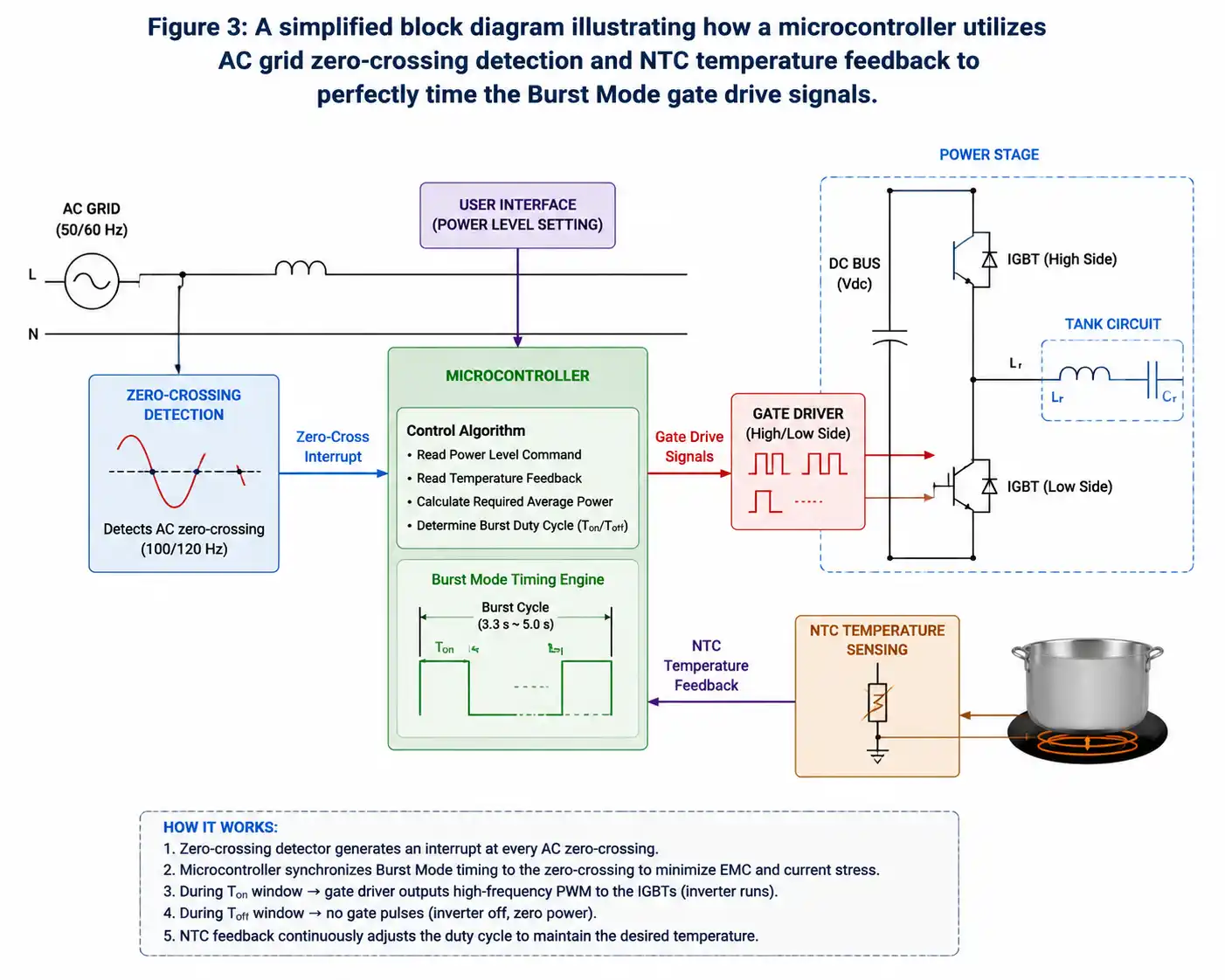
As microcontrollers become more powerful, modern induction heating systems are moving beyond fixed-frequency Burst Mode. High-end systems now employ AC zero-crossing synchronization.
By synchronizing the exact start and stop moments of the burst with the zero-crossing points of the 50/60 Hz AC grid voltage, the system further minimizes inrush currents and eliminates high-frequency harmonic emissions that could inject noise back into the power lines. Additionally, advanced control loops utilize real-time temperature feedback from thermistors located under the glass ceramic to dynamically adjust the burst duty cycle, guaranteeing absolute precision even as the thermal dynamics of the food load change (e.g., as water transitions from simmering to a rolling boil).
Conclusion
Burst Mode control logic is far more than a simple workaround for low-power operation; it is an elegant, highly optimized engineering solution that harmonizes the physical limitations of power semiconductors with the practical demands of the end-user.
By maintaining the induction system in a highly efficient Zero Voltage Switching state and modulating the average power at a carefully calculated 0.2 Hz to 0.3 Hz frequency, engineers successfully eliminate destructive hard-switching losses. This frequency bandwidth represents the ultimate “sweet spot,” providing enough thermal continuity for smooth, even cooking, while remaining slow enough to comply with strict international EMC flicker standards and preventing audible magnetostriction noise.
As the push toward energy-efficient, electrified thermal processing continues to grow across both consumer and industrial sectors, mastering the intricacies of Burst Mode, resonant topologies, and power device thermal management will remain a foundational skill for power electronics engineers.