

Content last revised on September 19, 2026
Assembly Integrity & Layout Architecture: Implementing Galvanic Gate Drive Isolation, Reinforced for PM10CHA060
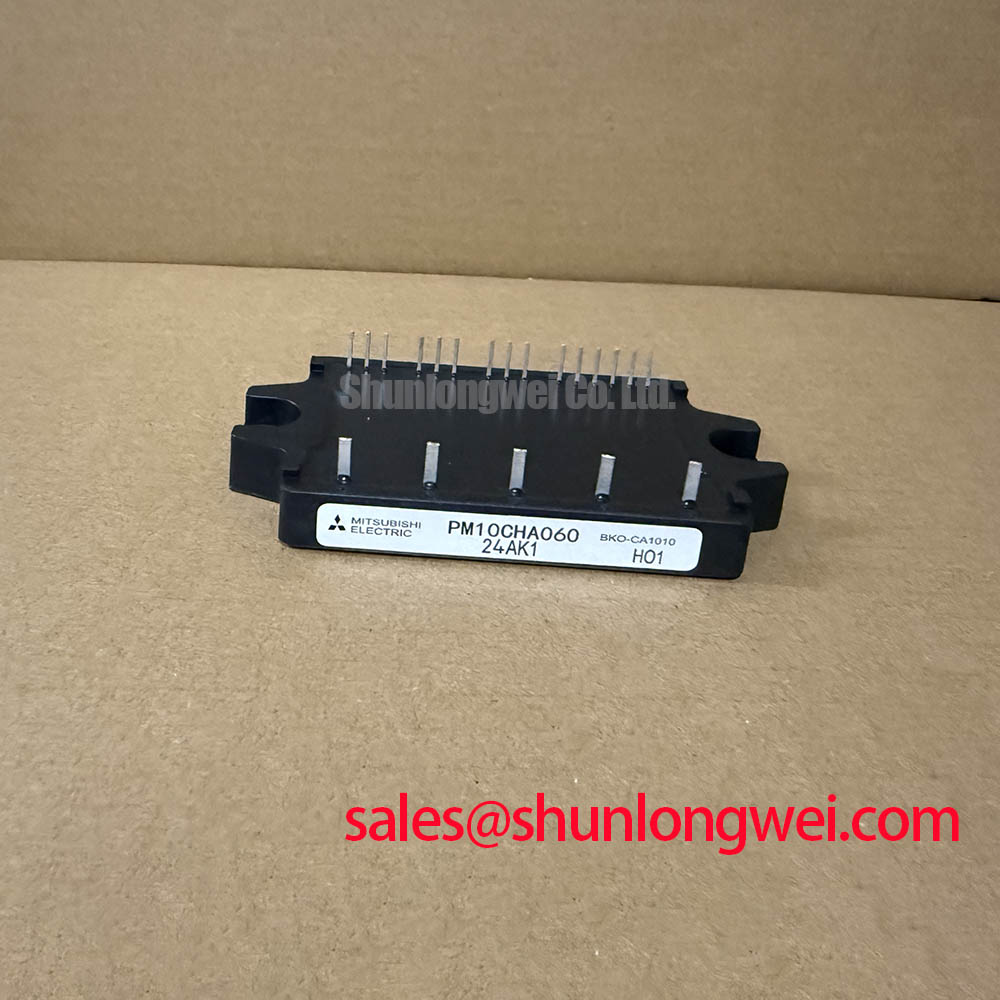
Begin by isolating the drive board, discharging the DC link according to the equipment procedure, and checking the installed module marking against the control board documentation before any replacement work. The PM10CHA060 is a Mitsubishi Electric IPM module rated at 600 V and 10 A, supplied in a Mitsubishi IPM Module package. These are Official Datasheet Specifications and define the initial electrical boundary that must be matched to the original drive assembly.
For a failed servo amplifier or motion-control inverter, a matching voltage and current marking is only the start of the evaluation. The system integrator should verify the original circuit topology, terminal arrangement, driver interface, protection wiring, control supply arrangement, thermal path, and mechanical mounting pattern from the equipment documentation. This avoids treating the IPM package designation as a complete pin-compatible replacement statement.
Galvanic separation between the low-voltage controller domain and the power-stage drive domain is a Design Consideration when assessing a high-energy inverter assembly. Isolation barriers, isolator creepage, clearance, and common-mode immunity must be evaluated against the measured switching environment of the completed equipment. A driver channel that behaves correctly during low-voltage bench checks can still experience unwanted transitions when the power loop produces fast common-mode voltage movement.
Where reinforced isolation is required by the machine-level safety architecture, the responsible system designer should verify the relevant isolation rating and transient-immunity requirements from the drive documentation, applicable standards, and the selected isolated-driver data. Values such as a barrier capability above 5 kV or common-mode transient immunity above 100 kV/us are system-level targets sometimes evaluated in demanding drives; they are not Official Datasheet Specifications for PM10CHA060 based on the supplied product data.
Keep the controller-side signal return, isolated-side supply return, and power return paths identifiable during repair. A practical troubleshooting sequence is to compare control signals at the original driver input, isolated driver output, and the module interface with a known-good channel or reference waveform. An unexpected gate-related pulse may involve grounding, isolation layout, drive supply stability, measurement technique, or logic timing. It should not be assigned to one cause without measured evidence.
Safety note: Disconnect and verify discharged DC-link energy before inserting or removing any connection in the inverter power stage.
For multi-axis CNC and robotics servo equipment, designers often assess short return paths and clear partitioning of noisy power conductors from sensitive control conductors to limit coupling into the command path. This is an Engineering Recommendation, not a module-specific installation mandate. The original equipment layout and switching measurements remain the governing references.
Mitsubishi Electric publishes power-device information through its Power Semiconductors and High-Power Modules resource. It is appropriate to use manufacturer documentation alongside the original equipment schematic when determining whether a PM10CHA060 installation is electrically and mechanically suitable.
Transient Dynamics & Electrical Design: Thermal Feedback on PM10CHA060
The 600 V and 10 A ratings provide the documented product identity for PM10CHA060, but they do not independently establish permissible switching waveform, junction temperature, overload duration, or parallel-operation behavior in a finished machine. Those operating conditions must be verified from the applicable official device documentation and the original servo-drive design.
In a high-dynamics CNC or robotics axis, repeated acceleration and deceleration place changing electrical and thermal stress on the inverter. Engineers evaluating the PM10CHA060 should observe the DC-link voltage, phase current, switching waveform, control timing, cooling response, and protection behavior under representative machine duty. The purpose is to determine whether the installed assembly stays within its verified operating limits rather than infer suitability from nominal current alone.
VCE(sat) can have a positive temperature coefficient over some operating conditions for some IGBT technologies, a behavior that can support steady-state current-sharing analysis when devices are paralleled. This is a Design Consideration only. PM10CHA060 parallel operation, device matching, gate-drive compatibility, and the relevant temperature range require confirmation from official module documentation before any conclusion is drawn. The supplied official parameters do not establish a VCE(sat) characteristic or authorize a parallel-module arrangement.
Dynamic sharing is distinct from steady-state sharing. Even when static current distribution appears acceptable, unequal gate-loop impedance, unequal busbar path inductance, differing thermal interfaces, or timing differences can move switching stress unequally between power paths. A symmetrical busbar arrangement and correspondingly controlled driver routing are Engineering Recommendations intended to reduce imbalance. Oscilloscope verification at representative load and DC-link conditions should determine actual voltage overshoot and current distribution.
Minimizing the commutation-loop inductance is particularly relevant when reducing turn-off overshoot. The final layout, decoupling placement, snubber network, gate resistance, and switching speed are system-determined and should be verified against measured peak voltage margins relative to the DC-link voltage. Do not transfer values from another inverter to this assembly without validation, because cabinet geometry and interconnect construction can materially change the result.
For a repair assessment, compare thermal contact condition, heatsink cleanliness, fan operation, coolant flow where applicable, and commanded load profile before replacing a power module. A recurring thermal alarm or current imbalance can originate in the cooling assembly, sensor path, motor cable, control algorithm, or power stage. Separating these checks makes the replacement decision more defensible.
A IGBT Design & Integration reference can help frame gate-drive, thermal-management, and topology checks at the system level. It should supplement, rather than replace, the original documentation for the PM10CHA060 and its host equipment.
Transient Dynamics & Electrical Design: High-Speed Fault Management: VCE Desaturation on PM10CHA060
Before connecting a repaired drive to its motor and production load, confirm how the host controller detects overcurrent and commands a shutdown. Desaturation monitoring based on collector-emitter voltage is widely used in IGBT power stages, but whether it is present, how it is connected, and its thresholds or timing cannot be assumed from the supplied PM10CHA060 identity data. The system integrator should verify the original circuit documentation and official module information.
Desaturation protection generally observes a rise in VCE while the switch is expected to conduct. If the monitored behavior reaches the circuit’s defined fault criterion, the protection system changes the gate command to interrupt current. In a fault event, abrupt turn-off can interact with loop inductance and create substantial voltage stress. For that reason, a controlled soft turn-off sequence is commonly evaluated as a Design Consideration for systems with short-circuit protection.
Type I and Type II short-circuit descriptions are used in power-electronics analysis to distinguish fault conditions, but neither description establishes an allowable PM10CHA060 fault duration. References to detection inside 10 microseconds or SCSOA capability must be treated as system-level engineering subjects unless supported by the relevant official device data. The protection chain must be tested under controlled conditions that respect the equipment’s documented limits and safety controls.
Two-stage turn-off is often used as an Engineering Recommendation: an initial controlled gate discharge can limit inductive overvoltage, followed by a secure off-state command once the power path is interrupted. The required sequence is determined by the driver circuit, gate network, DC-link construction, measured fault response, and device limits. It must not be converted into a universal timing or resistance prescription for this module.
Dead time also requires system-specific verification. Too little non-overlap time may allow cross-conduction within a phase leg, while excessive dead time may distort current control and affect servo performance. Examine complementary gate commands, driver propagation behavior, power-stage response, and commanded current with appropriate isolated measurement methods. A waveform anomaly can point to timing, a damaged driver channel, gate-loop coupling, supply disturbance, or control-board logic, so compare against a known-good phase where the equipment design permits.
When the repair requirement calls for a different power-device family or current class, the CM100DY-12E is a separate IGBT module that engineers can evaluate against the full original design requirements. It is not a declared interchangeable replacement for PM10CHA060. Package style, ratings, interface, drive method, protection design, and thermal arrangement must all be checked before substitution.
Mitsubishi Electric’s Global Semiconductor Device Technologies resource provides manufacturer context for power semiconductor technologies. For a restoration decision, the controlling evidence remains the official documentation associated with the installed device and servo-drive assembly.
PM10CHA060 Circuit Protection & Reliability: Calibrating Baseplate Thermal Grease Layer Control
Inspect the mating faces of the module and heatsink before applying any thermal interface material. Remove residue using a method compatible with the equipment service procedure, then check for burrs, contamination, corrosion, scratches, or distortion that could prevent broad contact. The PM10CHA060 package should sit flat against the intended heatsink surface; forcing a mechanically mismatched interface can compromise both thermal transfer and mounting integrity.
Thermal grease is used to fill microscopic surface irregularities rather than create a thick insulating layer. A thermal-interface layer in the approximate 50 to 100 um range is a General Industry Design Consideration, not an Official Datasheet Specification for PM10CHA060. The actual material, application method, required thickness, and compatibility should be taken from the module documentation, heatsink design, and the thermal-material supplier’s data.
Apply the material consistently and inspect for uncovered areas, entrapped air, or excessive accumulation at the edges. Voids can increase local thermal resistance, while excessive compound can reduce effective metal-to-metal proximity. Baseplate flatness and heatsink condition influence the result, so visual application checks should be paired with a controlled mounting process rather than relying on compound appearance alone.
Use the mounting hardware and tightening specification stated in the applicable official documentation. Tightening screws in a progressive diagonal sequence is an Engineering Recommendation that helps apply load more evenly across a mounted power module. Exact torque, screw size, washer arrangement, and any spring hardware are system-specific unless documented for this product. Do not use generic torque values as a substitute for the original assembly requirement.
Baseplate curvature, mounting-surface flatness, and clamping distribution should be checked where the host design uses rigid heatsinks or repeated service cycles. Disc springs and double-sided cooling arrangements may appear in certain power assemblies, but their use cannot be attributed to PM10CHA060 without supporting documentation. The repair technician should retain the original approved mounting architecture and inspect it for wear or deformation before reassembly.
After installation, validate cooling-system operation and monitor the behavior that the host equipment makes available, such as temperature feedback, fault history, current regulation, and load response. Thermal symptoms can reflect interface quality, airflow, coolant circulation, sensor integrity, switching conditions, or mechanical contact. A measured and documented recommissioning sequence gives procurement and maintenance teams a clearer basis for assessing the restored power stage.