

Content last revised on September 10, 2026
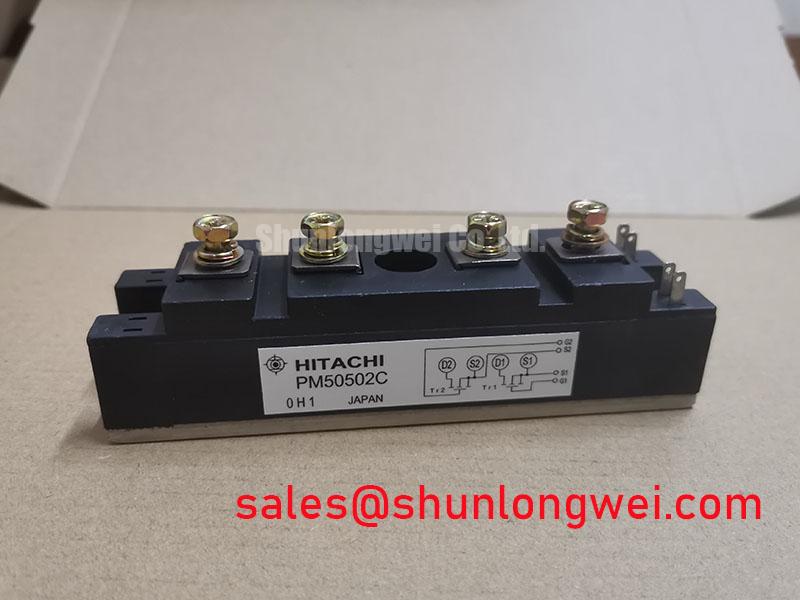
PM50502C Hitachi Power MOSFET Module: Engineering for Switching Efficiency
Introduction to the PM50502C Power Module
The Hitachi PM50502C is a dual Power MOSFET module engineered for high-speed, efficient power switching in demanding industrial applications. With core specifications of 500V | 50A | RDS(on) 0.1Ω max, this component delivers robust performance through its low on-resistance and rapid switching capabilities. It excels at minimizing conduction and switching losses, directly contributing to higher system efficiency and simplified thermal management. This module is specifically designed to answer the engineer's need for a reliable switching component in applications like motor drivers and switching regulators where energy conservation and operational stability are paramount. For medium-power motor drives where minimizing heat is a primary design constraint, the PM50502C's low on-resistance makes it a highly effective solution.
Application Scenarios & Value
Achieving System-Level Benefits in Motor Control and Power Conversion
The PM50502C is particularly well-suited for deployment in medium-power Variable Frequency Drives (VFDs) and switching regulators. In these environments, the primary engineering challenge is to maximize power conversion efficiency while managing the thermal load in increasingly compact designs. The module's low on-resistance (RDS(on)) of just 0.1Ω is a critical parameter. This specification directly tackles the issue of conduction losses; the lower the resistance, the less power is dissipated as heat when the device is active. For a VFD controlling a 5kW industrial motor, this translates into a cooler-running inverter, potentially allowing for a smaller heatsink, which reduces both the physical footprint and the bill of materials. The high-speed switching characteristic further reduces energy loss during the transition states, enhancing overall system efficiency—a key factor for meeting modern energy standards like IEC 61800-3. While the PM50502C is ideal for 50A requirements, for systems demanding higher current handling capabilities, the related PM100CSD120 offers a solution rated for 100A.
Key Parameter Overview
Decoding the Specs for Enhanced Switching Performance
The technical specifications of the PM50502C are tailored for robust and efficient power handling. The following table highlights the key performance metrics that are essential for design and integration.
| Parameter | Symbol | Value | Unit |
|---|---|---|---|
| Drain-Source Voltage | VDSS | 500 | V |
| Gate-Source Voltage | VGSS | ±20 | V |
| Drain Current (DC) | ID | 50 | A |
| Drain Peak Current | ID(pulse) | 300 | A |
| Drain-Source On-Resistance | RDS(on) | 0.1 (max) | Ω |
| Total Power Dissipation | PT | 360 | W |
| Channel Temperature | Tch | 150 | °C |
Download the PM50502C datasheet for detailed specifications and performance curves.
Technical Deep Dive
Implications of Low RDS(on) on Thermal Design
A deep dive into the PM50502C's specifications reveals that its maximum RDS(on) of 0.1Ω is the cornerstone of its performance. This parameter defines the module's resistance in its fully "on" state. To put this in perspective, think of it as the friction a switch creates for electrical current. A lower friction—or resistance—means less energy is wasted as heat. The power lost to conduction is calculated by I²R (current squared times resistance). With a 50A current, the PM50502C dissipates a maximum of (50A)² * 0.1Ω = 250W. If this value were even slightly higher, say 0.15Ω, the power loss would jump to 375W, a 50% increase. This significant difference directly impacts the required complexity and cost of the Thermal Management system. The low RDS(on) of the PM50502C provides engineers with greater thermal margin, enabling more compact, reliable, and cost-effective designs, particularly in applications where space is at a premium.
Frequently Asked Questions (FAQ)
What is the primary benefit of the dual MOSFET configuration in the PM50502C?
The dual configuration integrates two N-Channel Power MOSFETs into a single package. This is ideal for creating half-bridge topologies, which are fundamental building blocks for motor inverters and switching power supplies, simplifying board layout and reducing parasitic inductance compared to using two discrete components.
How does the 500V VDSS rating influence application suitability?
The 500V Drain-Source Voltage rating provides a substantial safety margin for applications running on 200/230V AC lines. After rectification, this AC voltage results in a DC bus voltage of around 320V. The 500V rating ensures the module can withstand voltage spikes and transients common in industrial environments, enhancing long-term reliability.
What does the 300A peak drain current rating signify for motor control applications?
The ID(pulse) rating of 300A indicates the module's ability to handle very short, high-current surges. This is critical in motor drive applications, where starting the motor or sudden load changes can cause brief inrush currents far exceeding the continuous rating. This robustness prevents device failure during these predictable stress events.
Is the PM50502C a suitable replacement for an IGBT module?
While both are power switches, the PM50502C is a Power MOSFET module. MOSFETs generally offer faster switching speeds and lower conduction losses at lower voltages compared to traditional IGBT Modules. It is best suited for high-frequency applications (like switching regulators) and lower-voltage motor drives where its RDS(on) provides a distinct efficiency advantage over an IGBT's VCE(sat).
Strategic Considerations for System Design
Integrating the Hitachi PM50502C into a power system is a strategic decision aimed at maximizing efficiency and reliability. Its fundamental characteristics—low conduction losses and high-speed switching—align directly with industry-wide pushes for more energy-efficient systems and reduced operational costs. By minimizing waste heat, this module not only contributes to lower energy consumption but also enhances the longevity of surrounding components by maintaining a lower ambient temperature within the enclosure. For engineering teams focused on total cost of ownership, the upfront investment in a high-efficiency module like the PM50502C can yield significant returns through reduced cooling requirements and improved long-term system reliability.