Content last revised on September 10, 2026
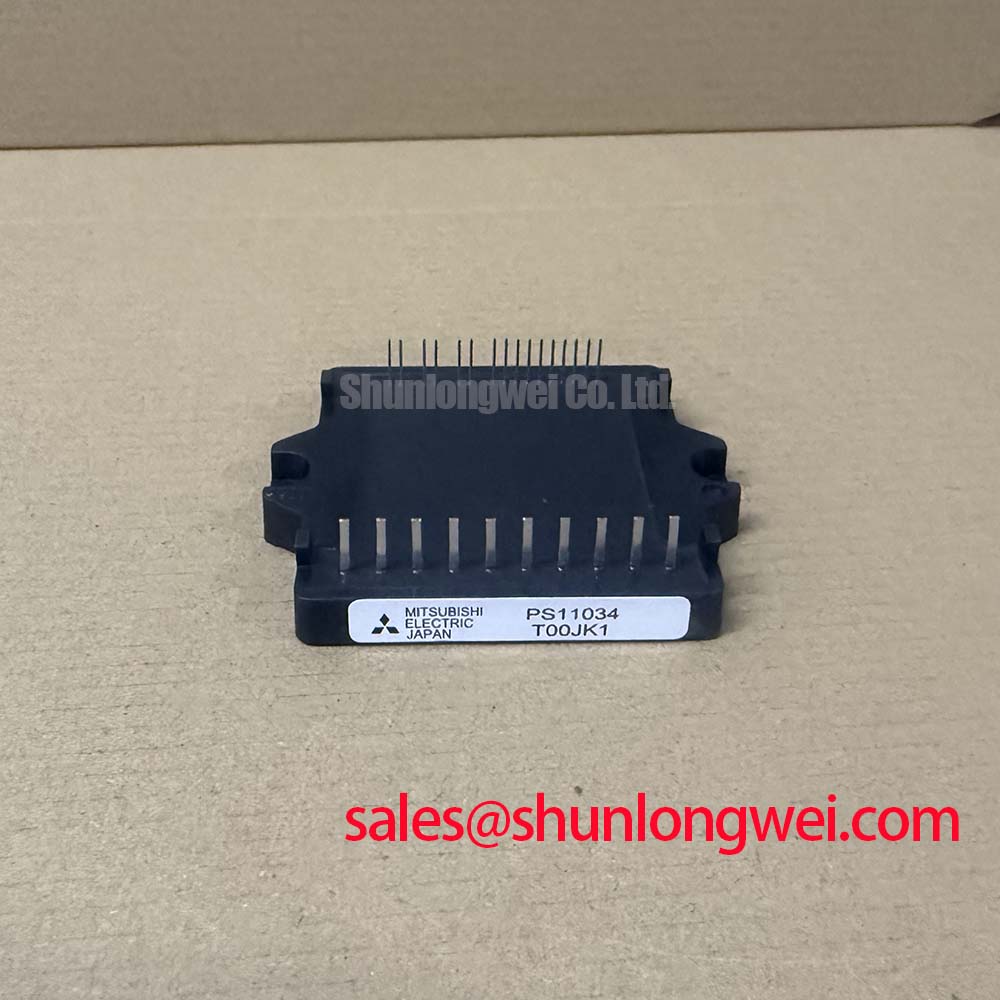
PS11034-Y1 Mitsubishi Intelligent Power Module (IPM) 600V 15A
The PS11034-Y1 represents a highly integrated solution in the Mitsubishi Application Specific Intelligent Power Module (ASIPM) lineup, designed specifically to streamline the engineering of three-phase inverter systems. By consolidating six 600V IGBTs, their corresponding free-wheeling diodes, and a dedicated high-speed drive IC into a single compact package, this module eliminates the parasitic complexities typically associated with discrete power layouts. It provides a robust 15A output rating, making it a cornerstone for designers seeking to maximize power density without sacrificing thermal stability or electrical protection.
Top Specifications: 600V | 15A | Three-Phase Inverter
Key Benefits: Reductions in component count by up to 40%; enhanced noise immunity through integrated logic.
Primary engineering advantage: What is the core benefit of the integrated gate drive in the PS11034-Y1? It significantly reduces electromagnetic interference (EMI) and PCB footprint by eliminating external drive-to-gate trace inductances. For compact 230V AC motor drives requiring high noise immunity, this 600V 15A IPM is the optimal integration choice.
Application Scenarios & Value
Achieving System-Level Benefits in High-Density Motor Control
Engineers often face the daunting challenge of managing switching noise and thermal dissipation in spatially constrained environments like industrial washing machines or small-scale Variable Frequency Drives (VFD). The PS11034-Y1 addresses this by integrating the entire power stage and its control logic. This high-density architecture is particularly effective in residential appliance control where quiet operation and low electromagnetic radiation are regulatory requirements. The module’s internal protection logic handles short-circuit and over-temperature events faster than many microcontroller-based software loops could respond.
For systems requiring slightly higher peak current handling within the same design family, the PS11035 offers an alternative current rating to scale performance without a total redesign of the PCB. This modularity allows for a platform-based approach to motor drive engineering, reducing the total cost of ownership (TCO). Integrating this module into a system using a high-quality IGBT module strategy ensures that thermal margins are maintained even under fluctuating load conditions common in pump and fan applications.
Technical & Design Deep Dive
Optimizing Switching Efficiency and Reducing Losses via Integrated Gate Drives
The internal drive IC of the PS11034-Y1 is tuned specifically to the characteristics of the IGBT chips it controls. This matched pair approach minimizes the Vce(sat) and switching energy losses (Eon/Eoff) that often plague designers using discrete components with mismatched gate resistors. By integrating the bootstrap circuit capability for the high-side IGBTs, the module allows for the use of a single 15V DC power supply for all six drive circuits, greatly simplifying the auxiliary power supply design.
Thermal management is further enhanced by the module's isolated baseplate, which allows for direct mounting to a heatsink without additional insulation layers that typically increase thermal resistance. To understand the broader impact of this technology, engineers may find our guide on IGBT vs MOSFET selection useful for verifying if an IPM is the correct architecture for their specific switching frequency. In practice, the PS11034-Y1 excels in the 5kHz to 15kHz range, balancing switching losses with audible noise reduction in robotic servo drives and high-efficiency appliance motors.
Key Parameter Overview
Decoding the Specs for Enhanced System Reliability
The following technical data is essential for accurate thermal modeling and circuit simulation. All values are based on Mitsubishi engineering standards for the PS11034-Y1.
| Parameter Description | Symbol | Rated Value |
|---|---|---|
| Collector-Emitter Voltage | Vces | 600V |
| Continuous Collector Current (Tc=25°C) | Ic | 15A |
| Peak Collector Current | Icp | 30A |
| Collector-Emitter Saturation Voltage | Vce(sat) | 1.8V (Typical) |
| Isolation Voltage (60Hz Sinusoidal, 1 min) | Viso | 2500Vrms |
| Control Supply Voltage | Vd | 15V ± 1.5V |
Frequently Asked Questions
What is the primary function of the "Fault" output pin on the PS11034-Y1?
The Fault pin provides a real-time hardware signal to the system controller when an internal protection event is triggered, such as a short-circuit or under-voltage on the control supply. This allows for an immediate system-level shutdown, preventing catastrophic failure of the 600V inverter stage.
Can I drive the module using 3.3V logic signals from a modern DSP or FPGA?
The PS11034-Y1 is typically designed for 5V CMOS/TTL logic levels. If using 3.3V logic, engineers must verify the input threshold voltages (Vih/Vil) in the datasheet to ensure reliable switching. In many cases, a simple level shifter is recommended to maintain noise immunity.
How does the integrated bootstrap circuitry simplify the design?
Normally, a three-phase inverter requires four isolated power supplies (three for high-side, one for low-side). The PS11034-Y1 allows the high-side gates to be powered via bootstrap capacitors from the main 15V control supply, reducing the complexity of the auxiliary power converter.
What are the critical considerations for heatsink mounting?
To maintain the 15A rating, a uniform thermal interface material (TIM) must be applied. The mounting screws should be tightened to the specific torque mentioned in the manual to ensure optimal contact with the isolated baseplate without warping the internal substrate.
Is the PS11034-Y1 suitable for 400V AC grid applications?
No, this module is rated for 600V Vces, which provides sufficient margin for 230V AC rectified DC buses (approx. 325V DC). For 400V/480V AC systems, a module with at least a 1200V rating is required to handle the higher DC link voltages and inductive kickback.