Content last revised on September 10, 2026
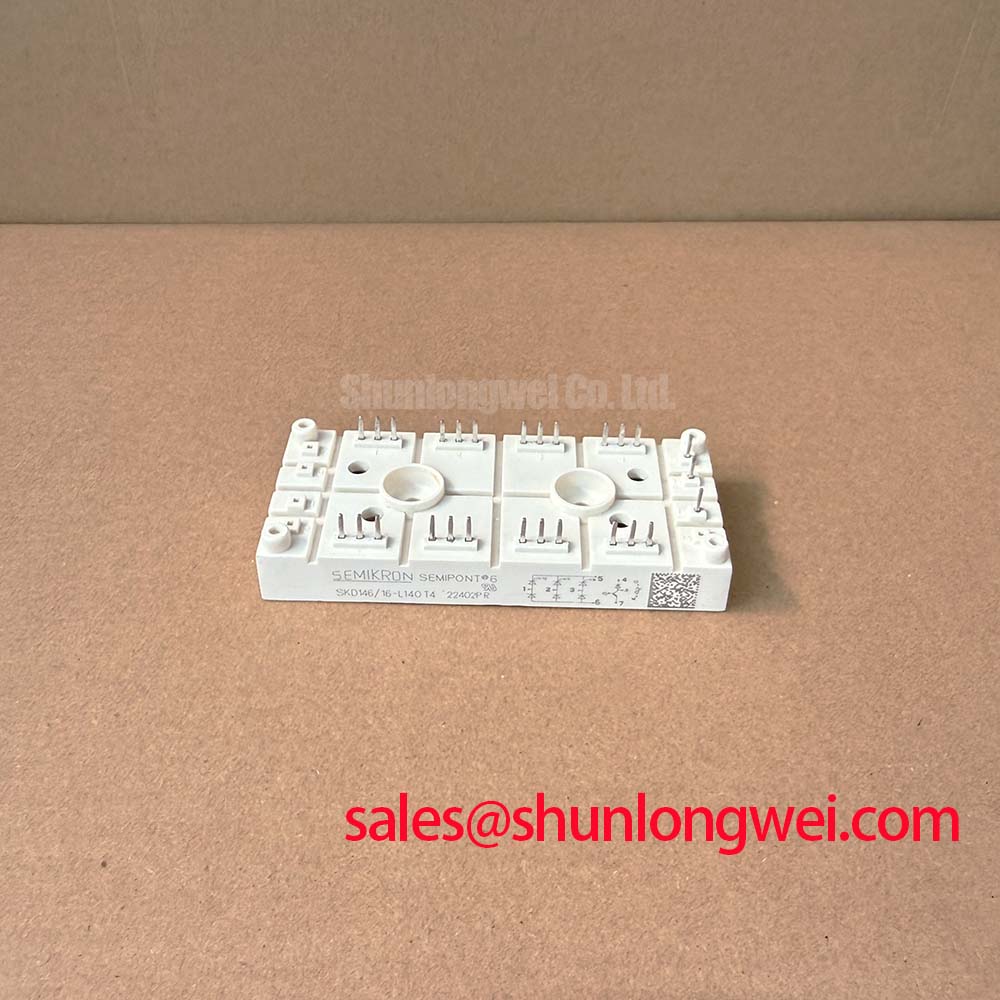
SKD146/16-L140 T4: Integrated Rectifier and Chopper Module for High-Reliability Drives
The SKD146/16-L140 T4 is an advanced power module from Semikron's SEMIPONT 6 family, engineered to streamline the design of high-performance power conversion systems. This component integrates a full three-phase bridge rectifier and an IGBT braking chopper into a single, compact package, offering key specifications of 1600V repetitive peak reverse voltage and 146A maximum DC output current. Its primary benefits include enhanced thermal performance and simplified system assembly. By consolidating multiple power stages, this module directly addresses the engineering challenge of reducing footprint and complexity in modern AC drive front-ends. For compact AC motor drives requiring robust 1600V rectification and integrated regenerative braking, the SKD146/16-L140 T4 is the optimal single-module solution.
Application Scenarios & Value
Achieving System-Level Benefits in Industrial Motor Control
The SKD146/16-L140 T4 is engineered for demanding industrial environments where reliability and power density are critical decision factors. Its primary application is in the front-end of Variable Frequency Drives (VFDs) and servo drives used for AC motor control. In a typical VFD, this module performs two essential functions: it converts the incoming three-phase AC supply into a stable DC Link voltage and manages excess energy during motor deceleration (regenerative braking) via the integrated IGBT chopper. The 1600V blocking voltage provides substantial safety margin for systems operating on 480V to 690V AC lines.
A high-fidelity engineering scenario for this module is in a conveyor belt system subject to frequent start-stop cycles. During braking, the motor acts as a generator, causing the DC link voltage to rise. The module's fast-switching IGBT chopper, controlled by the drive's logic, diverts this energy to a braking resistor, preventing a dangerous overvoltage condition. The module's high surge current rating of 1350A ensures it can withstand the inrush currents typical of motor startups without degradation, a key factor for long-term operational reliability. For systems requiring only rectification without the integrated chopper, the SKKD162/16 offers a similar voltage and current rating in a dedicated diode-diode configuration.
Key Parameter Overview
Decoding the Specs for Enhanced Thermal Reliability
The performance of the SKD146/16-L140 T4 is defined by its electrical and thermal characteristics, which are optimized for industrial drive applications. The following table highlights the key metrics derived from the official datasheet.
| Parameter | Value | Engineering Significance |
|---|---|---|
| Max. Repetitive Peak Reverse Voltage (VRRM) | 1600V | Provides a robust safety margin for operation on high-voltage industrial grids, enhancing system resilience against line voltage fluctuations. |
| Max. DC Output Current (IDavM) @ Tc=80°C | 146A | Defines the module's continuous current handling capability, suitable for a wide range of medium-power motor applications. |
| IGBT Collector Current (IC) @ Tc=80°C | 140A | Indicates the current capacity of the integrated braking chopper for effective energy dissipation during deceleration. |
| Thermal Resistance, Junction-to-Sink (Rth(j-s)) - Rectifier Diode | 0.8 K/W | A low thermal resistance signifies highly efficient heat transfer from the silicon to the heatsink, crucial for maintaining lower operating temperatures and extending component life. |
| Isolation Voltage (Visol) | 3000V / 3600V (1 min / 1 sec) | Guarantees high dielectric strength between the power circuit and the baseplate, ensuring safety and compliance in industrial systems. |
| Surge Forward Current (IFSM) | 1350A (10 ms) | Demonstrates the module's ability to withstand significant, non-repetitive current spikes, preventing failure during fault conditions. |
Download the SKD146/16-L140 T4 datasheet for detailed specifications and performance curves.
Technical Deep Dive
The Reliability Advantage of an Integrated, DCB-Based Design
The SKD146/16-L140 T4's design philosophy centers on maximizing reliability through integration and superior thermal engineering. The core of this is its use of a Direct Copper Bonded (DCB) aluminum oxide ceramic substrate. This construction offers two distinct advantages over traditional designs. First, it provides excellent electrical isolation while simultaneously acting as an efficient thermal conductor. Think of thermal resistance like the thickness of insulation on a hot water pipe; the lower the Rth(j-s) value of 0.8 K/W for the rectifier diodes, the 'thinner' the thermal insulation, allowing heat to escape the silicon chips to the heatsink much more effectively. This results in lower junction temperatures under load, a direct contributor to increased component lifetime and system reliability.
Secondly, the integration of the three-phase rectifier and the braking chopper into a single module delivers significant system-level benefits. This approach is analogous to how a modern car's powertrain might use a transaxle to combine the transmission and differential into one unit. For the power electronics engineer, this integration reduces the number of high-current interconnections, minimizes stray inductance, simplifies the assembly process, and shrinks the overall physical footprint of the drive's power stage. This allows for more compact and cost-effective system designs, a critical goal in competitive markets like Variable Frequency Drives (VFDs).
Application Vignette
Enhancing Reliability in Material Handling Systems
Consider the design of a power unit for a heavy-duty material handling elevator. Such a system requires precise speed control, high starting torque, and robust braking capabilities. The SKD146/16-L140 T4 provides an elegant solution for the drive's power core. During ascent, the six-diode bridge rectifies the mains voltage to power the motor. The challenge arises during descent with a heavy load, where the motor operates in a regenerative mode, pumping energy back into the drive's DC link. Without proper management, this energy would cause a catastrophic DC bus overvoltage failure.
Here, the integrated 140A IGBT chopper within the SKD146/16-L140 T4 becomes critical. The drive controller monitors the DC link and, upon detecting a voltage rise, activates the IGBT. This action creates a path for the excess current to flow through an external braking resistor, safely dissipating the regenerative energy as heat. The built-in NTC temperature sensor provides another layer of protection, allowing the controller to monitor the module's temperature and scale back performance or trigger a fault if thermal limits are approached. This integrated, thermally efficient design, as detailed in guides on IGBT thermal management, results in a more reliable, compact, and easily protected system compared to a solution using discrete components.
Frequently Asked Questions (FAQ)
What is the primary benefit of the integrated topology in the SKD146/16-L140 T4?
The integrated design, combining a rectifier and braking chopper, significantly reduces component count, simplifies power stage assembly, and minimizes the overall system footprint and stray inductance.
How does the Direct Copper Bonded (DCB) substrate impact thermal performance?
The DCB substrate offers low thermal resistance (e.g., 0.8 K/W for the rectifier diodes), enabling highly efficient heat transfer from the semiconductor chips to the heatsink. This leads to lower operating temperatures and enhances long-term reliability.
What is the function of the integrated NTC temperature sensor?
The NTC sensor allows for real-time monitoring of the module's internal temperature. This data enables the drive's control system to implement critical over-temperature protection (OTP), preventing thermal damage and allowing for smarter, load-based cooling strategies.
Is the 1600V rating sufficient for 690V AC line applications?
Yes, a 1600V VRRM rating provides a standard and robust safety margin for power conversion equipment operating on industrial 690V AC lines, accommodating voltage transients and fluctuations typically encountered in such environments.
From a system design perspective, the SKD146/16-L140 T4 represents a strategic move toward higher integration and reliability. By leveraging a thermally efficient package and combining key power functions, it empowers engineers to develop more compact, robust, and cost-effective motor drive solutions that are well-suited for the demands of modern industrial automation. For further reading on module integration, explore the comparison between IPMs and discrete designs offered by manufacturers like Semikron.