Content last revised on September 16, 2026
Assembly Integrity & Layout Architecture: Implementing Fuse Total Clearing I2t versus Device Melt for SKKH72/08E
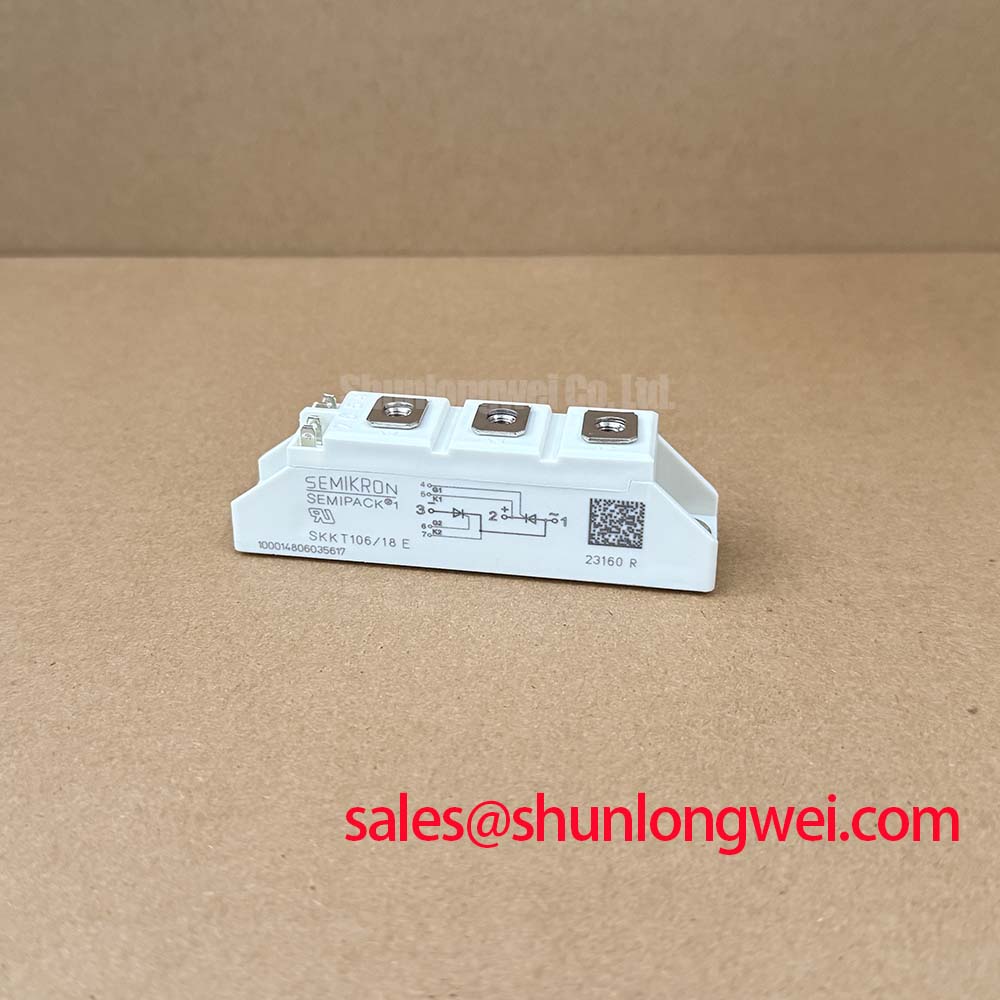
Begin by confirming the enclosure marking, terminal condition, and the stated electrical limits before connecting an SKKH72/08E module to a powered cabinet. This Semikron thyristor and diode module is officially rated at VRRM = 800 V, ITAV = 72 A at TC = 85°C, and ITSM = 1500 A for a 10 ms surge. These values establish the component boundary, but they do not replace system-level coordination checks.
| Official specification | Value | Integration relevance |
|---|---|---|
| Repetitive peak reverse voltage, VRRM | 800 V | Voltage withstand boundary for repetitive reverse blocking conditions |
| Mean on-state current, ITAV | 72 A at TC = 85°C | Thermal current rating under the stated case temperature condition |
| Surge on-state current, ITSM | 1500 A for 10 ms | Short-duration fault and inrush assessment input |
| Maximum on-state voltage, VT | 1.80 V at 200 A under the specified test conditions | Conduction loss estimation input |
| Junction-to-case thermal resistance, Rth(j-c) | 0.55 K/W | Thermal path assessment input |
| Isolation voltage, Viso | 2500 V AC for 1 minute | Official isolation test rating; system insulation compliance remains application dependent |
For a dead-short assessment, the semiconductor fuse total-clearing I2t must be compared with the module's relevant surge withstand information and the protected circuit's prospective fault current. Fuse selection cannot be based on continuous current alone: a fuse that clears too slowly can permit destructive thermal energy, while an unsuitable fuse can create unwanted interruption behavior. This is an Engineering Recommendation; the final coordination requires the fuse manufacturer's time-current data and the actual cabinet fault study.
Keep the protected current path short and mechanically secure. Bench Diagnostic: Isolate and verify the discharge state of the capacitor bank before loosening any power terminal, because stored energy can remain after the line supply is opened. Terminal and mounting torque should be verified against the applicable module and hardware documentation rather than assumed from a similar package.
SKKH72/08E Thermal-Electrical Optimization: Phase-Controlled Rectification, Firing Angle Practical Tuning
In phase-controlled rectification or capacitor-switching assemblies, check the firing reference against the measured AC waveform before attributing uneven current sharing to the SKKH72/08E. Adjusting firing angle from near zero toward 150 degrees changes the available average transfer, displacement power factor, current waveform, and reactive demand. The usable operating region is determined by the line impedance, load or capacitor branch, commutation conditions, and controller timing.
The official 1.80 V maximum on-state voltage at 200 A is a useful conduction loss boundary during peak current analysis. It should not be treated as a fixed operating drop at every current or temperature. Designers should evaluate the actual conduction interval, measured current waveform, heatsink condition, and case temperature against the official 72 A mean current rating at 85°C case temperature.
Gate trigger voltage and trigger current characteristics must be confirmed from the original full device documentation when repairing an existing firing board. A pulse train can be evaluated where the system's commutation and noise environment call for it, but pulse amplitude, width, repetition, isolation, and timing must be validated at the installed gate circuit. Avoid routing gate return conductors through a shared high-current path; minimizing common inductance helps prevent switching noise from altering the intended trigger reference.
For comparative sourcing analysis, the SKKT 106B08E can be reviewed as a separate thyristor module reference. Mechanical arrangement, terminal assignment, triggering requirements, thermal behavior, and protection coordination must be checked independently before any substitution decision.
SKKH72/08E Thermal-Electrical Optimization: Sinusoidal 10 ms Half-Cycle Surge Current Practical Tuning
The 1500 A, 10 ms ITSM rating is an Official Specification for a defined short-duration surge condition, not a repetitive operating current allowance. When examining an AC half-cycle event, capture the prospective current, waveform duration, case temperature, fuse response, and the interval before reverse voltage is reapplied. Those measurements establish whether the system event remains within the component boundary.
Thermal assessment should connect the event profile to the module's stated 0.55 K/W junction-to-case thermal resistance and the actual heatsink path. A transient thermal impedance curve, when available from the manufacturer documentation, is needed for pulse junction temperature evaluation; steady-state thermal resistance alone does not describe every short pulse. This is a Design Consideration, and the final margin must be verified through system tests rather than inferred from the surge current figure.
After a severe event, inspect the fuse, bus connection, heatsink interface, and gate circuit before returning equipment to service. Unexpected current waveforms may reflect a commutation issue, line disturbance, capacitor branch condition, or trigger timing problem. The Semikron SEMIPACK thyristor and diode module family information provides useful product line context, while device-specific ratings remain the governing reference for this module.
SKKH72/08E Operational Boundaries: Evaluating AC Line Surge Immunity and Lightning Transients
For AC line surge evaluation, begin with the measured incoming line arrangement, grounding scheme, cable routing, and the installation's applicable surge test requirement. The module's 800 V repetitive peak reverse voltage defines its official repetitive blocking rating, but it does not establish a complete immunity claim for a finished SVC or thyristor-switched capacitor cabinet.
MOV and RC snubber selection should be treated as system protection work. Their clamping behavior, energy capability, coordination with upstream protection, and placement relative to the thyristor loop must be verified against the measured surge environment. A compact, symmetric bus arrangement is a Design Consideration that can reduce parasitic inductance and help suppress transient overshoot; validation should use switching and surge measurements at the installed assembly.
Where higher switching-speed power devices are being assessed elsewhere in the same equipment platform, the technical tradeoffs described in Wide Bandgap Revolution can help frame the protection review. It does not change the required voltage, current, thermal, fuse coordination, and trigger verification for the SKKH72/08E.