Content last revised on September 10, 2026
SKKH72/14E: A High-Reliability Thyristor/Diode Module for Demanding Industrial Controls
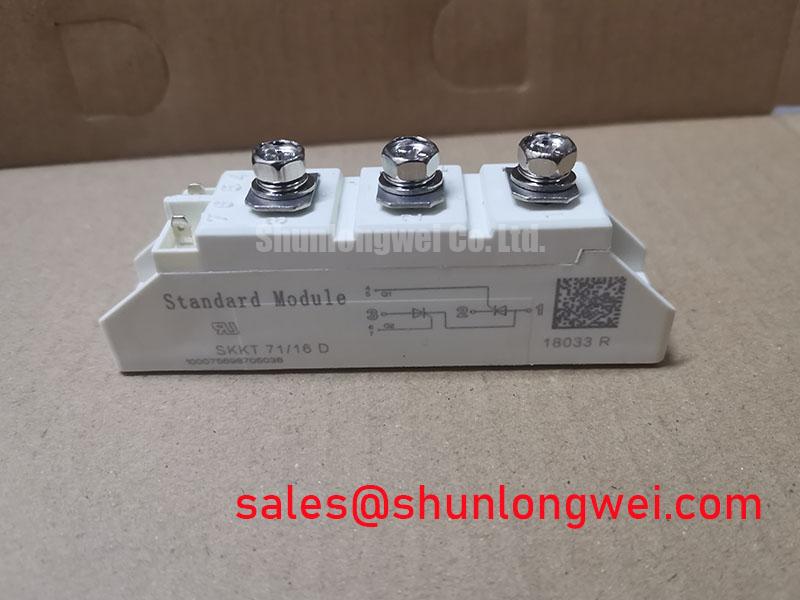
The SKKH72/14E, a component within the Semikron SEMIPACK® 1 family, is a Thyristor/Diode module engineered for superior endurance in high-stress power control systems. With core specifications of 1400V and 70A, this module provides a robust foundation for phase-controlled rectification and switching. Its design prioritizes operational longevity through hard-soldered internal joints and optimized thermal pathways, ensuring consistent performance. For industrial phase-control systems requiring long-term reliability under thermal cycling, the SKKH72/14E's hard-soldered construction offers a decisive advantage.
Key Parameter Overview
Decoding the Specs for Enhanced Thermal Reliability
The technical specifications of the SKKH72/14E are pivotal for system designers focusing on reliability and thermal management. The parameters below, sourced from the official datasheet, detail the module's capabilities in industrial environments.
| Electrical Ratings | |
|---|---|
| Repetitive Peak Off-State and Reverse Voltage (VDRM, VRRM) | 1400V |
| Average On-State Current (ITAV) | 70A (at Tcase = 85°C) |
| RMS On-State Current (ITRMS) | 125A (maximum value for continuous operation) |
| Surge non-repetitive On-State Current (ITSM) | 1450A (at Tvj = 125°C, 10 ms) |
| I²t-value | 10500 A²s (at Tvj = 125°C, 10 ms) |
| Thermal and Mechanical Ratings | |
| Operating Junction Temperature (Tvj) | -40 to +125°C |
| Thermal Resistance, Junction to Case (Rth(j-c)) | 0.37 °C/W (per thyristor/diode) |
| Package | SEMIPACK® 1 |
| Isolation Voltage (Visol) | 3000V (AC, 50 Hz, 1 min.) |
Application Scenarios & Value
Delivering System-Level Benefits in Industrial Automation
The SKKH72/14E is best suited for deployment in classic phase-control applications where robustness and precise power regulation are non-negotiable. Its architecture provides tangible value in systems that experience frequent thermal and electrical stress.
A prime engineering scenario is in DC motor control for industrial machinery like lathes or conveyors. These applications often involve repetitive start/stop cycles and variable loads, which induce significant thermal cycling. The module's construction, featuring hard-soldered joints and a heat-spreading aluminium oxide ceramic isolated metal baseplate, directly counters the primary failure mode of solder fatigue. This design ensures a reliable Thermal Resistance path, enhancing long-term operational stability and minimizing costly downtime. What is the primary benefit of its hard-soldered design? Enhanced long-term reliability by mitigating solder fatigue.
This module's capabilities also make it a strong candidate for AC motor soft starters, regulated power supplies, and temperature control systems for industrial ovens. In these contexts, its 1400V blocking voltage provides a significant safety margin for operation on standard industrial power lines. For systems that demand higher current handling or operate on higher voltage grids, the related SKKH92/16E provides a blocking voltage of 1600V with a higher current rating.
Frequently Asked Questions (FAQ)
How do the hard-soldered joints in the SKKH72/14E contribute to its long-term reliability compared to conventional modules?
Hard-soldered joints use a higher-melting-point solder alloy, creating a mechanically stronger bond that is far more resistant to the cracks and degradation caused by repeated expansion and contraction during thermal cycles. This significantly enhances the module's power cycling capability and operational lifetime, especially in applications with frequent on/off states like motor drives.
What is the engineering benefit of the aluminium oxide ceramic baseplate in the SKKH72/14E's design?
The aluminium oxide (Al₂O₃) ceramic baseplate serves a dual purpose: it provides high dielectric strength for electrical isolation while simultaneously offering an effective pathway for heat to transfer from the semiconductor chips to the heatsink. This efficient thermal management keeps the junction temperature lower during operation, improving both performance and reliability.
Technical Deep Dive
A Closer Look at the Hard-Soldered Construction and Thermal Pathway
The defining characteristic of the SKKH72/14E is its internal construction, which is purpose-built for industrial endurance. The use of hard-soldered joints is a critical design choice that directly impacts the module's resilience against wear-out mechanisms. Unlike standard soft soldering, this process creates interconnections that can withstand higher temperatures and greater mechanical stress. The engineering analogy is the difference between a glued wood joint and a dovetailed one in fine furniture; while both hold, the dovetailed joint is structurally integrated and built to endure generations of stress. This approach makes the module exceptionally suited for applications with high thermal cycling frequency.
This structural integrity is complemented by the module's thermal design. The silicon chips are soldered to an aluminium oxide ceramic Direct Bonded Copper (DBC) substrate, which is in turn soldered to a solid metal baseplate. This multi-layer stack is engineered to minimize the thermal resistance (Rth(j-c)), a measure of how effectively heat can be removed from the active semiconductor junction. A lower Rth(j-c), such as the 0.37 K/W specified for this device, means the module can operate at higher power levels or with a smaller, more cost-effective heatsink while maintaining a safe operating temperature, a key consideration for power-dense system designs.
For engineers evaluating power control components for new designs or as replacements in existing systems, the SKKH72/14E presents a compelling case based on its proven reliability and straightforward integration. To discuss your specific application requirements, please contact our technical sales team for further information.