



Content last revised on September 29, 2026
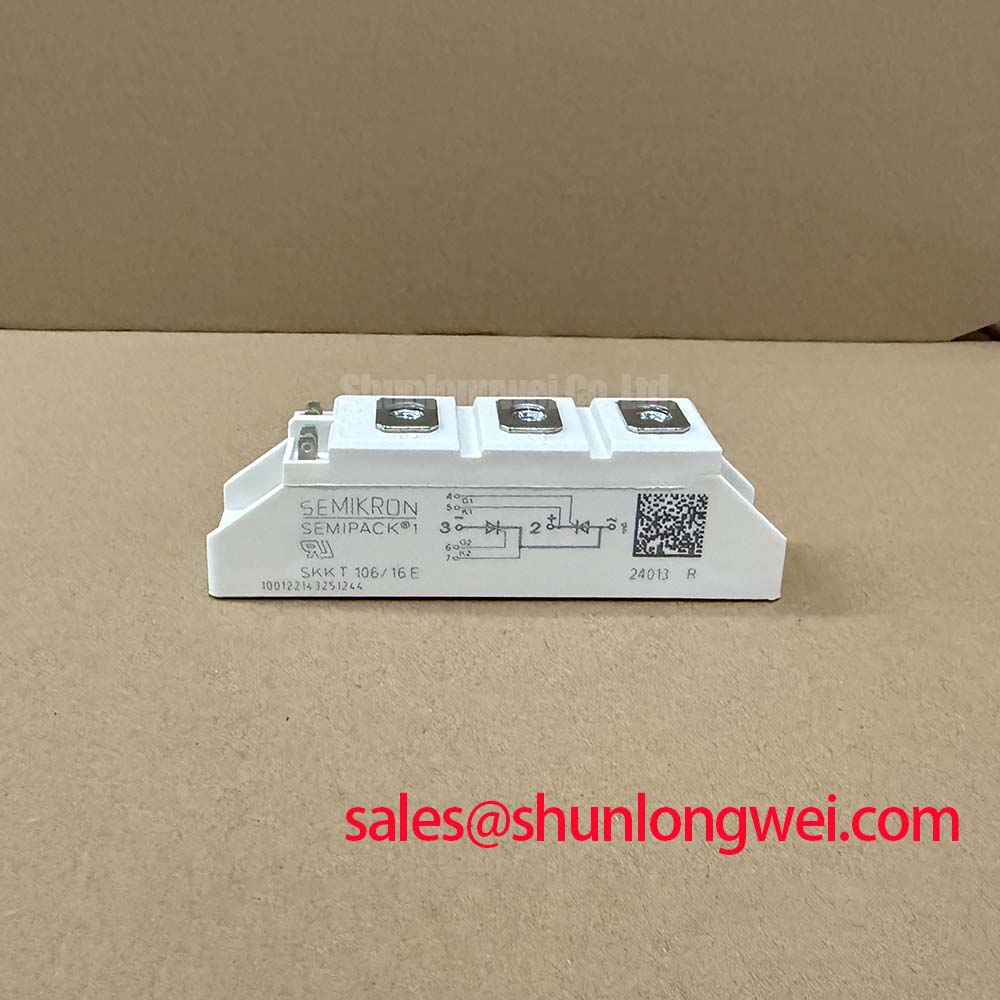
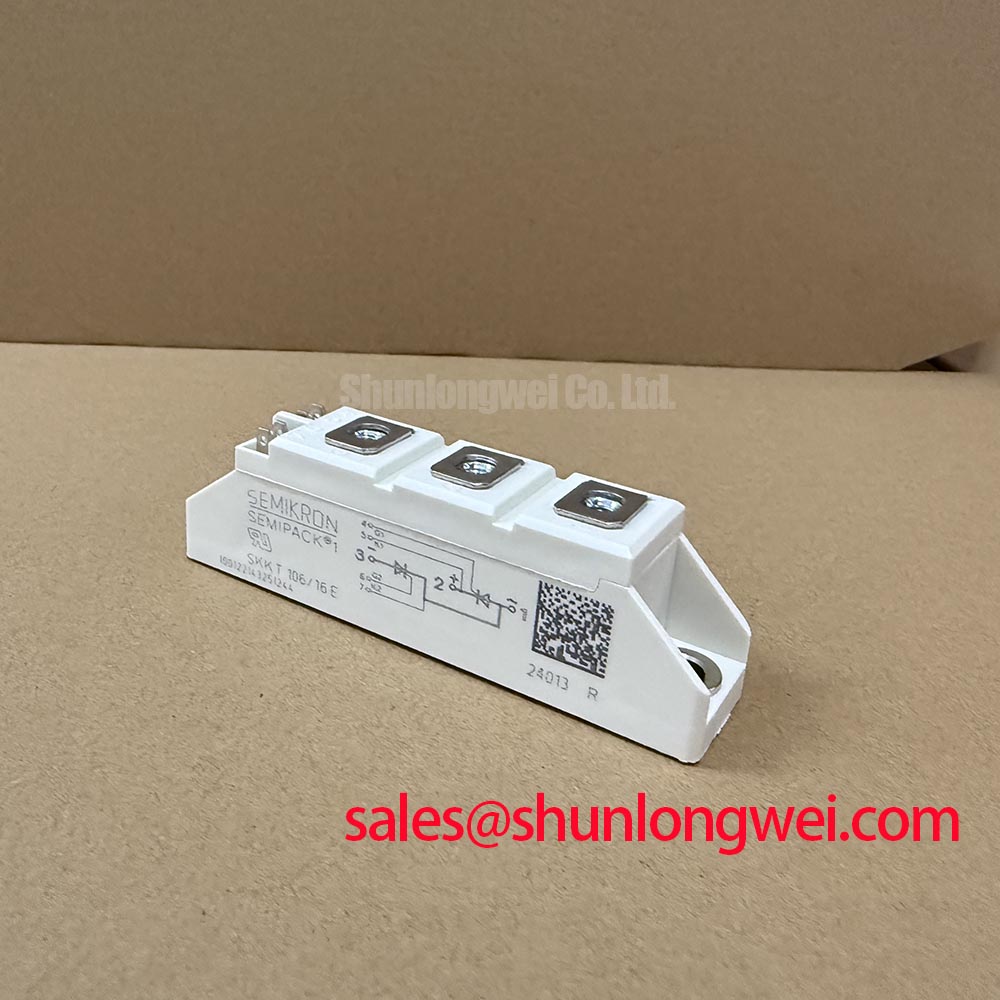
SKKT 106/16E: Thyristor Module for High-Reliability Power Control
Engineered for Durability and Thermal Stability
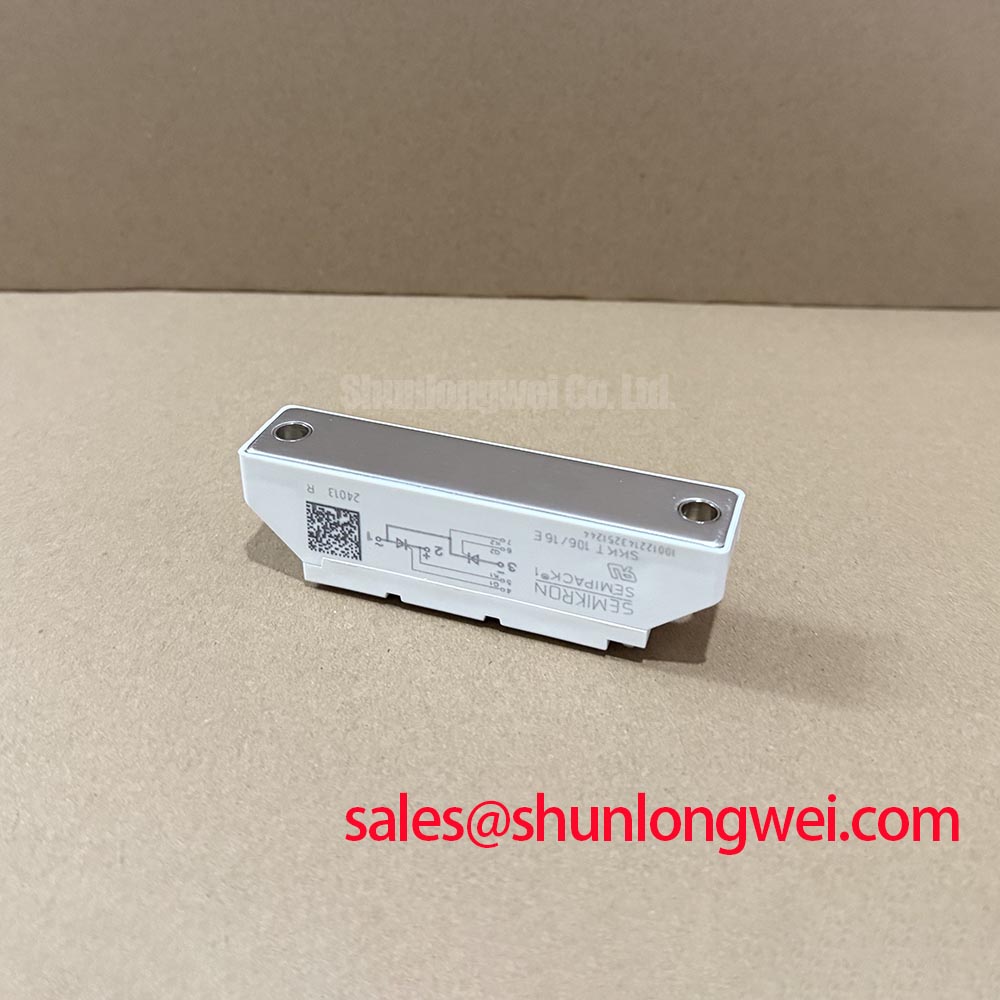
The SKKT 106/16E is a high-performance thyristor module from Semikron designed for robust and reliable power control in demanding industrial environments. It delivers consistent performance through superior thermal management and a durable mechanical design. Key specifications include: 1600V | 106A | Al₂O₃ Ceramic Insulation. The module’s primary benefits are its exceptional long-term reliability and efficient heat dissipation. This design directly addresses the engineering challenge of maintaining operational stability under significant thermal cycling. For systems requiring precise control in AC soft starters or DC motor drives, the SKKT 106/16E provides a dependable solution.
Key Parameter Overview
Decoding Specifications for System Reliability
The technical specifications of the SKKT 106/16E are tailored for demanding power control applications where both electrical performance and long-term reliability are critical. The module’s ratings ensure stable operation across a wide range of industrial conditions. Below is a breakdown of its key parameters.
| Parameter | Value | Conditions |
|---|---|---|
| Electrical Characteristics | ||
| Repetitive Peak Off-State Voltage (VDRM/VRRM) | 1600 V | |
| Average On-State Current (ITAV) | 106 A | Tcase = 85°C |
| RMS On-State Current (ITRMS) | 180 A | |
| Surge On-State Current (ITSM) | 1900 A | 10 ms, Tvj = 25°C |
| I²t Value | 18000 A²s | 10 ms, Tvj = 25°C |
| Gate Trigger Voltage (VGT) | Max 3 V | Tvj = 25°C |
| Gate Trigger Current (IGT) | Max 150 mA | Tvj = 25°C |
| Thermal and Mechanical Characteristics | ||
| Operating Junction Temperature (Tvj) | -40 to +130 °C | |
| Thermal Resistance, Junction to Case (Rth(j-c)) | 0.24 K/W | Per Thyristor |
| Insulation Test Voltage (Visol) | 3000 V | RMS, 50 Hz |
| Mounting Torque | 5 Nm | Tolerance ± 15% |
| Terminal Connection Torque | 3 Nm | Tolerance ± 15% |
Download the SKKT 106/16E datasheet for detailed specifications and performance curves.
Application Scenarios & Value
Delivering System-Level Benefits in Industrial Power Conversion
The SKKT 106/16E is engineered for a range of phase-angle control and controlled rectifier applications where uptime and precision are non-negotiable. Its robust build makes it an ideal fit for harsh industrial settings. What is the primary benefit of its construction? Enhanced long-term reliability by minimizing mechanical stress from temperature changes.
A high-fidelity engineering scenario for this module is in an AC motor soft starter for a conveyor belt system. During startup, the motor draws significant inrush current, creating both electrical and mechanical stress. The SKKT 106/16E’s ability to precisely manage the firing angle of its thyristors allows for a gradual voltage ramp-up, effectively limiting this current. Its substantial surge current rating (ITSM) of 1900A provides a critical safety margin to handle these transient conditions without degradation. This controlled start reduces mechanical shock on gears and belts, extending the lifespan of the entire system. For applications demanding higher current, the related SKKT132/16E offers similar voltage ratings with increased capacity.
- DC Motor Drives: Provides precise and reliable speed and torque control for industrial machinery.
- Industrial Heating & Temperature Control: Enables accurate power regulation for processes in industrial ovens or chemical reactors.
- Professional Light Dimming: Delivers smooth and stable power control for high-power lighting systems in theaters and studios.
Frequently Asked Questions
Engineering-Focused Inquiries
How does the Al₂O₃ ceramic baseplate in the SKKT 106/16E contribute to system reliability?
The Aluminium Oxide (Al₂O₃) ceramic baseplate provides excellent electrical insulation while maintaining effective heat transfer away from the thyristor junctions. This dual function is critical; it prevents short circuits to the heatsink and ensures the semiconductors operate within their safe temperature limits, directly enhancing the module’s long-term reliability and performance. For more on thermal design, see this guide on mastering thermal management.
What is the significance of the 18000 A²s I²t rating for system protection?
The I²t rating, often called the fuse rating, represents the thermal energy the device can withstand during a very short-duration, non-repetitive fault current event. A value of 18000 A²s allows engineers to precisely coordinate and select upstream fuses or circuit breakers that will open before the thyristor module is damaged, ensuring effective protection and preventing catastrophic failure in overcurrent scenarios.
Can the SKKT 106/16E be used for 400V and 690V line applications?
With a repetitive peak voltage rating of 1600V, the SKKT 106/16E has a substantial safety margin for standard 400V and 480V three-phase systems. It is also suitable for many 690V line applications, providing sufficient headroom to handle typical voltage transients found in industrial grids, making it a versatile choice for a wide range of AC voltage levels.
Technical Deep Dive
A Closer Look at Thermal Resistance and its Impact on Design
A critical, yet often overlooked, parameter for power modules is the thermal resistance from junction to case, Rth(j-c). For the SKKT 106/16E, this is specified at 0.24 K/W per thyristor. This value is a direct measure of how efficiently heat generated within the silicon chip can be transferred to the module’s baseplate. A lower number signifies better performance.
To understand its importance, consider an analogy: Rth(j-c) is like the resistance of a pipe carrying heat away. A narrow, clogged pipe (high thermal resistance) will cause pressure—or in this case, temperature—to build up at the source, even if the outflow is cool. The SKKT 106/16E’s low thermal resistance acts as a wide, clear pipe, ensuring the heat generated during operation is quickly and efficiently moved to the heatsink. This directly enables engineers to either use a smaller, more cost-effective heatsink for a given power level or to push more power through the module while maintaining a safe junction temperature, thereby increasing the power density of the overall system. This concept is fundamental in power electronics, as explained in resources covering Thermal Resistance.
Request for Information
For technical inquiries, purchasing information, or to discuss system design requirements for the SKKT 106/16E, please contact our technical sales team for expert support.