
Industrial Display & HMI Solutions: Engineering for Harsh Environments
In the industrial sector, a display is never just a screen—it is the critical interface between human intent and machine execution. As we enter the 2025-2026 innovation cycle, the standard for Industrial HMIs (Human-Machine Interfaces) has shifted from simple “ruggedness” to intelligent environmental adaptability.
For system integrators and OEM engineers, the challenge is no longer just finding a display that turns on; it is specifying a solution that survives the “Triple Threat” of industrial environments: thermal shock, electromagnetic interference (EMI), and variable lighting conditions. A consumer-grade tablet might survive a drop, but it will fail reliably when exposed to the 60°C ambient heat of a steel mill or the salt fog of a marine rig.
The Thermodynamics of Visibility: Fighting the Sun
Achieving sunlight readability is a thermodynamic balancing act. While boosting backlight intensity to 1,000+ nits improves outdoor visibility, it introduces a significant thermal load that can shorten LED half-life and cause liquid crystal “blackening” (isotropic phase change).
The modern engineering solution—as highlighted in industry standards by the Society for Information Display (SID)—is not just “brighter lights,” but Optical Bonding. By eliminating the air gap between the TFT panel and the cover glass using optical-grade resin, we reduce internal reflection by up to 400%. This allows for lower backlight power consumption while maintaining superior contrast ratios in direct sunlight, effectively solving the visibility-heat paradox.
Interface Evolution: PCAP vs. Resistive in the IIoT Era
The debate between Projected Capacitive (PCAP) and Resistive Touch (RTP) technologies is no longer binary; it is situational.
- PCAP has become the dominant standard for 80% of new industrial designs, driven by the demand for multi-touch gestures and ruggedized glass surfaces (up to IK10 impact rating). Advanced controller firmware now allows PCAP to function reliably even with thick industrial gloves or water droplets on the screen.
- Resistive Touch (RTP), however, retains a strategic stronghold in mission-critical sectors like Oil & Gas and Heavy Avionics. Its pressure-based actuation offers a “zero-error” input method that is immune to extreme EMI noise that might trigger phantom touches in capacitive systems.
Ruggedization Beyond the Datasheet (IP & IK Ratings)
A spec sheet boasting “IP65” is meaningless without context. True reliability engineering considers the chemical composition of cleaning agents (requiring specific cover lens coatings), the vibration frequency of the mounting chassis, and the galvanic corrosion potential in saline environments.
According to 2025 reliability reports from IEEE technical archives, display failures in the field are rarely due to panel defects; they are overwhelmingly caused by package fatigue and seal degradation. Shunlongwei’s resource library below bridges the gap between theoretical ingress protection (IP) ratings and real-world survival strategies.
Explore our curated engineering guides below to navigate the complexities of industrial display selection, from thermal management to EMI compliance.
Content in This Series

Industrial vs. Consumer Displays: Why Total Cost of Ownership Trumps Initial Price

Industrial HMI for Gloved Hands: A Guide to Resistive, Capacitive, and IR Touchscreens

Built to Last: The Engineering Behind All-Weather Digital Signage

All-Weather Clarity: The Critical Role of Industrial LCDs in Public Transit

Engineering for Extremes: A Guide to Reliable Displays in Heavy Machinery

Navigating Hazardous Environments: A Guide to Explosion-Proof Displays in the Oil & Gas Industry

Marine LCDs: Engineering for Reliability Against Salt, Sun, and Sea

The Tangible Advantage: How Haptic Feedback Boosts Safety and Efficiency in Industrial HMIs
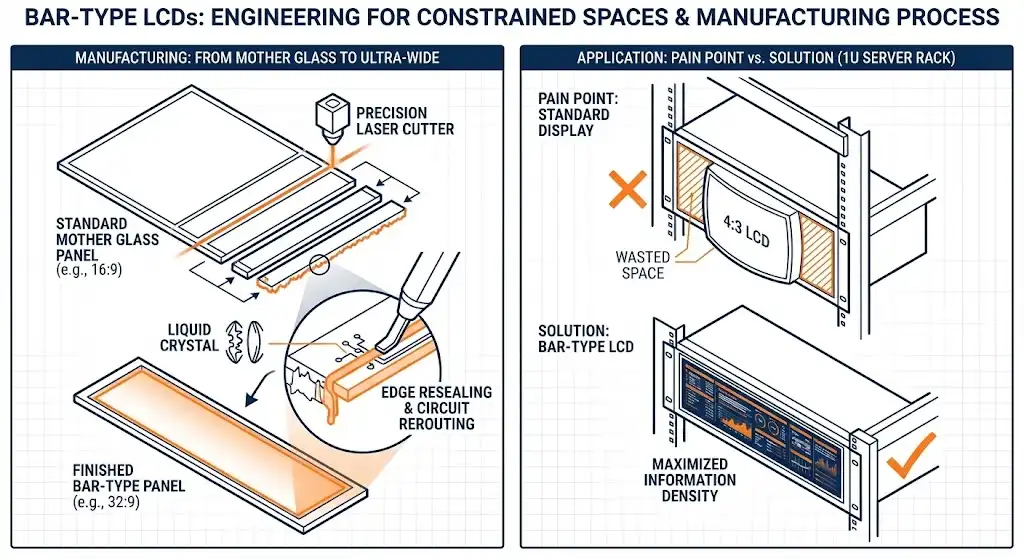
Bar-Type LCDs: A Guide to Information-Dense Displays for Constrained Spaces

Industrial Display Maintenance: A Guide to Safe Cleaning and Preventing Chemical Damage
