
Public Information Display Systems (PIDS): All-Weather Applications of Industrial LCDs from Bus Stops to Metro Cars
In the bustling arteries of modern cities, from sun-baked bus shelters to the rumbling interiors of subway cars, clear and reliable information is not a luxury—it’s a necessity. Public Information Display Systems (PIDS) are the silent navigators for millions of commuters daily. Yet, the environments they operate in are relentlessly harsh. Standard displays flicker out in the summer heat, become unreadable under the midday sun, and shudder into failure from constant vibration. For transport authorities and system integrators, this translates into a cycle of costly maintenance, frustrated passengers, and a tarnished public image. The core challenge is sourcing a display technology that doesn’t just show information, but performs flawlessly under non-stop, all-weather pressure.
The Unseen Challenge: Why Consumer Displays Fail in Public Transit
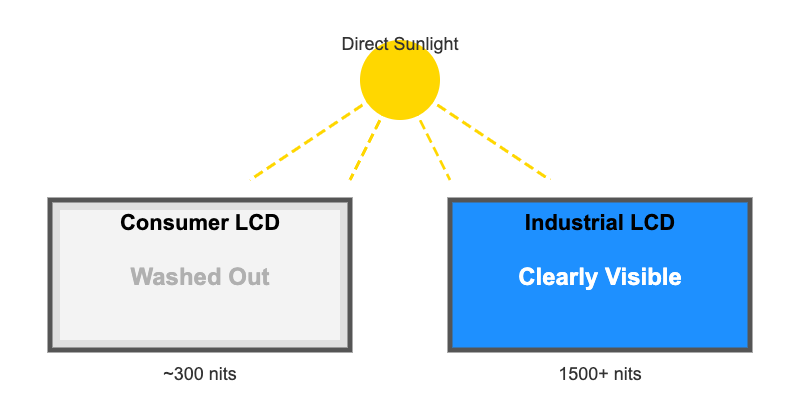
Attempting to deploy consumer-grade LCDs in public transportation is a common but costly mistake. A screen designed for a climate-controlled living room is fundamentally mismatched for the rigors of public infrastructure. Consumer displays typically have an operating temperature range of 0°C to 50°C, which is easily exceeded in a metal bus shelter on a winter morning or a sunlit train car in July. Their brightness levels, usually around 250-300 nits, are instantly washed out by direct sunlight, rendering them useless when they’re needed most. Furthermore, they lack the robust construction to withstand the constant vibrations of a moving vehicle or the potential for vandalism, leading to premature failure and frequent replacement.
Decoding PIDS: The Role of Industrial LCDs in Modern Transportation
Industrial LCDs are engineered from the ground up to conquer these environmental challenges. They are the backbone of any effective and durable Public Information Display System, ensuring information is always accessible, accurate, and legible.
What Constitutes a Public Information Display System?
A PIDS is more than just a screen. It’s an integrated network designed to deliver real-time data to the public. This includes:
- Static and Dynamic Route Maps: Showing the vehicle’s current location and upcoming stops.
- Arrival and Departure Times: Providing live updates, delays, and schedule changes.
- Service Alerts: Communicating emergencies, detours, or public safety announcements.
- Wayfinding Information: Guiding passengers through complex stations and interchanges.
- Infotainment and Advertising: Displaying supplementary content to improve the passenger experience.
The display is the final, critical link in this chain. If it fails, the entire system’s value is lost.
The Industrial-Grade Difference: Beyond the Screen
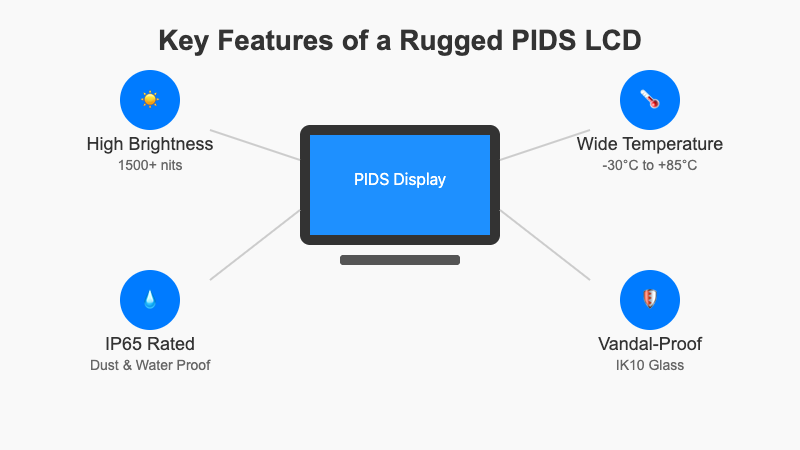
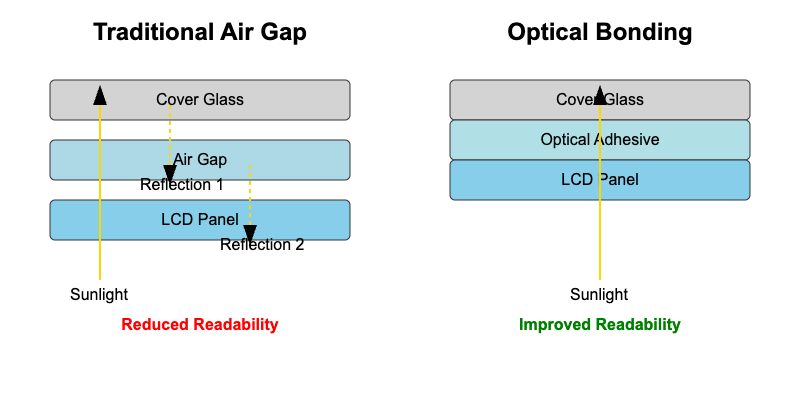
What sets an industrial LCD apart is its specialized design. Key differentiators include high-brightness backlights (often 1000 nits or more) for sunlight readability, ultra-wide operating temperature ranges (-30°C to 85°C), and conformal coatings on internal PCBs to protect against humidity and condensation. Many feature robust metal chassis and toughened cover glass (IK-rated) to resist impact and vandalism. Technologies like optical bonding are used to eliminate the air gap between the LCD panel and the cover glass, which dramatically reduces internal reflections and improves contrast in bright conditions.
Critical Technical Specifications for PIDS LCDs: An Application-Based Breakdown
The “best” industrial LCD is relative to its specific application. The requirements for a display inside a climate-controlled train are vastly different from those for an exposed platform information board.
Outdoor Bus Stops & Platforms: Battling the Elements
These displays face the most extreme conditions. Key requirements include:
- High Brightness (≥1500 nits): Essential for direct sunlight readability. Models like the G215HAN01.0 are designed with this in mind.
- Wide Operating Temperature (-30°C to +85°C): Must function reliably through freezing winters and scorching summers.
- IP65 Rating or Higher: The enclosure must be sealed against dust and water ingress.
- Optical Bonding: Prevents screen fogging from condensation and maximizes contrast.
- UV Protection: Prevents the polarizers and other materials from degrading under prolonged sun exposure.
In-Vehicle Displays (Buses & Metro Cars): Vibration and Variable Lighting
Inside a vehicle, the challenges shift from weather to mechanical stress and rapidly changing light.
- Vibration and Shock Resistance: Components must be securely mounted, and connectors ruggedized to prevent disconnection from constant movement.
- Wide Viewing Angles (≥178°/178°): Passengers will be viewing the screen from various seats and positions. IPS technology is ideal here.
- Auto-Dimming Capability: An ambient light sensor is crucial to adjust brightness, ensuring the screen is readable in daylight but not blindingly bright in tunnels or at night.
- Lower Brightness (800-1000 nits): Still needs to be brighter than a consumer display to handle sunlight through windows, but does not require the intensity of a fully outdoor screen.
A Comparative Glance: Key LCD Parameters for PIDS
This table provides a quick reference for engineers and procurement managers when specifying displays for different public transit environments.
| Parameter | Outdoor Bus Stop / Platform | In-Vehicle (Bus/Metro) | Indoor Station / Concourse |
|---|---|---|---|
| Brightness (nits) | 1500 – 2500+ | 800 – 1200 | 500 – 700 |
| Operating Temp. | -30°C to +85°C | -20°C to +70°C | 0°C to +60°C |
| IP Rating (Enclosure) | IP65 / IP67 | IP54 (front) | IP20 |
| Readability Tech | Optical Bonding, AR Glass | Wide Viewing Angle (IPS), Anti-Glare | Wide Viewing Angle (IPS) |
| Durability | IK10 Vandal-proof Glass | Vibration/Shock Certified | Long MTBF Backlight |
Engineer’s Checklist: Selecting the Perfect Industrial LCD for Your PIDS Project
Choosing the right display is a systematic process. Follow this checklist to ensure you cover all critical aspects and avoid costly specification errors.
Assess the Operating Environment: Temperature, Humidity, and Light
Quantify the environmental challenges. What are the recorded temperature extremes at the installation site? Is it exposed to rain, snow, or high humidity? What is the maximum ambient light level it will face? This data is the foundation of your specification.
Define Readability Requirements: Brightness, Contrast, and Viewing Angle
Determine the typical viewing distance and angle. For a platform sign viewed from afar, raw brightness is key. For an in-vehicle map, wide viewing angles are paramount so passengers standing to the side can read it clearly. Always request a sample to test in a real-world environment if possible.
Evaluate Durability and Longevity: MTBF, IP Ratings, and Vandal Resistance
Look beyond the initial performance. What is the Mean Time Between Failures (MTBF) rating for the backlight and the display itself, typically 50,000 to 100,000 hours for industrial models? Does the display and its enclosure meet the necessary IP (Ingress Protection) and IK (Impact Protection) ratings? Investing in a durable solution like the G150XNE-L01 reduces long-term total cost of ownership.
Consider Connectivity and Integration
Ensure the display’s interface (e.g., LVDS, eDP, HDMI) is compatible with your controller board or media player. Check for physical mounting compatibility (e.g., VESA standards) and ensure the power supply requirements match your system’s capabilities.
Case Study: Upgrading a Metropolitan Bus Network with All-Weather PIDS
Problem: Outdated, Unreliable Displays Leading to Rider Dissatisfaction
A major city’s transit authority was struggling with a network of 500 bus stops equipped with older, backlit sign boxes and a few early-generation consumer-grade LCDs. The static signs couldn’t provide real-time updates, while the LCDs frequently failed due to heat and were unreadable in the afternoon sun. Rider complaints about missing information were high, and maintenance teams were spending over 2,000 hours per year on display-related service calls.
Solution: Deploying High-Brightness, Wide-Temperature Industrial LCDs
The authority launched a phased upgrade, replacing the old units with fully-enclosed PIDS kiosks built around a 21.5-inch industrial LCD. The chosen display featured 2000-nit brightness, an operating temperature of -30°C to +85°C, optical bonding, and an IK10-rated protective glass front. The displays were connected via a cellular network to the central transit management system for live data feeds.
Result: 99.8% Uptime and a 40% Reduction in Maintenance Calls
Within a year of completing the rollout, the results were transformative. The new PIDS achieved an average uptime of 99.8%, even through a record-breaking summer heatwave. The clear, sunlight-readable screens provided reliable real-time information, leading to a measured increase in passenger satisfaction. Most impressively, annual maintenance hours dedicated to displays dropped by 40%, from 2,000 to 1,200 hours, freeing up technical staff for other critical tasks. The investment in robust industrial technology paid for itself in reduced operational costs and improved public service.
Conclusion: The Future of PIDS is Clear, Bright, and Resilient
Public Information Display Systems are no longer a futuristic concept but a core component of intelligent urban infrastructure. As cities grow smarter and passenger expectations rise, the demand for reliable, all-weather information delivery will only intensify. The success of these systems hinges on the resilience of their most visible component: the display. By moving away from fragile consumer products and investing in industrial-grade LCDs specifically engineered for harsh environments, transit authorities and system integrators can build PIDS networks that are not only informative but also exceptionally reliable and cost-effective over their entire lifecycle. For any engineer or procurement manager working on a PIDS project, prioritizing specifications like high brightness, wide temperature range, and robust construction is the key to ensuring your system delivers clarity, day in and day out. If you’re navigating the complexities of selecting the right display for your transportation project, exploring a comprehensive catalog of industrial LCD solutions is the perfect place to start.