Content last revised on September 10, 2026
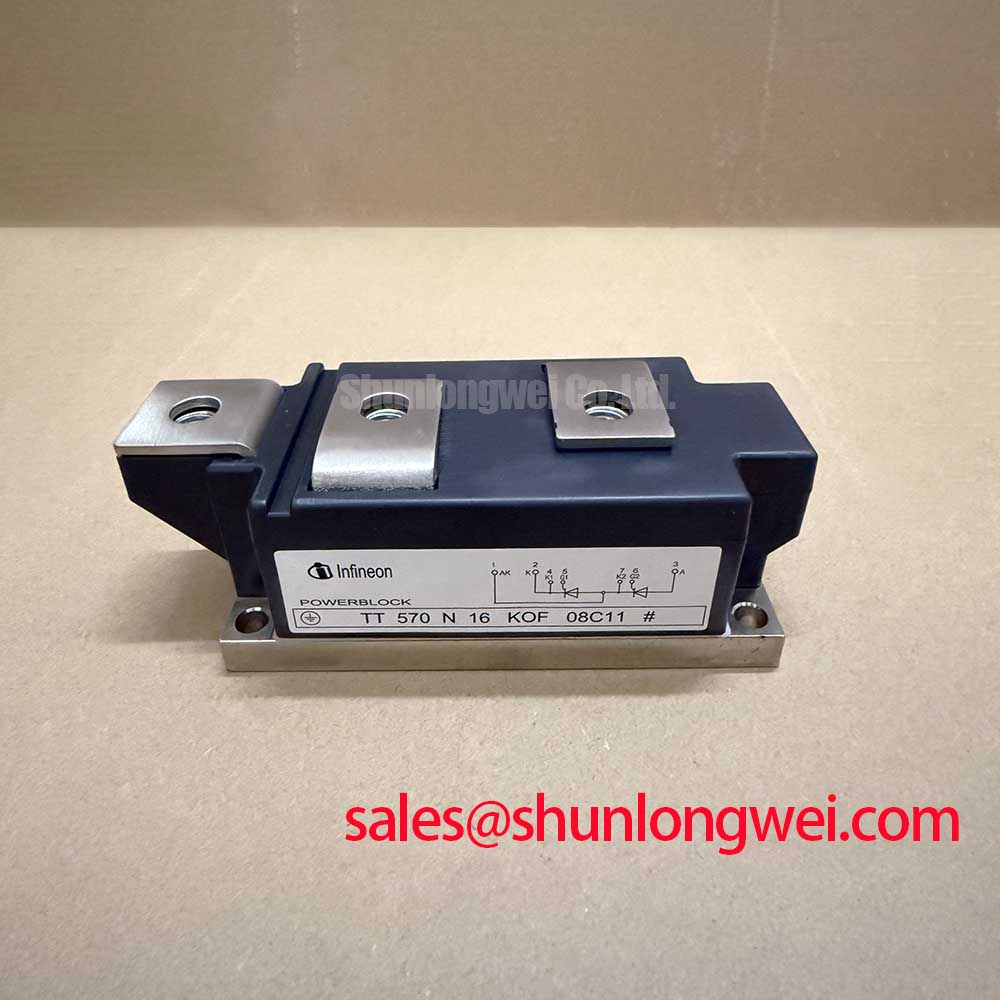
Evaluating the Infineon TT570N16 Phase Control Thyristor Module for Industrial Power Applications
Uncompromising thermal cycling reliability in high-power soft starters is enabled by industrial-grade pressure-contact technology.
Top Specs: 1600V | 600A | RthJC 0.058 K/W.
Key Benefits:
- Pressure-contact ensures high thermal reliability.
- Isolated base plate simplifies mounting.
Engineers often ask how the module handles massive start-up stress. The pressure-contact design eliminates solder fatigue, securing operation under extreme cycles. For 1600V industrial soft starters requiring high surge current protection up to 17000A, the TT570N16 is the optimal choice.
Application Scenarios & Value
Optimizing Soft Starters and Industrial Drive Rectification
Engineers often face the challenge of managing high inrush currents during the start-up phase of heavy machinery, such as industrial conveyor belts. A sudden surge can cause voltage sags or trigger overcurrent protection circuits. The TT570N16 addresses this issue with a massive surge on-state current rating of 17000A at 10ms. This capability allows the module to withstand start-up transients without degraded performance. It is commonly implemented in soft starter systems and phase control circuits for heavy industrial motors.
In addition to soft starters, this module serves as an input rectifier in high-power converters and static bypass switches. While this module provides a continuous average current of 600A at a case temperature of 85 degrees Celsius, systems requiring lower current handling can utilize the TT500N16KOF06C11.
For designs utilizing smaller motors, the TT162N16KOF provides a more compact footprint. For high-capacity drives, thermal management is key to preventing system outages. Engineers can learn more by reading about why Rth matters to ensure proper cooling system design.
Technical & Design Deep Dive
Pressure-Contact Technology and Thermal Resistance Analysis
The internal construction of the TT570N16, manufactured by Infineon, utilizes Advanced Medium Power Technology (AMPT). This approach employs a pressure contact design instead of soldered joints. Standard soldered modules suffer from wear and tear over time, much like a wire that is repeatedly bent back and forth until it snaps. By replacing solder with a mechanical contact, the module accommodates micro-expansion and contraction during temperature fluctuations. This design removes the primary wear-out mechanism of solder fatigue, extending operational lifespan.
Thermal management is further optimized by the module's exceptionally low junction-to-case Thermal Resistance (RthJC) of 0.058 K/W per thyristor arm. Think of thermal resistance as a bottleneck in a highway. A high resistance value acts like a narrow toll booth that slows down traffic, causing a build-up of heat. In contrast, the low thermal resistance of 0.058 K/W acts like an open multi-lane highway. It allows heat to flow rapidly from the silicon junction to the base plate, keeping internal temperatures well below critical limits.
This thermal path is critical when the module handles its maximum RMS on-state current of 900A. The electrically insulated base plate uses a 60mm copper design, offering 2500V insulation voltage. This enables multiple modules to be mounted on a single heatsink, reducing the footprint of the converter cabinet. For engineers designing drive systems, integrating these modules requires careful coordination with gate triggers and snubber circuits to prevent voltage transients.
For quick reference: What is the primary benefit of the pressure-contact design? It enhances thermal cycling lifetime by eliminating solder fatigue. What is the thermal resistance junction-to-case of this module? The RthJC is exactly 0.058 K/W per thyristor arm.
Key Parameter Overview
Functional Grouping of Maximum Ratings and Characteristics
| Category | Specification Parameter | Symbol | Official Datasheet Value | Engineering Significance |
|---|---|---|---|---|
| Voltage & Current Ratings | Repetitive Peak Off-State & Reverse Voltage | VDRM / VRRM | 1600 V | Maximum continuous blocking voltage capacity for 400V/480V lines. |
| Average On-State Current (TC = 85°C) | ITAVM | 600 A | Continuous current capability under nominal cooling conditions. | |
| Maximum RMS On-State Current | ITRMSM | 900 A | Maximum AC current limits to prevent internal connection overload. | |
| Thermal & Physical Characteristics | Thermal Resistance (Junction-to-Case) | RthJC | 0.058 K/W | Defines heat evacuation efficiency to the cooling assembly. |
| Surge On-State Current (10ms, Tvj = 25°C) | ITSM | 17000 A | Indicates maximum single-cycle fault current survivability. | |
| Module Weight (Approximate) | W | 1450 g | Physical weight for chassis structural load calculations. | |
| Gate & Control Specifications | Gate Trigger Current (Tvj = 25°C, vD = 12V) | IGT | 250 mA | Minimum gate current required to latch the SCR into conduction. |
| Gate Trigger Voltage (Tvj = 25°C, vD = 12V) | VGT | 2.2 V | Gate drive voltage threshold needed for reliable turn-on. |
Download the TT570N16 datasheet for detailed specifications and performance curves.
FAQ
Addressing Common Technical and Integration Questions
How does the pressure-contact technology in the TT570N16 improve system reliability compared to soldered thyristor modules?
Soldered modules face degradation over thermal cycles due to the mismatch of expansion coefficients between materials, leading to solder fatigue. The spring-loaded pressure contacts in the TT570N16 maintain constant contact pressure. This layout avoids solder joints entirely, preventing wear and ensuring high cycling durability under cyclic loads.
What is the engineering impact of the low thermal resistance RthJC of 0.058 K/W in high-power applications?
A low thermal resistance of 0.058 K/W ensures rapid thermal evacuation from the semiconductor junction to the heatsink. This decreases the operating temperature of the junction under heavy loads, which directly increases safety margins. It also allows engineers to use smaller heatsinks, maximizing system power density in confined industrial enclosures.
To discuss your system requirements, request pricing, or check availability for the TT570N16, please contact our technical sales team directly.