Content last revised on September 10, 2026
T508N14: High-Reliability Phase Control Thyristor for Demanding Industrial Applications
Engineered for Unmatched Durability in High-Power Systems
The T508N14 is a high-performance phase control thyristor engineered for exceptional reliability in the most demanding high-power industrial environments. With core specifications of 1400V and an average on-state current of 508A, this device provides robust and precise control for line-commutated systems. Key benefits include outstanding thermal performance and superior resilience against surge currents. Its design directly addresses the critical need for long-term operational stability in applications like industrial DC drives and high-power rectifiers by utilizing a proven pressure-contact design. For systems requiring even higher voltage handling, related devices like the SKKD162/18 offer blocking voltages up to 1800V.
Key Parameter Overview
Decoding the Specs for Enhanced Thermal Reliability
The technical specifications of the T508N14 are tailored for high-power phase control applications where thermal management and electrical ruggedness are paramount. The device's performance is anchored by its ability to handle significant power loads while maintaining operational stability. What is the primary benefit of its pressure-contact design? Enhanced long-term reliability by eliminating solder fatigue.
| Parameter | Value | Engineering Significance |
|---|---|---|
| Repetitive Peak Off-State and Reverse Voltage (VDRM, VRRM) | 1400 V | Provides substantial safety margin for direct use in 480V to 600V AC line applications. |
| Average On-State Current (IT(AV)) | 508 A (at Tc=100°C) | Enables high continuous power delivery, critical for large motor drives and rectifier systems. |
| Thermal Resistance, Junction to Case (Rth(j-c)) | 0.065 K/W | This extremely low value signifies highly efficient heat transfer, simplifying heatsink design and improving system power density. |
| Surge On-State Current (ITSM) | 10500 A | Exceptional ruggedness to withstand significant inrush currents and fault conditions without failure. |
| Critical dV/dt | 1000 V/µs | High immunity to false triggering caused by rapid voltage changes, ensuring stable operation in noisy industrial settings. |
Download the T508N14 datasheet for detailed specifications and performance curves.
Application Scenarios & Value
Achieving System-Level Benefits in Heavy Industrial Power Control
The robust design of the T508N14 makes it the optimal choice for high-stress, line-frequency applications where reliability is non-negotiable. Its combination of high current and voltage ratings with a durable disc package provides tangible value in several key areas. For systems where precise, high-frequency switching is the priority, an IGBT Module such as the FZ400R12KE3 might be more suitable; however, for raw power throughput, the T508N14 is superior.
- Industrial Motor Drives: In large-scale soft starters and DC motor drives, the T508N14 excels at managing high inrush currents during motor startup. Its high surge current (ITSM) capability of 10.5kA ensures survival through demanding torque requirements without degradation, a common challenge in applications like conveyors, fans, and pumps.
- High-Power Rectifiers: For controlled rectifiers in welding power supplies or electrochemical processing, the device provides stable and efficient AC-to-DC conversion. Its low on-state voltage drop at high currents minimizes conduction losses, directly contributing to higher overall system efficiency.
- Static VAR Compensators (SVC): In power quality applications, this thyristor can be used in thyristor-controlled reactors (TCRs) to provide dynamic reactive power compensation, stabilizing the grid under fluctuating loads.
Technical Deep Dive
A Closer Look at the Pressure-Contact Design for Long-Term Reliability
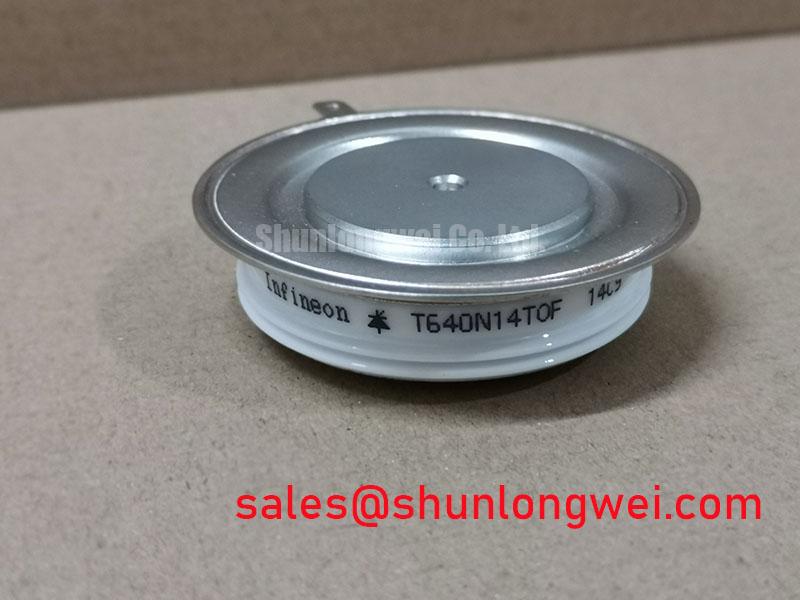
A defining feature of the T508N14 is its pressure-contact, or "disc," package design. Unlike conventional power modules that rely on soldered connections, this device is mechanically clamped between two heatsinks. This design choice is fundamental to its long-term reliability in harsh environments. The constant pressure ensures a large, uniform contact area for both electrical and thermal paths.
This method completely circumvents a primary failure mode in high-power modules: solder fatigue. Repetitive thermal cycles, caused by power-on/power-off sequences, induce mechanical stress on solder joints, eventually leading to cracks and failure. The pressure-contact design is immune to this. Think of it like the robust connection of a bolted industrial busbar versus a less durable soldered wire; the bolted connection is designed for decades of service under heavy load and vibration. This intrinsic ruggedness makes the T508N14 an ideal component for capital equipment with expected service lives of 15-20 years or more, such as in metal processing or power distribution infrastructure. For further reading on device durability, understanding Safe Operating Area is crucial.
Frequently Asked Questions (FAQ)
Technical Insights for Design Engineers
What is the main advantage of the T508N14's pressure-contact design over a standard soldered module?
The primary advantage is dramatically improved reliability and operational lifespan. By eliminating solder layers, it becomes immune to solder fatigue failure caused by thermal cycling. This makes it exceptionally durable for applications with frequent load changes or harsh operating conditions.
How does the low thermal resistance (Rth(j-c)) of 0.065 K/W directly benefit my thermal design?
This extremely low thermal resistance means heat is evacuated from the semiconductor junction to the heatsink with exceptional efficiency. For a design engineer, this translates into the ability to use a smaller, less costly heatsink for a given power dissipation, or to run the device at a higher current level while keeping the junction temperature within safe limits, thereby increasing system power density.
Is the T508N14 suitable for line-commutated converters?
Absolutely. The T508N14 is specifically designed for line-frequency (50/60 Hz) applications. Its characteristics are optimized for the commutation process in controlled rectifiers and AC voltage controllers, where the AC line voltage itself is used to turn off the thyristor.
What are the critical mounting requirements for a disc-type thyristor like this?
Proper mounting is essential to realize the benefits of the pressure-contact design. A specific, evenly distributed mounting force must be applied using a calibrated clamp. This ensures low thermal and electrical resistance. Insufficient or uneven force can lead to localized overheating and premature failure. Always refer to the manufacturer's application notes for precise force specifications and mounting procedures.
The enduring architecture of the T508N14 positions it as a strategic component for the backbone of heavy industry and power infrastructure. Its focus on robustness and raw power handling ensures it remains a vital element in systems where long-term reliability is not just a feature, but a fundamental requirement for operational continuity and safety.