Content last revised on September 10, 2026
VI-252-IW: A High-Density DC-DC Converter for Scalable and Customizable Power Systems
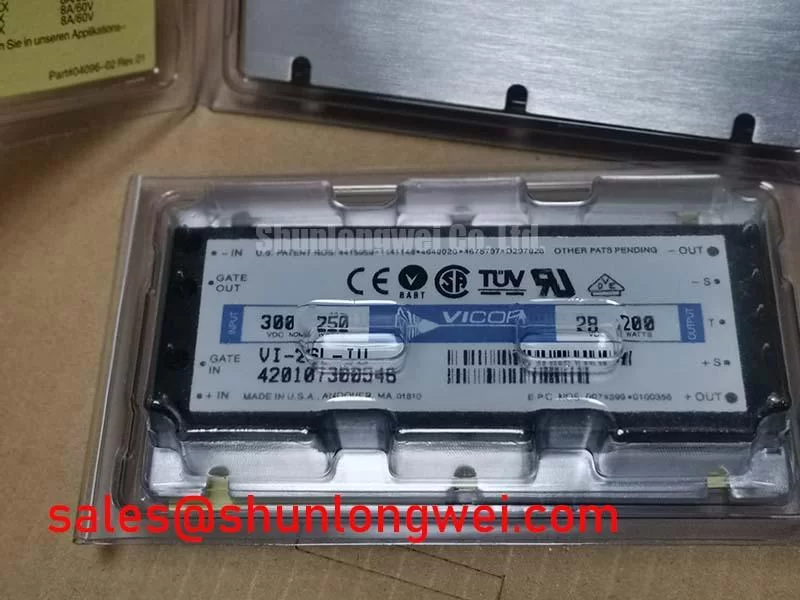
The VI-252-IW is a high-density, component-level DC-DC converter module engineered for robust performance in demanding applications. As part of Vicor's VI-200 series, it leverages a high-frequency zero-current switching (ZCS) topology to deliver a potent combination of efficiency and power density. This module provides a nominal 15V output at up to 10A, delivering 150W of isolated power. Key benefits include inherent parallelability for scalable power arrays and a wide output trim range for ultimate design flexibility. It addresses the critical engineering challenge of creating adaptable power systems by allowing designers to easily scale power output or create custom voltage rails without requiring a complete redesign. For modular power systems requiring a customizable and scalable 15V rail, the VI-252-IW offers an optimal blend of density and flexibility.
Key Parameter Overview
Decoding the Specs for System Integration Flexibility
The specifications of the VI-252-IW are tailored to support simplified system design and high reliability. The high power density of up to 50W/in³ is a defining feature, enabling the development of compact and lightweight end-equipment where space is at a premium. This is achieved through a high-frequency switching architecture that minimizes the size of magnetic components. Furthermore, the module's efficiency, reaching up to 90%, directly translates to reduced waste heat. This lessens the burden on the system's thermal management infrastructure, potentially allowing for smaller heatsinks and contributing to a lower total cost of ownership.
| Parameter | Value |
|---|---|
| Output Voltage | 15V |
| Output Power | 150W |
| Output Current | 10A |
| Nominal Input Voltage | 300V (from VI-2xx series front-end) |
| Efficiency | Up to 90% |
| Output Voltage Trim Range | 50% to 110% of Nominal |
| Isolation Voltage | 3000Vrms (Input to Output) |
| Dimensions | 4.6” x 2.4” x 0.5” (116,8 x 61,0 x 12,7 mm) |
Download the VI-252-IW datasheet for detailed specifications and performance curves.
Application Scenarios & Value
Achieving System-Level Benefits in Automated and Industrial Platforms
The VI-252-IW is engineered for applications where power system adaptability and reliability are paramount. Its modular design is a cornerstone of modern Distributed Power Architectures (DPA), moving power conversion closer to the point of load for improved regulation and efficiency.
A prime engineering scenario is in the design of Automated Test Equipment (ATE). ATE systems often require a variety of voltage rails to test different devices, and these requirements can change from one project to the next. The challenge is to design a power system that is flexible without being overly complex or expensive. The VI-252-IW directly solves this with its wide output voltage trim capability. An engineer can use a single part number across multiple test heads, using a simple external resistor to precisely adjust the 15V nominal output down to 7.5V or up to 16.5V. This drastically simplifies the bill of materials (BOM), streamlines inventory, and accelerates the development of new test fixtures. What is the primary benefit of its wide trim range? It offers unparalleled flexibility to meet custom voltage needs with a standard component.
The module's capability for easy paralleling is also critical for creating scalable or high-reliability N+1 redundant power systems in industrial process controls and telecommunications infrastructure. By connecting multiple modules, engineers can increase the total available power output to meet growing system demands without replacing the entire power supply.
Technical Deep Dive
Inside the Component-Level Power Architecture: Paralleling and Trimming
The architectural design of the Vicor VI-200 series, including the VI-252-IW, is what enables its exceptional flexibility. Two key features merit a closer look: the output voltage trim function and the booster module capability for paralleling.
The output trim functionality is controlled via the SC (Sense/Compensation) and Trim pins. By connecting an external resistor between the Trim pin and either the +Sense or -Sense pin, the output voltage can be precisely adjusted. This provides an elegant, analog method for programming the output voltage, a feature essential for applications requiring fine-tuning or accommodation for voltage drops in long cable runs.
For power scaling, the VI-252-IW can be paralleled with "Booster" modules (designated VI-Bxx). This master/slave configuration is remarkably simple to implement. The "Driver" module (like a standard VI-252-IW) has a GATE OUT pin, which connects to the GATE IN pin of a companion Booster module. This single connection synchronizes the power trains, ensuring they operate at the same frequency and inherently share the load current dynamically to within 5%. Paralleling these modules is like having a team of perfectly synchronized workers; a dedicated connection ensures each one carries an equal share of the load, preventing any single module from being overworked and enhancing overall system lifespan.
Frequently Asked Questions (FAQ)
How does the VI-252-IW's current sharing mechanism work when paralleling modules?
Current sharing is achieved by connecting the GATE OUT of a master (Driver) module to the GATE IN of one or more slave (Booster) modules. This synchronizes the internal power stages, leading to inherent and automatic load balancing without the need for external control circuits or adjustments.
What is the adjustable output voltage range of the VI-252-IW?
The VI-252-IW offers a very wide trim range, typically allowing adjustment from 50% to 110% of its nominal 15V output. This means it can be programmed to deliver an output voltage from approximately 7.5V to 16.5V.
What is the significance of the high power density in the VI-252-IW's design?
Its high power density (up to 50W/cubic inch) allows engineers to design more compact and lighter systems. This is a critical advantage in applications such as aerospace, portable equipment, and densely packed industrial enclosures where space and weight are significant constraints.
What type of front-end module is required for the VI-252-IW?
As a DC-DC converter, the VI-252-IW requires a rectified and filtered DC input. For AC line operation, it is typically paired with a front-end module, such as a Power Factor Correction (PFC) module or a filter/rectifier, to provide the necessary nominal 300VDC input.
The design philosophy of the VI-252-IW centers on providing engineers with modular building blocks to construct sophisticated, high-performance power systems. By integrating advanced switching technology with user-centric features like wide trimming and effortless paralleling, it enables the rapid development of power solutions that are not only compact and efficient but also strategically adaptable to future requirements.