
Content last revised on January 31, 2026
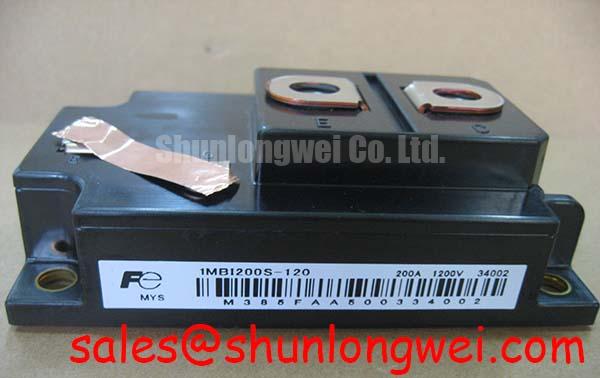
Fuji Electric 1MBI200S-120 IGBT Module | 1200V 200A High-Performance Switching
The 1MBI200S-120, a flagship single IGBT module from Fuji Electric, is engineered to deliver low conduction losses and high-speed switching capabilities for demanding industrial power systems. By integrating a high-density trench structure, this module achieves a superior balance between thermal efficiency and electrical robustness, making it a staple in high-reliability power conversion architectures.
- Unique Value Proposition: Optimized for low Vce(sat) and high-speed switching to maximize system-level energy efficiency in 1200V industrial platforms.
- Core Specifications: 1200V Vces | 200A Ic | 1500W Ptot.
- Key Engineering Benefits: Reduced heat sink requirements due to low thermal resistance; enhanced long-term reliability in harsh cyclic loading environments.
- Expert Insight: For engineers questioning the thermal headroom of 1200V modules, the 1MBI200S-120 features an Rth(j-c) of 0.085 °C/W, providing the margin needed for compact inverter designs.
For industrial motor drives requiring 1200V isolation and 200A continuous collector current, the 1MBI200S-120 stands as the optimal choice for balancing thermal margin with switching performance.
Application Scenarios & Value
Achieving System-Level Efficiency in High-Frequency Power Conversion
The 1MBI200S-120 is primarily utilized in Variable Frequency Drives (VFD) and large-scale Uninterruptible Power Supply (UPS) systems. In a typical Variable Frequency Drive (VFD) application, the primary engineering challenge is managing the heat generated during the high-torque startup phase of an induction motor. The 200A collector current rating of the 1MBI200S-120 allows the system to handle these transient surges without exceeding the 150°C maximum junction temperature, thereby preventing catastrophic thermal runaway. This makes it an essential component for high-efficiency inverter systems.
In high-power Solar Inverters, this module facilitates precise power modulation. The low Vce(sat) (typically 2.3V at 200A) directly translates to lower conduction losses during the peak sun hours, improving the overall efficiency of the Photovoltaic (PV) plant. For systems requiring even higher power density or parallel configurations, engineers may consider the 1MBI300SA-120B, which provides expanded current handling within a similar technological framework. These modules are critical for maintaining compliance with IEC 61800-3 standards regarding electromagnetic compatibility and power quality in industrial grids.
Key Parameter Overview
Decoding the Specs for Enhanced Thermal Reliability
| Key Parameter | Official Value | Engineering Significance |
|---|---|---|
| Collector-Emitter Voltage (Vces) | 1200V | Provides robust safety margin for 400V/480V AC line applications. |
| DC Collector Current (Ic) | 200A (@ Tc=80°C) | High current density allows for compact module footprint in 75kW+ drives. |
| Saturation Voltage (Vce(sat)) | Typ. 2.3V | Directly minimizes conduction losses, equivalent to a 10-15% efficiency gain over older generations. |
| Thermal Resistance (Rth(j-c)) | 0.085 °C/W | Critical for thermal management and heatsink downsizing. |
| Isolation Voltage | 2500V AC (1 min) | Ensures operator safety and equipment protection in high-voltage environments. |
Download the 1MBI200S-120 datasheet for detailed specifications and performance curves.
Industry Insights & Strategic Advantage
Aligning Power Density with the Carbon Neutrality Roadmap
As the global industrial sector shifts toward Industry 4.0 and aggressive decarbonization, the efficiency of power semiconductors has moved from a technical detail to a strategic asset. The 1MBI200S-120 addresses the growing need for high-efficiency Power Electronics in decentralized energy grids. By utilizing a single-switch topology with optimized gate charge, this module enables designers to increase switching frequencies without the typical penalty of excessive switching losses. This is vital for reducing the physical size of passive components like inductors and capacitors, leading to a lower Total Cost of Ownership (TCO) for the end-user.
Furthermore, the Fuji Electric S-series packaging is renowned for its mechanical robustness against Power Cycling. This reliability is essential in applications like Marine Inverters or Heavy Machinery, where vibration and thermal fluctuations are constant. Aligning with these trends, the 1MBI200S-120 provides a platform that supports high-uptime requirements while meeting the stringent energy-saving regulations of modern industrial landscapes. For a deeper technical understanding, engineers may refer to the Fuji Electric V-Series IGBT application notes.
Application Vignette
Optimizing Heavy Duty Servo Systems for Peak Precision
In a high-performance Servo Drive system used in automotive assembly lines, the 1MBI200S-120 serves as the critical switching element. The challenge in these systems is the high-frequency "start-stop" cycle, which induces rapid thermal expansion and contraction within the IGBT module. A failure in the Gate Drive or a slow response during a Short-Circuit event can lead to production downtime costing thousands of dollars per hour.
The 1MBI200S-120 resolves this through its high Short-Circuit Withstand Time. When paired with a sophisticated Miller Clamp circuit, the module resists parasitic turn-on events caused by high dv/dt switching. This allows the servo system to maintain micro-millimeter precision under heavy loads. By leveraging the low internal inductance of the Fuji S-series package, the system also experiences fewer voltage spikes, reducing the stress on the motor's insulation and extending the overall system lifespan.
Frequently Asked Questions
What is the primary benefit of the 1MBI200S-120 low Rth(j-c) value?
The 0.085 °C/W thermal resistance allows for significantly more efficient heat transfer from the junction to the case. This directly enables engineers to use smaller heatsinks or increase the power throughput of the system while maintaining safe operating temperatures.
Is the 1MBI200S-120 suitable for 690V AC line applications?
While the 1200V Vces rating is ideal for 400V or 480V AC lines, for 690V applications, a module with a 1700V rating is typically recommended to provide a sufficient safety margin against peak voltage transients.
How does the Vce(sat) of 2.3V impact the efficiency of a 50kW inverter?
A lower Vce(sat) minimizes the energy dissipated as heat during the conduction phase. In a 50kW system, even a 0.1V reduction in saturation voltage can save hundreds of watts of power loss over time, leading to lower operating costs and reduced cooling requirements.
What type of gate driver is recommended for the 1MBI200S-120?
A driver capable of providing a +/-15V gate swing with a peak current of at least 2.0A is recommended. Ensuring a Negative Gate Voltage during the off-state is critical to prevent accidental turn-on in high-noise industrial environments.
What makes the 1MBI200S-120 suitable for UPS applications?
Its low Vce(sat) ensures high efficiency during continuous operation under critical power loads, while the robust 1200V rating handles the high DC bus voltages common in double-conversion UPS topologies.
As industrial requirements evolve towards higher power densities, the 1MBI200S-120 remains a reliable, field-proven solution. Its balance of electrical performance and thermal management makes it a cornerstone for engineers designing the next generation of efficient power conversion hardware.