Content last revised on October 29, 2026
2DI300A-120 Operational Boundaries: Evaluating IEC 61000-4-5 Industrial Surge Immunity Limits
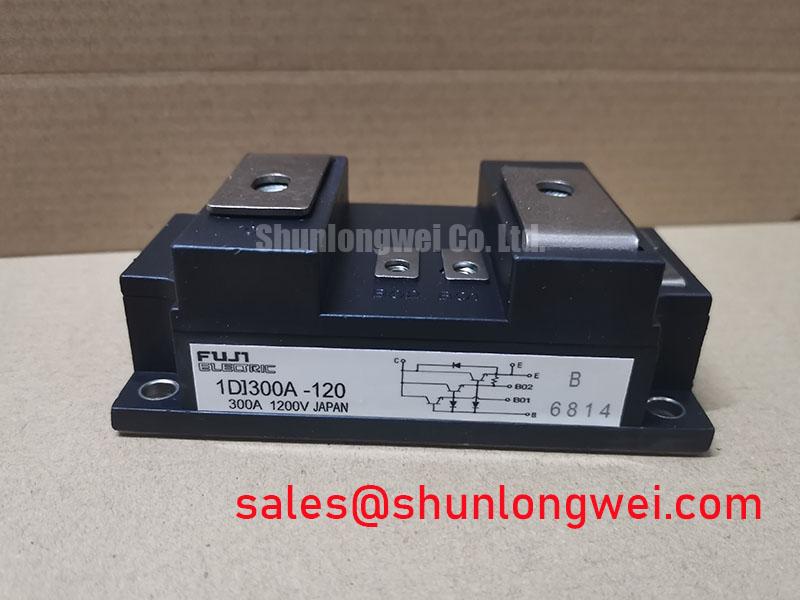
When a medium-frequency induction melting or hardening furnace trips after an input surge, isolate the power stage first and inspect the protection path around the Fuji Electric 2DI300A-120. This power transistor / Darlington module is listed with a 1200.0 V voltage rating and 300.0 A current rating. These ratings are subject to the applicable datasheet conditions; they do not replace system-level surge coordination or insulation verification.
For an IEC 61000-4-5 evaluation, the AC input protection network should be reviewed as a complete chain. The metal oxide varistor selection, upstream fuse, wiring impedance, and any RC snubber placed near the power switching device must be assessed together. A MOV should clamp the expected transient without creating an unsuitable continuous leakage condition, while the snubber should be evaluated for pulse energy, switching frequency, and thermal loading. The final protection arrangement remains a system design decision confirmed through controlled surge testing.
During service, compare the installed fuse with the manufacturer’s published I²t coordination information, where available, rather than selecting by current rating alone. Confirm that the fuse interrupting capability, clearing behavior, and semiconductor withstand characteristics are compatible. Inspect the main terminals for discoloration, looseness, or heat marking, then verify that the cable arrangement matches the original power path before applying test voltage.
⚠️ Field Alert: Apply the fastening torque specified for the actual terminal and mounting hardware, and keep the thermal interface layer uniform so mechanical pressure does not become an additional source of thermal resistance.
Mechanical installation should also preserve the intended creepage and clearance around the high-voltage terminals. If the module is being evaluated in a furnace cabinet, check contamination, conductive dust, and moisture because enclosure conditions can change the effective insulation environment. For thermal interface workmanship, the principles described in From Chip to Air provide useful engineering context without replacing the device manufacturer’s mounting instructions.
Transient Dynamics & Electrical Design: Isolated Base Drive for 2DI300A-120
An isolated base-drive circuit must deliver repeatable drive under the actual furnace switching conditions. Where transformer isolation is used, the service check begins at the transformer, isolation barrier, secondary wiring, and base return path. Look for asymmetric drive amplitude, ringing, or weak drive at elevated temperature. These symptoms can arise from transformer saturation, excessive leakage inductance, poor termination, or a control board fault, so compare the affected channel with a known-good channel using an appropriately rated isolated oscilloscope setup.
The 2DI300A-120 is a bipolar Darlington transistor module, not a thyristor: gate trigger current, gate trigger voltage, and holding current are not the applicable drive parameters. Base current, base-emitter voltage limits, and switching characteristics must be checked against the applicable Fuji Electric electrical characteristics and the specific drive circuit. They should not be inferred from the 1200.0 V and 300.0 A headline ratings. The driver must maintain adequate base drive throughout the intended on-time and remove stored charge appropriately at turn-off. For transformer-coupled arrangements, transformer reset, duty cycle, and drive-circuit dissipation must also be validated by the system designer.
Keep the base-drive loop physically separated from high-current commutation conductors. Minimize parasitic coupling and verify the base-emitter waveform at the module terminals rather than relying only on the driver-board test point. If localized heating is suspected, inspect the drive transformer where fitted, series components, connector contacts, and return conductor before replacing the power module.
When assessing a replacement path, compare terminal arrangement, electrical ratings, mounting geometry, and base-drive requirements as separate checks. The 1DI75F-100 may be reviewed as a related Fuji Electric module, but that relationship does not establish it as a replacement for the 2DI300A-120.
Preventing Spurious Faults: Reverse-Recovery Temperature Dependence in 2DI300A-120 Applications
Reverse-recovery behavior becomes important when the power stage commutates at high current. The diode path should be evaluated for reverse-recovery peak current, recovery time, softness, and temperature dependence under the real load and switching conditions. These characteristics influence commutation stress, switching loss, voltage overshoot, and conducted or radiated interference, but none can be established from the module’s 1200.0 V and 300.0 A ratings alone.
For a furnace power stage, capture the switching waveform at the power terminals with a probe and connection method suitable for the voltage environment. Review the relationship between current reversal, voltage rise, snubber activity, and heatsink temperature. A sharp recovery event can also expose weaknesses elsewhere in the layout, including excessive loop inductance, an incorrectly placed capacitor, or an unsuitable damping network. The design objective is to control the commutation transient while keeping additional snubber losses within the system thermal budget.
Thermal validation should use the actual heatsink, airflow arrangement, mounting surface, and duty cycle. The temperature response of the assembly is affected by the complete thermal path, so a module that passes a short bench test may behave differently during repeated heating cycles. Where internal solder integrity is part of a failure investigation, X-Ray Inspection for solder void detection can be considered by a qualified inspection provider. Airflow analysis may also benefit from Computational Fluid Dynamics when the cabinet cooling path is complex.
Engineers may also review the related 1DI150H-055 as a reference for another Fuji Electric power transistor module, not as an established substitute. Confirm polarity, terminal functions, electrical ratings, fuse coordination, base-drive compatibility, and physical clearances against the original equipment documentation before any installation decision.