
Content last revised on February 10, 2026
2DI300A-050D: Engineering Analysis of a High-Current 500V Dual IGBT Module
An Engineer's Introduction to the Fuji Electric 2DI300A-050D
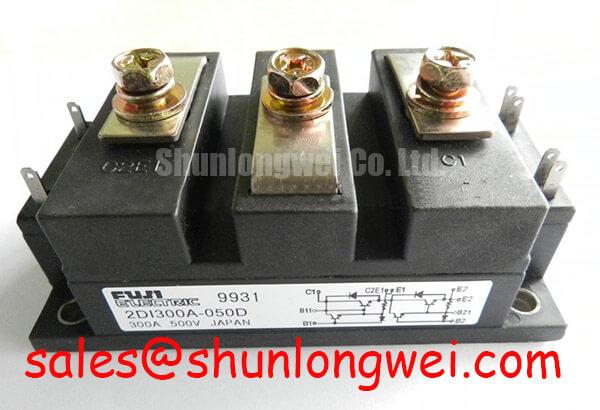
The Fuji Electric 2DI300A-050D is a dual IGBT module engineered for robust performance in low-voltage, high-current power conversion systems. With core specifications of 500V and 300A in a half-bridge configuration, this module provides a solid foundation for applications prioritizing straightforward design and reliable current handling. Its key benefits include optimized low-voltage operation and a thermally efficient package. For engineers designing power stages for 200-240V AC line applications that demand substantial current capacity without the need for higher voltage-rated, and often more expensive, 600V or 1200V modules, the 2DI300A-050D presents a precisely tailored solution. What is the primary benefit of its dual configuration? It simplifies the circuit layout for common half-bridge topologies, reducing design complexity.
Key Parameter Overview
Decoding the Specs for Low-Voltage System Reliability
The technical specifications of the 2DI300A-050D are optimized for durability and efficiency in its target application range. The module's performance is anchored by a balanced set of electrical and thermal characteristics that are critical for system designers evaluating components for demanding industrial loads.
| Parameter Group | Characteristic | Value |
|---|---|---|
| Absolute Maximum Ratings (Tc=25°C) | Collector-Emitter Voltage (VCES) | 500V |
| Continuous Collector Current (IC) | 300A | |
| Gate-Emitter Voltage (VGES) | ±20V | |
| Electrical Characteristics (Tj=125°C) | Collector-Emitter Saturation Voltage (VCE(sat)) | 2.7V (Max) at IC = 300A |
| Collector Cut-off Current (ICES) | 1mA (Max) at VCE = 500V | |
| Thermal Characteristics | Thermal Resistance, Junction to Case (Rth(j-c)) per IGBT | 0.083°C/W (Max) |
| Operating Junction Temperature (Tj) | -40 to +150°C |
Application Scenarios & Value
Achieving Robust Performance in Motor Drives and Power Supplies
The 2DI300A-050D is best suited for applications where high current is a primary concern in a low-voltage environment. Its 500V collector-emitter voltage provides an appropriate safety margin for systems operating on 200V or 240V AC lines, making it a strong candidate for industrial equipment.
A prime engineering scenario for this module is in the power stage of a Variable Frequency Drive (VFD) controlling a three-phase AC motor. In such an application, the 300A current rating is critical for handling not just the continuous load but also the significant inrush currents during motor startup. The module's dual IGBT configuration directly forms a half-bridge, simplifying the inverter's power stage layout and reducing component count. Furthermore, its low collector-emitter saturation voltage (VCE(sat)) of 2.7V at full load minimizes conduction losses, which is vital for maintaining thermal stability within the VFD's enclosure. For systems that require operation on higher voltage lines, a module such as the 2MBI300N-060 offers a 600V rating while maintaining a similar current capability.
Other key applications include:
- High-power uninterruptible power supplies (UPS) requiring reliable switching under heavy load conditions.
- Industrial welding power supplies where precise control of high currents is essential.
- High-current chopper circuits for DC-DC power conversion.
Technical Deep Dive
Analyzing Conduction Loss and Thermal Implications
A critical parameter for any high-current IGBT is the VCE(sat), or collector-emitter saturation voltage. The 2DI300A-050D specifies a maximum VCE(sat) of 2.7V at 300A. This value is a direct measure of the module's conduction efficiency. To put this in perspective, think of VCE(sat) as the resistance or friction in a pipeline; a lower value means less energy is wasted as heat while current flows through the device. At 300A, this module will dissipate approximately 810 watts (P = V * I) per switch during conduction. Understanding this figure is fundamental to designing an effective thermal management system.
This links directly to its thermal resistance (Rth(j-c)) of 0.083°C/W. This parameter quantifies how effectively heat can be transferred from the silicon chip to the module's case. A lower thermal resistance is always better. Imagine it as the efficiency of a car's radiator; a more effective radiator (lower Rth) can dissipate heat faster, keeping the engine (the IGBT junction) at a safe operating temperature. For the 2DI300A-050D, this thermal characteristic ensures that the heat generated from conduction losses can be efficiently moved to a heatsink, maintaining reliability under sustained high-current operation.
Application Vignette
Enhancing Reliability in a Compact Welding Power Supply
The Challenge: An engineer is tasked with designing a compact, portable welding power supply. The primary challenge is managing the immense thermal stress generated by high, pulsating currents within a small, fan-cooled enclosure. Excessive heat can lead to premature component failure and compromise the welder's duty cycle and long-term reliability.
The Solution with 2DI300A-050D: By selecting the 2DI300A-050D, the engineer directly addresses this thermal challenge. The module's low VCE(sat) characteristic is the key. By minimizing conduction losses—the primary source of heat in a welding application's power stage—the module reduces the total thermal load that the cooling system must handle. The 300A rating provides ample headroom for the peak currents required for arc striking and stabilization.
System-Level Benefit: The reduced heat generation allows the engineer to specify a smaller, more cost-effective heatsink and a lower-power cooling fan. This not only helps meet the design's size and weight constraints but also improves the overall system's power efficiency. The result is a more reliable welding machine with a higher effective duty cycle, capable of sustained performance in the field without succumbing to thermal overload—a direct outcome of selecting a component with optimized conduction performance for its specific voltage and current class.
Frequently Asked Questions (FAQ)
Why is a 500V VCES rating significant for this module?
The 500V rating makes the 2DI300A-050D specifically optimized for power systems based on 200V to 240V AC lines. It provides sufficient voltage headroom for safe operation without the higher switching losses and costs associated with over-specified 600V or 1200V modules, making it a more efficient and economical choice for this voltage class.
How does the dual-element (half-bridge) configuration of the 2DI300A-050D benefit a power electronics designer?
The integrated half-bridge configuration simplifies the design and assembly of inverter and chopper circuits. Instead of mounting and wiring two separate IGBTs, a designer can use a single module. This reduces stray inductance, simplifies the Gate Drive layout, and can lead to more compact and reliable power stages, as seen in many Variable Frequency Drive (VFD) designs.
To evaluate the 2DI300A-050D for your specific application, or to explore alternatives for different voltage and current requirements, contact our technical team for a detailed consultation.