Content last revised on April 14, 2026
Fuji 2MBI150N-120 IGBT Module: Engineering Robust Thermal Management for 1200V Drives
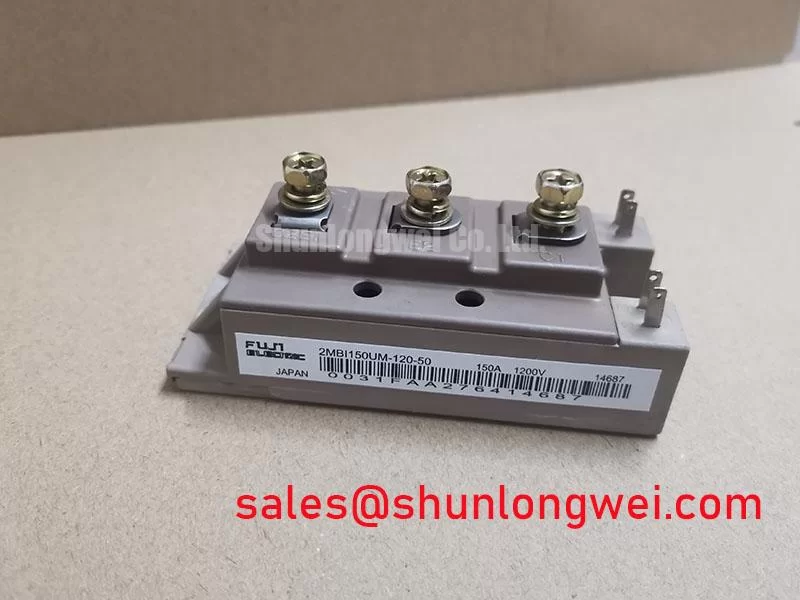
How do you ensure thermal stability in 1200V industrial inverters facing continuous thermal cycling? The Fuji 2MBI150N-120 is a 1200V, 150A dual IGBT module engineered specifically to answer this exact challenge. Featuring an impressive 1100W maximum power dissipation and a low 0.11 °C/W Rth(j-c), it secures exceptional thermal reliability for heavy-duty applications. What is the primary benefit of its low inductance structure? It actively suppresses voltage overshoots during high-speed switching. By combining a square RBSOA with a 2500V AC isolation voltage, this module drastically simplifies system-level cooling and protection networks. For 1200V AC motor drives and UPS systems prioritizing thermal margin, this 150A module is the optimal choice.
Critical Engineering FAQ
Addressing the Most Searched Design Queries
- How does the 0.11 °C/W Rth(j-c) of the 2MBI150N-120 impact heatsink selection for industrial UPS?
This ultra-low thermal resistance ensures highly efficient heat transfer from the semiconductor junction to the case. It allows engineers to utilize more compact, cost-effective heatsinks without exceeding the 150°C maximum junction temperature, even under continuous 150A current loads. - What makes the square RBSOA critical for welding machine applications?
A square Reverse Bias Safe Operating Area guarantees that the IGBT can safely turn off large currents—up to 300A pulsed—at high voltages without entering secondary breakdown. This is an absolute necessity for surviving the unpredictable, harsh load transients inherent in industrial welding equipment.
Key Parameter Overview
Decoding the Specs for Enhanced Thermal Reliability
Understanding the core trio of voltage, current, and thermal specifications is fundamental for deploying this module effectively.
| Functional Group | Parameter | Symbol | Value |
|---|---|---|---|
| Absolute Maximum Ratings | Collector-Emitter Voltage | VCES | 1200V |
| Continuous Collector Current | IC | 150A | |
| Maximum Power Dissipation | PC | 1100W | |
| Electrical Characteristics | Collector-Emitter Saturation Voltage | VCE(sat) | 3.3V (Max) |
| Isolation Voltage (1 min) | Vis | 2500V AC | |
| Thermal Characteristics | Thermal Resistance (IGBT) | Rth(j-c) | 0.11 °C/W |
| Thermal Resistance (Diode) | Rth(j-c) | 0.33 °C/W |
Download the 2MBI150N-120 datasheet for detailed specifications and performance curves.
Technical Deep Dive
A Closer Look at the Low-Inductance Architecture and Thermal Dynamics
The 2MBI150N-120 leverages an optimized internal layout designed to tackle two major adversaries of high-power switching: thermal bottlenecking and parasitic inductance. With a capability to dissipate 1100W, managing the thermal gradient is critical. Think of the 0.11 °C/W Rth(j-c) thermal resistance as a multi-lane highway toll booth. A lower value means more "lanes" are open, allowing intense heat (traffic) to escape rapidly into the external cooling apparatus rather than bottlenecking and melting the silicon structure. This is essential for mastering IGBT thermal management.
Furthermore, the internal low-inductance package structure serves a vital electrical function. High-speed switching in 1200V environments naturally induces voltage spikes. Consider stray inductance like water inertia in a high-pressure plumbing system. The low-inductance packaging acts as a pressure relief valve, preventing destructive "water hammer" (voltage spikes) when the high-speed switching abruptly halts the 150A current flow. This physical design inherently protects the die, limiting the need for excessively large external snubber circuits.
Application Scenarios & Value
Achieving System-Level Benefits in High-Frequency Power Conversion
When engineering an Uninterruptible Power Supply (UPS) or an AC motor drive inverter, the system frequently encounters severe startup surges and continuous full-load states. Engineers often struggle with thermal runaway in these scenarios. By integrating the 2MBI150N-120, the high 300A pulsed current rating absorbs startup surges gracefully, while the 3.3V VCE(sat) minimizes conduction losses during continuous operation.
In industrial welding, the dynamic load changes demand a robust Fuji Electric power module capable of surviving repeated thermal shocks. The durable baseplate and secure 3.5 N·m mounting torque ensure mechanical integrity against vibration and thermal expansion, translating to lower maintenance costs and higher equipment uptime.
While the 2MBI150N-120 excels in standard 150A load scenarios, your project requirements may vary. For systems requiring higher current handling with an identical footprint, the related 2MBI200N-120 scales up to 200A. Conversely, if your architectural design strictly targets a 600V line, the 2MBI150U2A-060 offers a tailored lower-voltage alternative. Evaluate your system's peak requirements and leverage these technical insights to finalize your procurement strategy today.