Content last revised on September 10, 2026
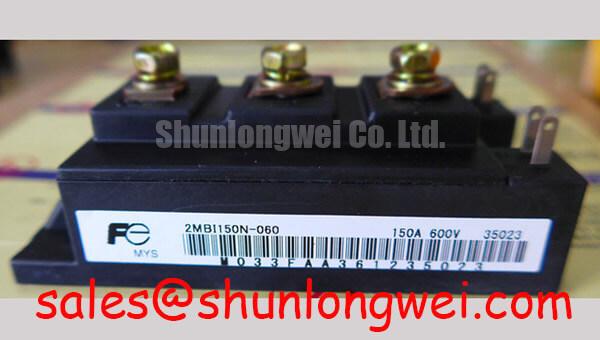
Fuji Electric 2MBI150U2A-060: 600V Dual IGBT Module Engineered for High-Frequency Efficiency
The Fuji Electric 2MBI150U2A-060 is a U-Series dual IGBT module designed to deliver superior switching performance in demanding power conversion systems. This module provides a robust solution for engineers focused on minimizing total power losses and maximizing efficiency. Featuring key specifications of 600V | 150A | VCE(sat) 2.7V max, it combines high-speed operation with low conduction losses. This balance offers the critical engineering benefits of reduced thermal load and enhanced system reliability. It directly addresses the need for efficient power handling in high-frequency applications by integrating advanced trench gate IGBT technology. For high-frequency Switch Mode Power Supply (SMPS) and motor drives up to approximately 50kW, the 2MBI150U2A-060's blend of low VCE(sat) and fast switching provides an optimal path to minimizing total power loss.
Application Scenarios & Value
Achieving System-Level Benefits in High-Frequency Power Conversion
The Fuji Electric 2MBI150U2A-060 is engineered for applications where switching speed and efficiency are paramount. Its characteristics make it a prime component for modern, high-frequency power electronics. What is the primary benefit of its low VCE(sat)? Reduced conduction losses, leading to higher system efficiency. This is particularly crucial in systems that operate continuously, as lower energy waste translates directly into lower operational costs and reduced cooling requirements.
A key engineering challenge in the design of Variable Frequency Drive (VFD) systems is managing the heat generated by power semiconductors. The 2MBI150U2A-060's low collector-emitter saturation voltage (VCE(sat)) of 2.7V (max) at its rated current directly mitigates this issue. This low on-state voltage drop is analogous to reducing friction in a mechanical system; less energy is wasted as heat during operation. This allows for smaller heatsinks, contributing to a more compact and cost-effective overall system design. In addition to VFDs, this module is well-suited for:
- High-frequency industrial welding machines
- AC and DC servo drive amplifiers requiring precise control
- Uninterruptible Power Supplies (UPS) where efficiency impacts battery runtime
While this module is optimized for 600V applications, for systems requiring similar current handling but at a higher voltage, the related 2MBI150US-120-50 offers a 1200V rating.
Key Parameter Overview
Decoding the Specs for Switching Loss Minimization and Reliability
The specifications of the 2MBI150U2A-060 are tailored for designers aiming to reduce both conduction and switching losses, which are the two primary sources of inefficiency in a power converter. The following table highlights the parameters that are most influential in achieving this goal.
| Parameter | Value | Engineering Implication & Value |
|---|---|---|
| Collector-Emitter Voltage (VCES) | 600V | Provides a safe operating margin for applications running on 200V-class and some 400V-class AC lines, ensuring resilience against voltage transients. |
| Continuous Collector Current (IC) | 150A (at Tc=25°C) | Supports medium-power applications like motor drives and industrial power supplies, delivering substantial current in a compact dual-module footprint. |
| Collector-Emitter Saturation Voltage (VCE(sat)) | 2.05V (typ) / 2.7V (max) | Value: A low VCE(sat) is a direct indicator of minimal conduction loss. This results in less heat generation, improving overall system efficiency and reducing the size and cost of the required thermal management solution. |
| Turn-on / Turn-off Time (ton / toff) | 0.45µs / 0.70µs (typ) | Value: These fast switching times are critical for high-frequency operation. Quicker transitions reduce switching losses, enabling the use of smaller and lighter magnetic components and improving power density. |
| Reverse Recovery Time (trr) | 0.15µs (typ) | Value: The fast and "soft" recovery characteristic of the integrated Free-Wheeling Diode (FWD) minimizes voltage overshoots and electromagnetic interference (EMI), simplifying the design of snubbing circuits and improving system reliability. |
| Thermal Resistance (Rth(j-c)) | 0.25°C/W (IGBT) / 0.50°C/W (FWD) | Specifies the efficiency of heat transfer from the semiconductor junction to the case. A lower value indicates better thermal performance, allowing for higher power dissipation or operation at higher ambient temperatures. |
Download the 2MBI150U2A-060 datasheet for detailed specifications and performance curves.
Technical Deep Dive
A Closer Look at the U-Series Trench Gate Technology
The performance of the 2MBI150U2A-060 is rooted in Fuji Electric's U-Series technology, which utilizes an advanced trench gate structure. Unlike older planar gate designs, the trench gate architecture dramatically increases the density of cells on the silicon chip. This structural change effectively eliminates the JFET resistance that exists in planar devices, which is a primary contributor to on-state voltage drop. The result is a significant reduction in VCE(sat), directly lowering conduction losses and improving the module's thermal efficiency.
Furthermore, the module incorporates a co-packaged Free-Wheeling Diode (FWD) optimized for fast and soft reverse recovery. In applications like motor drives, when the IGBT turns off, the inductive load forces current to flow through the FWD. A slow or abrupt ("snappy") recovery in the diode can cause large voltage spikes and oscillations, stressing the IGBT and generating significant EMI. The optimized FWD in this module ensures a smooth transition, enhancing the Reverse Bias Safe Operating Area (RBSOA) and improving the overall ruggedness of the power stage.
Frequently Asked Questions (FAQ)
What is the primary advantage of the 2-in-1 (dual) configuration of the 2MBI150U2A-060?
The dual configuration integrates two IGBTs in a single module, typically used to form one leg of a power inverter (a half-bridge). This simplifies assembly, reduces component count, and minimizes stray inductance between the switches compared to using two discrete components, leading to cleaner switching and improved reliability.
How does the low inductance module structure benefit my design?
The low internal inductance minimizes voltage overshoots (spikes) during high-speed turn-off. This reduces the stress on the IGBTs, lessens the need for complex external snubber circuits, and helps in meeting electromagnetic compatibility (EMC) requirements more easily.
What considerations are important for the gate drive circuit for this module?
As a voltage-controlled device, a gate driver capable of providing a stable voltage within the recommended ±20V VGES range is essential. For optimal performance, especially at high frequencies, the gate driver should have low output impedance to quickly charge and discharge the IGBT's input capacitance, ensuring crisp switching transitions. Utilizing a proper gate resistor is also critical to balance switching speed and voltage overshoot.
Is this module suitable for paralleling to achieve higher current?
While paralleling IGBT modules is a common practice, it requires careful design considerations. The 2MBI150U2A-060 has a positive temperature coefficient for VCE(sat), which aids in current sharing. However, designers must ensure symmetrical layout for gate drive and power connections to prevent current imbalance. For in-depth guidance, consulting resources like the practical guide for engineers on decoding datasheets is recommended.
Can the 2MBI150U2A-060 be used in hard-switching and soft-switching topologies?
Yes, its characteristics are well-suited for both. The low switching losses make it highly efficient in hard-switching pulse-width modulation (PWM) topologies common in VFDs and UPS systems. Its fast FWD and low device capacitances also make it a strong candidate for soft-switching resonant topologies, which can further reduce switching losses at very high frequencies.
From an engineer's perspective, the 2MBI150U2A-060 represents a well-balanced component where the trade-offs between conduction loss, switching speed, and thermal performance have been carefully optimized. Its U-Series technology provides a direct route to achieving higher power density and efficiency, simplifying the design process for a wide range of medium-power industrial applications.